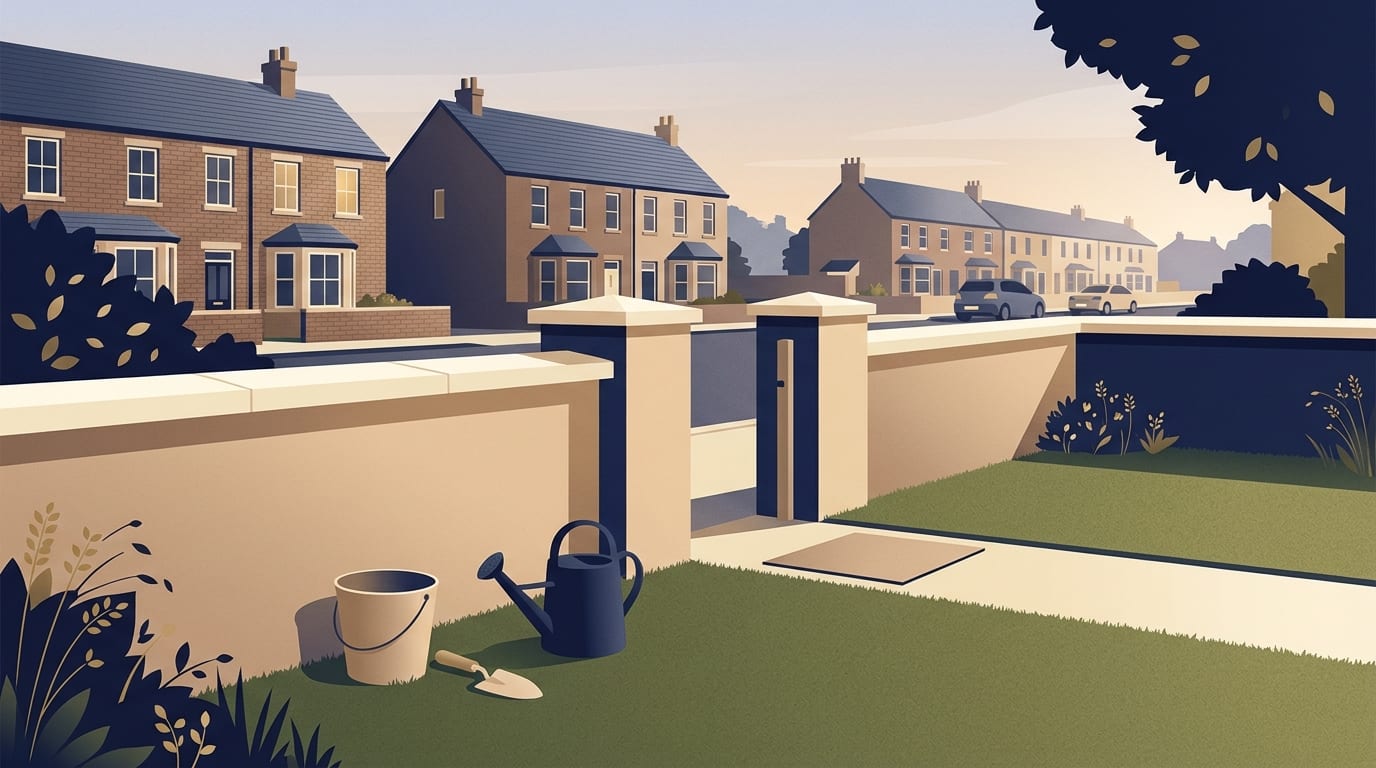
Yes, garden walls are commonly rendered, but because a boundary wall is exposed to the weather on both faces and the top, the details matter much more than on a house. Getting the copings, the base and the finish right gives the new coating the best chance of lasting. Typical 2026 published guide prices run from £40 to £80 per square metre for rendering alone, to between £160 and £220 per square metre for a fully finished rendered block wall that includes primer, masonry paint and coping stones.
Can you render a garden wall?
Rendering is a highly effective way to smarten up a tired block, old brick or breeze block garden wall. It hides mismatched brickwork, covers old mortar repairs, and creates a clean, uniform finish that ties the outside of your property together.
However, a boundary wall is a freestanding structure. Unlike the walls of your house, which are protected by a roof overhang and heated from the inside, a garden wall sits entirely out in the open. It faces rain, frost, and wind from every direction. It absorbs moisture from the ground below and takes the full force of the weather on top.
Because of this exposure, the top and the base of the wall need particular care, and a plasterer should be able to explain how they will deal with both.
What state the wall needs to be in
Before any work begins, a professional renderer will check the existing structure to ensure it is a suitable background. A sound, dry, and uncracked wall is essential for a lasting finish. Render is a decorative surface coating, not a structural repair. It adds considerable weight to the bricks but provides no structural strength of its own.
Render does not cure a moving wall, so a plasterer will look for problems such as:
- Structural movement or leaning, which a surveyor or structural engineer should assess.
- Cracks that suggest the wall is moving, which a surveyor or structural engineer should look at.
- Crumbling bricks.
- Damp patches.
If the wall has loose or crumbling areas, these need dealing with first. If it has persistent wet patches, the source of the water needs fixing before any render goes on.
Copings and the top of the wall
The highest point of a boundary is its most vulnerable area. To protect the new finish, the top of the wall needs a cap that sheds water away from the vertical faces. These caps are known as copings, coping stones, or capping.
Copings are an extra for a rendered block wall, listed as coping stones or capping, so check that your quote says which kind is being priced.
The top of a wall is exposed to the weather, which is why copings are worth asking about.
Copings are listed as an extra on top of the square metre rate for the render. In one 2026 example, extras such as copings and piers cost between £100 and £400 for a five-metre wall. For a ten-metre wall, the extra cost runs from £200 to £800.
The base of the wall and the damp proof course
The bottom of the structure requires just as much attention as the top. Render should always stop cleanly above ground level and must remain clear of any damp proof course.
A damp proof course is a waterproof layer built into the lower courses of the wall to stop ground moisture from rising through the bricks. If the new render bridges this layer, or is carried down into the soil, ground moisture can get into the wall.
A plasterer should explain how the base of the render will be finished clear of the ground and the damp proof course.
If you are changing the ground levels by adding a new patio or raised flower beds next to the wall, you must ensure the soil or paving does not breach this line. You can read more about these rules in the guide to render above the damp proof course.
What rendering a garden wall costs
Plasterers price per job after seeing it in person. The cost is based on the total area in square metres, the state of the background, and the amount of preparation required. Estimates vary widely depending on these factors, and costs are generally higher in London and the South East.
Typical 2026 guide prices run from £40 to £80 per square metre for the rendering alone. However, a finished price can often rise close to £160 to £200 per square metre once the wall is fully rendered and painted. Estimates vary for a complete project. Some estimates put a finished rendered block wall at £160 to £220 per square metre, including a two coat render system, primer, masonry paint, and coping stones or capping, while others put it at £120 to £180 per square metre.
The table below shows typical costs for the different parts of the job.
|
Item |
Typical 2026 price |
Note |
|---|---|---|
|
Render alone (base rate) |
£40 to £80 per m² |
Base rate for applying the render only |
|
Finished rendered block wall |
£160 to £220 per m² |
Includes a two coat render system, primer, masonry paint and copings |
|
Finished rendered block wall (lower estimate) |
£120 to £180 per m² |
A lower estimate for the same job, kept separate from the row above |
|
Repainting |
£10 to £25 per m² |
Required every 5 to 10 years |
|
Copings and piers for 5m wall |
£100 to £400 |
Priced as an extra addition |
|
Copings and piers for 10m wall |
£200 to £800 |
Priced as an extra addition |
These are typical published prices for 2026, and local quotes will differ depending on your wall and where you live. Small jobs often carry a minimum charge.
Painting and upkeep
If you choose a traditional sand and cement finish, it will need painting to protect it from the weather and keep it looking smart. Fresh render needs to dry before it is painted, and the plasterer will advise how long to wait.
Once the wall is fully dry, your quote should list the primer and masonry paint that go on it.
In the 2026 example, a rendered wall is repainted about every five to ten years. Typical 2026 guide prices for repainting sit between £10 and £25 per square metre. For a deeper look at your options, read the guide on choosing the right masonry paint.
Do you need planning permission?
The rules below are for England, according to the Planning Portal. If you live elsewhere in the UK, check with your council. No planning permission is needed if a wall next to a vehicle highway or its footpath would not exceed one metre in height from ground level. Elsewhere on your property, the limit is two metres in height.
Crucially, the height of an existing structure over these limits must not be increased. If adding raised coping stones to the top of your wall will push it over the one-metre or two-metre limit, you must check with your local council before starting work. If any part of your site is a listed building or falls within the curtilage of a listed building, these permitted development rights do not apply. You will need consent for any significant work, inside or out.
In a conservation area, you may need permission even to take down a boundary wall. You can find these limits clearly stated on the Planning Portal rules for fences, gates and garden walls.
The Planning Portal render page states that you need to apply before cladding the outside of a house in a Conservation Area, a National Park, an Area of Outstanding Natural Beauty, or the Broads. Because that specific rule refers to houses, you should always ask your local council for clarification before rendering a garden wall in a conservation area.
What a quote should list
When you are ready to hire a professional, never rely on a quick verbal estimate or a cash-only deal with nothing in writing. An estimate is just a rough guess, whereas a quote is a fixed price. Citizens Advice suggests getting written quotes from at least three traders.
A thorough quote for rendering a garden wall should list:
- The total area of the wall in square metres.
- The exact render system being applied to the bricks.
- Separate costs for the primer and the masonry paint.
- The cost of the coping stones and their installation.
- Any access equipment or scaffolding if the wall is exceptionally high.
- Whether VAT is included in the final figure.
The quote must also state how long the price is valid for and under what circumstances the price can go up. Check who is responsible for waste removal. If the tradesperson is carrying away old bricks, hacked-off render, or rubble, they must be a registered waste carrier, and this register is public.
Under the Consumer Rights Act 2015, all work must be done with reasonable care and skill. If it is not, the customer can ask for it to be put right or seek a partial or full refund. Citizens Advice also suggests paying by card for added protection and notes you might be able to cancel within 14 days of agreeing a contract.
Common questions
What is the best render for garden walls?
Sand and cement is the traditional choice, provided the wall is sound, the base is detailed correctly and the top is capped. Thin-coat silicone or acrylic systems are another option. You can read the comparison of silicone or sand and cement to see the differences.
Can you render over a painted garden wall?
Rendering over old paint is a job for a professional to assess, because rendering over loose, damp or unsealed painted surfaces is a common reason for the new coat to crack or peel. Ask the plasterer how they will deal with the paint before they price the job.
Why has the render blown on my boundary wall?
Water getting behind the coating is a common cause. A plasterer should check the top of the wall, the base and any damp before deciding whether to patch or re-render.
How long does the job take?
The time depends on the area of the wall, the weather and how much preparation is needed, so ask the plasterer for a timescale in writing. The render also needs to dry before any masonry paint goes on.
What to do next
Before you start calling local tradespeople, it helps to have a clear idea of what the job involves. Use this checklist to get prepared:
- Walk the length of your wall and check for structural problems, loose bricks, or damp patches that a builder might need to fix before a plasterer arrives.
- Measure the length and the height of the wall so you can give tradespeople a rough square metre area when you first contact them.
- Decide whether you need coping stones or capping added to the top, keeping in mind that this is priced as an extra.
- Check with your local council if your wall borders a vehicle highway, exceeds the standard one-metre or two-metre height limits, or sits in a conservation area.
- Ask for written quotes from three different firms, ensuring each quote breaks down the specific costs for the render system, primer, paint, copings, and waste removal.
- Confirm that the tradesperson is a registered waste carrier if they are taking away rubble, and ask if their price includes VAT.
Taking the time to get the details right gives the new render the best chance of lasting. When you are ready to start gathering quotes, you can use the directory to find a plasterer near you and read what previous customers have to say about their work.
Find a top rated plasterer near you
1,036 plasterers across the UK, each ranked on their Google rating and the number of reviews behind it. Start with your county: