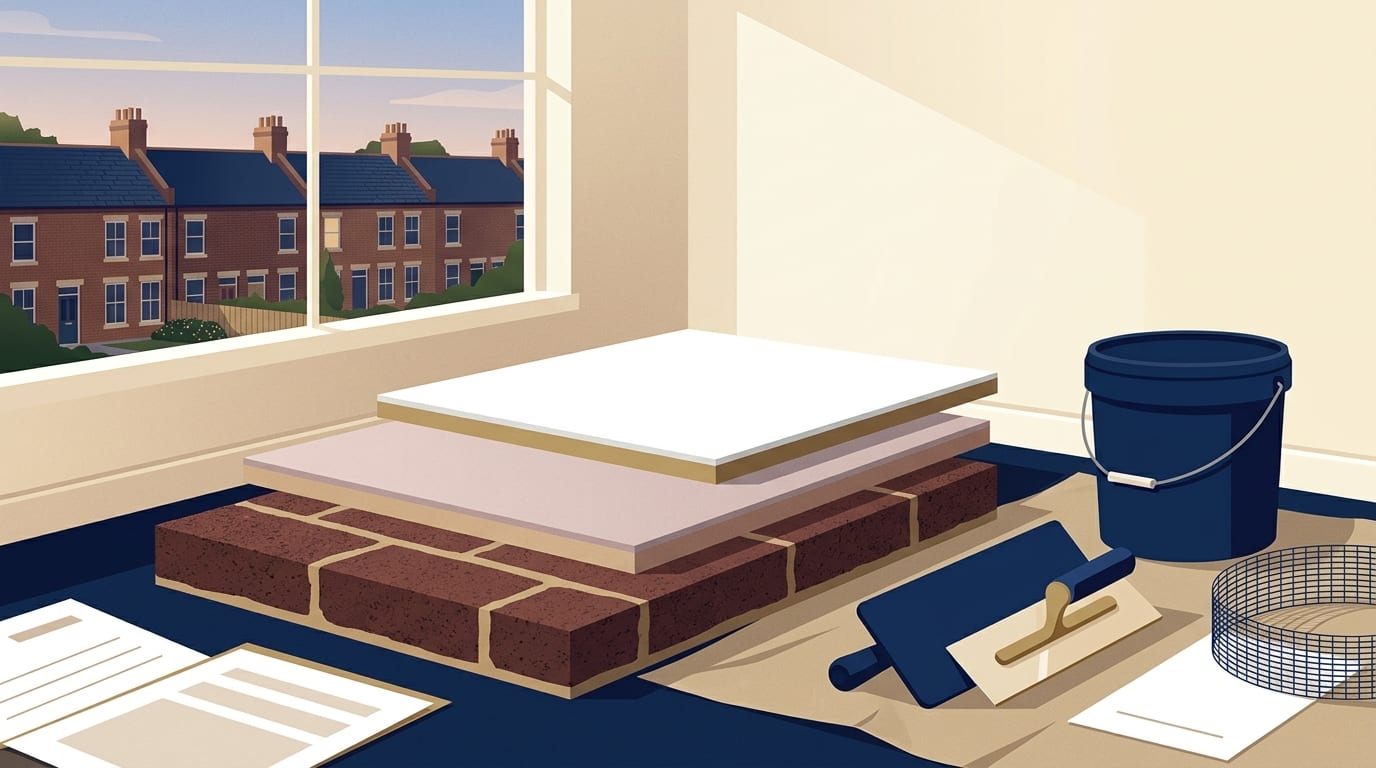
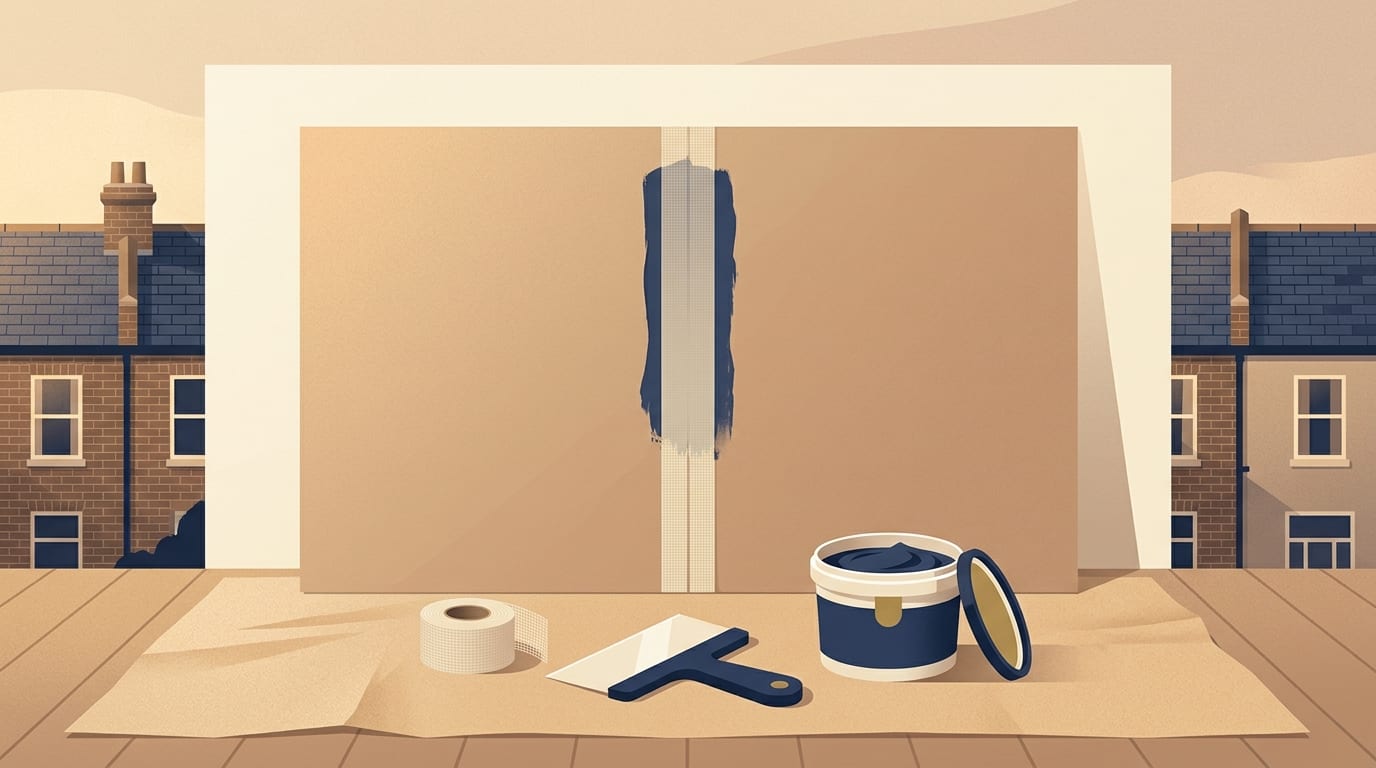
Machine plastering uses a pump to spray the wet plaster onto the wall, but the surface is still trowelled smooth by a plasterer. The machine changes how the material gets onto the wall, not who finishes it. It suits larger areas and is not worth it for small patches.
What spray plaster and machine plastering mean
People searching for spray plaster often find results for DIY sprayers and equipment hire. This guide is about professional machine plastering work done by an experienced tradesperson.
Plastering is traditionally a manual trade. A skim is a thin finishing coat, a few millimetres thick, applied over sound plaster or plasterboard. A replaster means hacking off failed plaster and applying a backing coat plus a finish coat, or fixing new plasterboard and skimming it. This second method is known as board and skim.
How machine plastering works
Machine applied finishes are applied with airless or screw pumps. The material is either a plaster based product mixed on site or a ready mixed finish that needs little water.
The machine pumps this mixture directly to the work area. The plasterer sprays the material onto the wall or ceiling in a thin coat. For one finishing system introduced in 2014, the plaster is sprayed by one operative and goes on 1.5 to 2 millimetres thick. Another manufacturer says its machine applied finishing plaster goes on at 2 to 3 millimetres, while its one coat plaster can be applied up to 20 millimetres thick.
The surface is then flattened and trowelled by hand, so the finish still depends on the plasterer.
This method means less hand carrying of material around your house. It also allows access to height without always needing towers or scaffolding, which reduces health and safety risks as claimed by one manufacturer.
In one manufacturer's case study, material taken off the surface can be recycled back through the machine.
How machine plastering compares with hand plastering
The main difference between the two methods is the delivery system. With a machine the plaster is pumped and sprayed onto the wall, while with hand plastering it is applied by hand.
The table below shows how the two approaches compare. The speed and waste figures for machine plastering are manufacturer claims that apply to particular products.
|
Job feature |
Hand plastering |
Machine plastering |
|---|---|---|
|
Application method |
Applied by hand |
Airless or screw pump |
|
Surface finishing |
Flattened and trowelled by hand |
Flattened and trowelled by hand |
|
Best job size |
Small rooms and awkward areas |
Mid sized to larger jobs |
|
Access at height |
Towers or scaffolding may be needed |
Access without towers or scaffolding (as claimed by a manufacturer) |
|
Material waste |
Not given |
Below 1 per cent (one manufacturer's claim) |
|
Finish depends on |
Plasterer's trowel work |
Plasterer's trowel work |
These details highlight that the machine does not replace the tradesperson. The finish quality still depends on the plasterer's trowel work and experience.
Is machine plastering faster and does it look different
Speed is a common reason people look into machine plastering. Manufacturers say their one coat machine plaster is up to three times faster than traditional methods. Another manufacturer claims their machine applied finishing system is more than three times faster than hand plastering.
Drying times can also be shorter with specific materials. One machine applied system is claimed to be ready for decoration within 12 to 24 hours. The same manufacturer puts traditional plaster at five to seven days. For drying in general, see how long plaster takes to dry.
These speed and drying figures are manufacturer claims for particular products, not a promise on every job. Ask whether the time saved applies to your job.
The product formulation is unchanged. Spraying is simply a method of getting the material onto the surface and helps plasterers apply it more ergonomically.
Because the formulation is the same, the finish quality still depends on the plasterer's trowel work and experience. Spraying still allows a traditional hand-finished surface.
Which jobs suit a machine and which suit hand work
Not every project is right for a plastering pump. As one contractor notes in a trade article, machine application is not applicable to all applications.
Machine plastering suits mid sized to larger jobs. Jobs needing multiple bags of plaster over wide wall areas are the kind it suits.
Hand work is better for smaller domestic jobs. Skilled hand plastering is still needed for quality in most areas.
- Small domestic repairs and single wall patches.
- Awkward areas with tight access.
- Small rooms.
Machines are also used for exterior work. Applying harling by mechanical spray may in some circumstances be used for the pricking up or straightening coat. A hand cast finishing coat is then applied over the top.
What plastering costs in 2026
Plasterers price per job after seeing it. They base their quote on the area in square metres, the state of the background, ceiling height, access and preparation. Preparation includes stripping wallpaper, removing loose plaster and sealing painted surfaces.
Ceilings are usually priced separately and small jobs carry a minimum charge. Render is priced per square metre with scaffolding often added as a separate line.
Estimates vary across the industry. Some 2026 price lists put skimming an existing sound wall at £15 to £25 per square metre for the rest of the UK, and £18 to £32 for London and the South East. For a complete replaster, they suggest £25 to £45 per square metre, or £30 to £58 in London and the South East. A ceiling skim is priced at £20 to £35, rising to £25 to £45 in London and the South East.
Other 2026 price lists group their figures differently. They put a basic skim at £20 to £30 per square metre and a standard skim at £22 to £30. For full plastering from scratch, they estimate £35 to £60 per square metre. If the job involves fixing plasterboard plus a skim coat, they suggest £35 to £65 per square metre.
For specific materials, standard gypsum wet plaster applied to a wall is approximately £25 to £40 per square metre. Typical one coat plaster also costs £25 to £40 per square metre. One coat plaster jobs typically cost between £150 and £700, averaging around £450, and most take one to two days. These one coat jobs can often be finished faster than a traditional two coat system.
The table below shows the regional price ranges for standard plastering tasks.
|
Plastering job |
Rest of the UK per square metre |
London and the South East per square metre |
|---|---|---|
|
Skimming an existing sound wall |
£15 to £25 |
£18 to £32 |
|
Replastering (backing plus skim, or board and skim) |
£25 to £45 |
£30 to £58 |
|
Ceiling skim |
£20 to £35 |
£25 to £45 |
These figures include VAT where applicable. Local quotes will differ based on your specific room.
Day rates also depend on the plasterer's experience. A general plasterer charges £250 to £350 a day, while an experienced plasterer costs £300 to £400. Other 2026 lists put the average plasterer's day rate slightly lower at £200 to £300. If the job needs a plasterer plus a labourer, expect to pay £400 to £550 or more. Hiring two plasterers for a large job costs £500 to £700 or more.
Is machine plastering cheaper than hand work
You might expect a machine to lower your bill because it applies the material faster. However, there is no standard price for machine plastering, so ask for a quote.
Machine jobs are quoted per job after a site visit, exactly like hand work. The price depends on the area, the background and the access, as with hand work.
Only certain machines have been tested with each plaster, and machines must comply with UK standards. Customers should check compatibility with manufacturers first to ensure the setup is correct.
Do not assume spraying will lower your quote. Ask the plasterer what they would charge and why.
Always get three written quotes to compare prices. A quote is a fixed price, while an estimate is just a rough guess.
Rules and regulations to keep in mind
Plastering is not a licensed trade. There is no legal register like the one for gas engineers, so evidence of past work matters. A CSCS card is for construction sites, not proof of quality on domestic work.
FIS is the trade body for the finishes and interiors sector. TrustMark is the government-endorsed quality scheme.
Under the Consumer Rights Act 2015, work must be done with reasonable care and skill. If a tradesperson skims over loose, damp or unsealed painted surfaces and the new coat cracks, you can ask for it to be put right or seek a partial or full refund.
Older properties can contain asbestos in some materials. The HSE says textured coatings such as Artex may contain asbestos in any building built or refurbished before 2000. Work on them does not normally need a licensed contractor but must be done by people trained to work safely with asbestos. Homeowners should not sand, scrape or drill suspect coatings and should tell tradespeople about them before work starts.
Building regulations normally apply where 25 per cent or more of an external wall is re-rendered, re-plastered or re-lined internally. The wall's insulation would normally have to be improved at the same time, so confirm with building control.
For exterior work, rendering needs no planning permission in England if materials are of similar appearance to the existing house. Permission is needed in conservation areas, National Parks, Areas of Outstanding Natural Beauty and the Broads. If you live elsewhere or are unsure, check with your council.
Listed buildings need consent for any significant work, inside or out. Conservation bodies advise repairing original lime plaster where possible and replacing like for like. Putting gypsum or cement on old lime walls is a common mistake.
A trader who carries waste must be a registered waste carrier, and the register is public.
What to ask before you book
Finding a skilled tradesperson means asking the right questions before they start. You need to know exactly what they will do and what they will charge.
- Whether the quote includes all preparation, such as stripping wallpaper and sealing painted surfaces.
- Who exactly will finish the surface with a trowel if they use a machine.
- Whether the plasterer uses the machine regularly on domestic jobs.
- If the quote includes ceiling work, which is usually priced separately.
- Whether VAT, materials, waste removal and floor protection are included in the final price.
Quotes that omit preparation, ceilings, scaffolding or waste removal will lead to surprise bills later. Cash only deals with nothing in writing leave you with no record of what was agreed.
Citizens Advice suggests getting a written contract and paying deposits of no more than 25 per cent. Paying by card gives you better protection, and you might be able to cancel within 14 days of agreeing a contract.
Common questions
Does spray plaster need a mist coat?
Ask your plasterer what should go on first and when you can decorate, because drying times depend on the product. The guide on how to paint new plaster covers the usual steps.
Can I hire a plastering machine to do it myself?
This guide is about work done by a plasterer. The machine only changes how the material gets onto the wall, and the finish still depends on the plasterer's trowel work and experience.
Can you spray plaster over Artex?
Do not sand, scrape or drill suspect textured coatings. The HSE says textured coatings such as Artex may contain asbestos in any building built or refurbished before 2000, so tell the plasterer before any work starts. The guide on what to do about an Artex ceiling has more.
Is spray plaster the same as traditional wet plaster?
The product formulation is unchanged when a plaster is sprayed, and only certain machines have been tested with each plaster. It still needs a skilled tradesperson to achieve a flat, smooth finish.
Next steps for your project
Before you hire a tradesperson for your plastering job, follow a few simple steps to protect yourself and your home.
- Ask the plasterer to look at your walls to see whether you need a skim or a full replaster.
- Look for tradespeople with clear evidence of past domestic work, as a CSCS card is not proof of quality.
- Ask for three written quotes that list all materials, waste removal and VAT.
- Check the public register to ensure your tradesperson is a registered waste carrier.
- Agree a deposit of no more than 25 per cent and pay by card.
Taking the time to check these details helps you avoid wavy walls and unexpected costs. When you are ready to start gathering quotes, find a plasterer near you to discuss your exact needs.
Find a top rated plasterer near you
1,036 plasterers across the UK, each ranked on their Google rating and the number of reviews behind it. Start with your county: