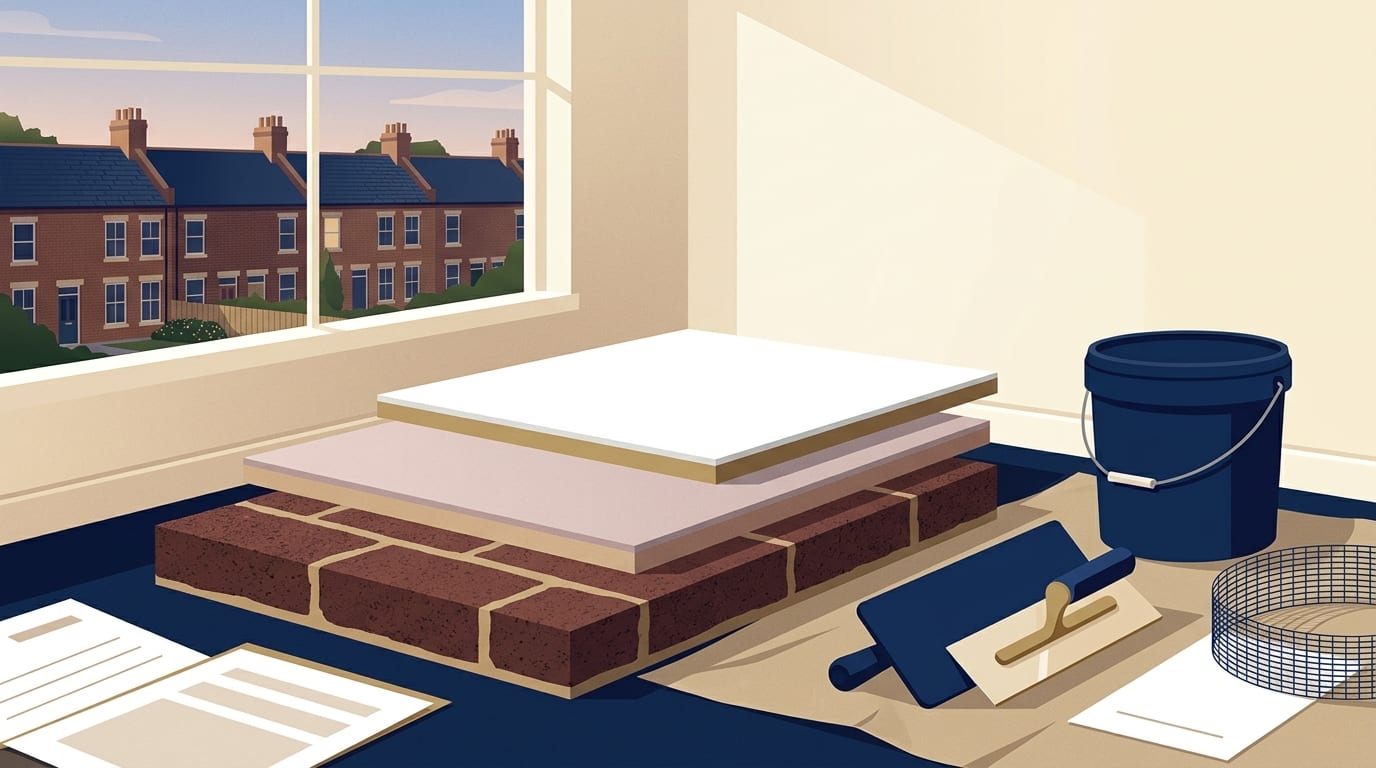
Plastering on an internal wall is usually done in two layers to give a flat and smooth surface. The first layer is a backing coat that evens out the bare wall, and the second is a thin finish coat that provides the final smooth surface. Bonding coat and hardwall are backing coats, multi finish is the finish coat, and one coat plaster combines both into a single product. When quoting for the work, a plasterer chooses the right backing coat based on suction, which is how thirstily your wall soaks up water.
The terminology on your quote will depend heavily on the condition of your walls. A replaster means hacking off the old, failed plaster and applying a fresh backing coat followed by a finish coat. Alternatively, a replaster can involve fixing new plasterboard and skimming it, which is known in the trade as board and skim. The backing coat is the foundational layer. It is applied thickly to cover uneven brickwork, blockwork or bare masonry, bringing the wall to a flat and level standard.
A skim is a thin finishing coat, just a few millimetres thick, applied over sound plaster or plasterboard. You should not decorate or tile directly onto a backing coat. A finish coat plaster goes on first, before painting, wallpapering or tiling.
The choice of backing coat is entirely dictated by the background material and its suction. Suction refers to how quickly the wall absorbs moisture from the wet plaster. Choosing a backing coat to suit the wall is the plasterer's job, which is why your quote should say which one is being used. You can read more about the different types of plastering.
What bonding coat plaster is and when it is used
Bonding coat is a specific type of gypsum undercoat plaster. It is an ideal undercoat plaster for smooth or low suction backgrounds. This means it is used on surfaces that do not soak up water very quickly. Typical backgrounds for a bonding coat include some types of brickwork, blockwork and concrete. It is also applied to plasterboard, expanded metal lath, and surfaces that have been treated with bonding agents.
Plasterers use bonding coat because it is perfect for new walls, or for making good old walls before skimming them with finishing plasters. When applying a bonding coat, the recommended application thickness is 11 millimetres on walls and 8 millimetres on ceilings. If the plasterer is applying it over plasterboard, the undercoat is applied without exceeding 8 millimetres on the board.
Once the bonding coat is on the wall, it is scratched to form a key for 2 millimetres of finish plaster. This scratching creates a rough texture that helps the final skim coat grip the surface. You must not decorate directly onto the undercoat and you must not tile directly onto it. A finish coat plaster goes on before painting, wallpapering or tiling. A quote that lists only a bonding coat on a wall you intend to paint is incomplete.
What hardwall plaster is and where it goes
Hardwall is a gypsum undercoat plaster that is ideal for two coat plaster systems. While bonding coat is designed for low suction surfaces, hardwall is ideal for most medium to high suction backgrounds. This includes masonry such as bricks and aircrete blocks, which are thirsty materials that draw moisture out of the plaster very quickly.
A hardwall undercoat can be applied by hand or by a plaster projection machine. Once applied to the bare wall, the undercoat is ruled to an even surface and lightly scratched to form a key for 2 millimetres of finish plaster.
Just like a bonding coat, hardwall is not a finished surface. It requires a final top layer to make it ready for decoration. With a final coat of multi finish, the hardwall system gives a smooth, inert surface to internal walls. This is why the plasterer matches the undercoat to the background, and why the quote should say which backing coat is being used.
What multi finish plaster is and why it matters
Multi finish is a gypsum finish plaster designed for internal walls and ceilings. It is the final layer that goes over the backing coat to create the smooth surface you see in a finished room. It is designed for finishing a wide range of backgrounds, making it a very versatile product.
A plasterer will use multi finish over low suction backgrounds such as plasterboard, right through to medium to high suction gypsum or cement based undercoat plasters. Once it dries, it provides a durable base for decorative finishes.
If your walls are already in good condition and the existing plaster is sound, you may only need a skim coat rather than a full replaster. Re-skimming walls over existing plaster provides a 5 to 8 millimetre cosmetic finish. A 2026 Which? survey of its Trusted Traders puts this at £300 to £1,000 for a small room, £400 to £1,250 for a medium room and £600 to £2,500 for a large room. These typical guide figures exclude VAT and include both labour and materials. Prices will always vary based on ceiling height, access and where you live, as London and the South East cost more.
What one coat plaster is and what it costs
One coat plaster combines an undercoat and finishing plaster into a single product. Instead of applying a separate backing coat and then returning to apply a finish coat, the plasterer applies this single mixture to build the depth and create the finish at the same time.
It suits blockwork, brick, plasterboard and concrete. Typical 2026 prices for one coat plaster, labour and materials, are about £25 to £40 per square metre. The average one coat job is around £450, and typical jobs range from £150 to £700. These one coat figures were compiled separately from the re-skim prices above, so the two sets should not be added together.
Which plaster goes on which wall
The table below shows the different types of plaster and the backgrounds they are designed for.
|
Plaster |
What it is |
Typical backgrounds |
|---|---|---|
|
Bonding coat |
Gypsum undercoat |
Smooth or low suction backgrounds, plasterboard, concrete, expanded metal lath |
|
Hardwall |
Gypsum undercoat |
Medium to high suction backgrounds, masonry such as bricks and aircrete blocks |
|
Multi finish |
Gypsum finish plaster |
Low suction plasterboard to medium and high suction undercoat plasters |
|
One coat |
Combined undercoat and finishing plaster |
Blockwork, brick, plasterboard and concrete |
Your local plasterer will confirm the exact specification after seeing your walls in person.
What a written quote should say about the plaster
Plasterers price per job after seeing it in person. The cost is based on the area in square metres, the state of the background, ceiling height, access and the amount of preparation required. Preparation can include stripping wallpaper, removing loose plaster, sealing painted surfaces and dealing with textured coatings like Artex. Ceilings are usually priced separately and small jobs often carry a minimum charge.
A quote is a fixed price, whereas an estimate is just a rough guess. You should ask for written quotes from at least three traders. According to Citizens Advice, a written quote should include:
- A fixed total price rather than a daily rate
- A breakdown of all the work to be done and the materials needed
- Separate costs for each material and part of the work
- How long the price is valid for
- Whether the price includes VAT
- When the price can go up
Citizens Advice also suggests getting a written contract, paying deposits of no more than 25 per cent, and paying by card. You might also be able to cancel within 14 days of agreeing a contract.
When checking your quote, look closely at the preparation and the background. If you are having plasterboard fitted, the quote might mention dot and dab, which is plasterboard stuck directly to the wall on dabs of adhesive. It might mention overboarding, which is new plasterboard fixed under an old ceiling.
You must also check whether waste removal and floor protection are included. A trader who carries waste must be a registered waste carrier, and the register is public.
Building regulations, asbestos and consumer rights
Plastering is not a licensed trade. There is no legal register like the one for gas engineers, so evidence of past work matters deeply. A CSCS card is for construction sites and is not proof of quality on domestic work. TrustMark is the government-endorsed quality scheme, and FIS is the trade body for the finishes and interiors sector.
Under the Consumer Rights Act 2015, work must be done with reasonable care and skill. If it is not, the customer can ask for it to be put right or seek a partial or full refund. A bad job often involves skimming over loose, damp or unsealed painted surfaces so the new coat cracks or peels. Cash-only deals with nothing in writing leave you with very few protections. Quotes that omit preparation, ceilings, scaffolding or waste are one of the things that go wrong. Putting gypsum or cement on old lime walls is another thing that goes wrong, so older homes need advice before a backing coat is chosen.
If your preparation involves removing textured coatings such as Artex, you must be careful. The Health and Safety Executive says these coatings may contain asbestos in any building built or refurbished before 2000. Work on them does not normally need a licensed contractor but must be done by people trained to work safely with asbestos. Homeowners should not sand, scrape or drill suspect coatings and should tell tradespeople about them before work starts. Dry sanding or scraping Artex is highly dangerous and a clear sign of poor practice.
You should also be aware of building regulations. Where 25 per cent or more of an external wall is re-rendered, re-plastered or re-lined internally, the regulations normally apply and the wall's insulation would normally have to be improved.
If you are rendering the outside of your property, planning rules in England, according to the Planning Portal, dictate that rendering needs no permission if materials are of similar appearance to the existing house. However, it does require permission in conservation areas, National Parks, Areas of Outstanding Natural Beauty and the Broads. If you live elsewhere in the UK, or if you are unsure, you should check with your council. Listed buildings need consent for any significant work, inside or out. Conservation bodies advise repairing original lime plaster where possible and replacing like for like.
Common questions
Why does the plasterer need to know what my wall is made of?
Backing coats are chosen for the background. Bonding coat suits smooth or low suction backgrounds, while hardwall suits medium to high suction masonry such as brick and aircrete blocks. The plasterer will confirm the right one after seeing the wall.
Can you paint straight onto a bonding coat?
You must not decorate directly onto the undercoat. A finish coat plaster goes on before painting, wallpapering or tiling. The wall needs a finish coat first.
Is multi finish the same as a skim coat?
A skim is the general trade term for a thin finishing coat, a few millimetres thick, applied over sound plaster or plasterboard. Multi finish is the specific gypsum finish plaster product that plasterers use to create that skimmed layer.
How long does the plaster take to dry?
Drying times depend on the job, so ask your plasterer when the wall will be ready. You can find more detail on how long plaster takes to dry to understand when you can start decorating.
Should you use lime or gypsum in an older house?
Older houses often feature lath and plaster, which is lime plaster on timber laths. Conservation bodies advise replacing like for like, and you can read more about whether to use lime or gypsum to ensure the walls can still breathe.
What to do next
Before you agree to a plastering contract, make sure you understand exactly what is going on your walls.
- Ask the plasterer why they have specified a particular bonding or hardwall backing coat for your walls.
- Ask for a written quote that separates the cost of the backing coat, the finish coat, any preparation and waste removal.
- Check whether the plasterer is a registered waste carrier if they are taking away old plaster, rubble or damaged plasterboard.
- Look for evidence of past work and clear written terms rather than relying on a construction site card as proof of domestic quality.
- Make sure any quote for a wall you plan to paint includes a finish coat, as you cannot decorate straight onto a backing coat.
Taking the time to read the specification on your quote means you can spot a missing finish coat or the wrong backing plaster before the job begins. When you are ready to get started and want to compare detailed written quotes, you can find a plasterer near you to assess your walls and recommend the right approach.
Find a top rated plasterer near you
1,036 plasterers across the UK, each ranked on their Google rating and the number of reviews behind it. Start with your county: