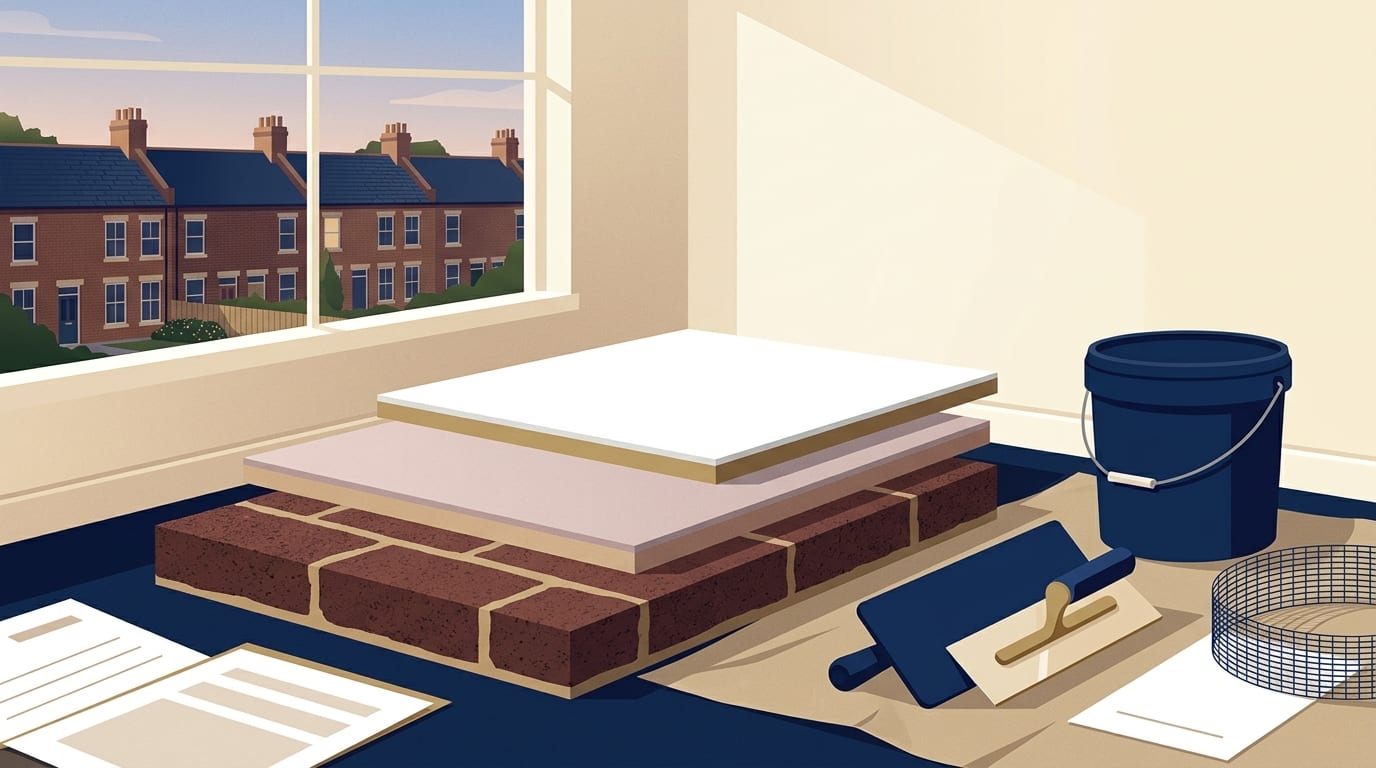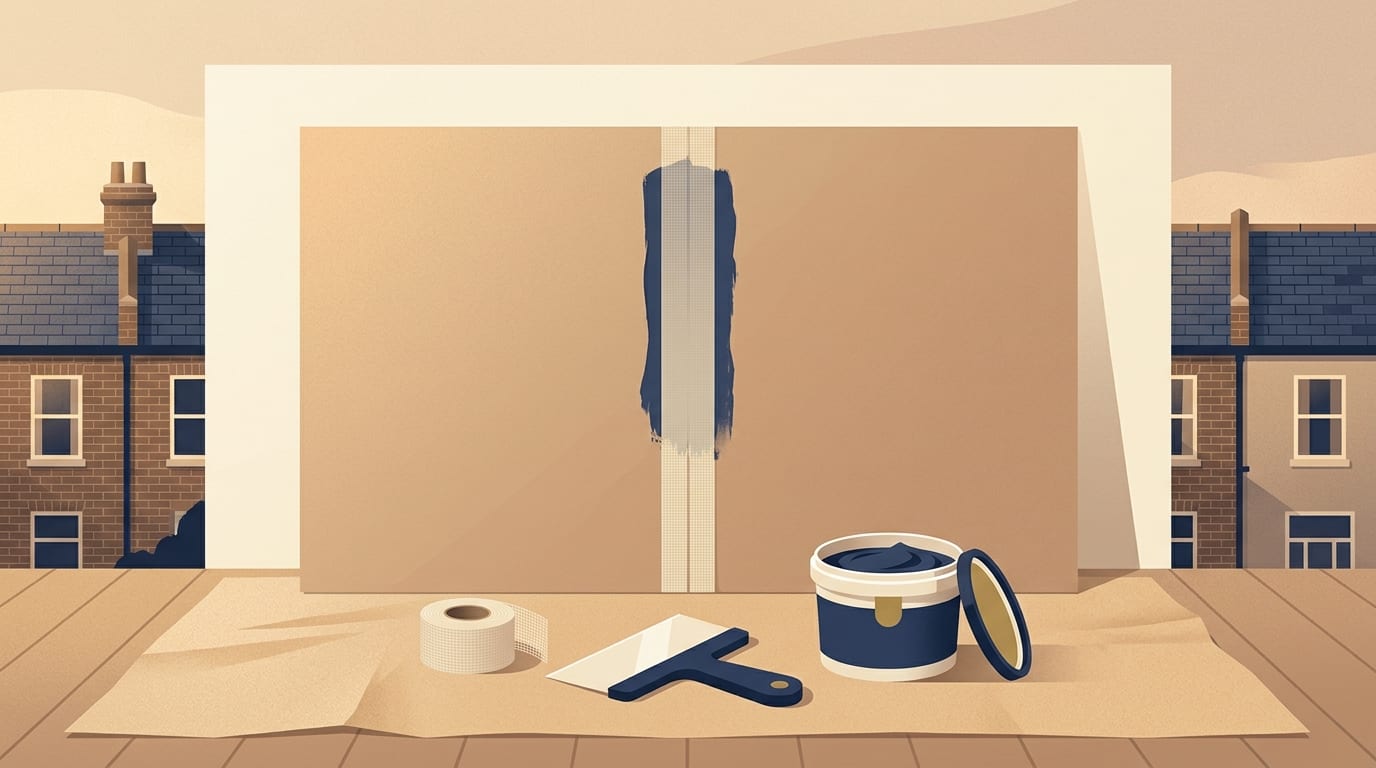
The joints between plasterboard sheets are weak points in your wall or ceiling. They are reinforced with tape and then either covered by a full skim of finish plaster, or filled and finished with joint compound only. This second route is known as tape and joint, which is a cheaper method that leaves a surface ready to be decorated. Knowing how these seams are treated helps you understand your quotes and why a poor finish can lead to recurring cracks.
Why joints between plasterboard sheets need treating
When walls or ceilings are boarded, the flat panels of plasterboard butt up against each other. This creates seams across the entire surface. If a plasterer simply painted over these seams, or skimmed directly over the bare boards without any preparation, the finish would quickly fail.
Because these seams are natural weak points, they must be reinforced before any wet plaster or jointing compound is applied. Perforated plaster tape is used over plasterboard joints to strengthen the seams. This tape bridges the gap and strengthens the seam.
It is important to note that this applies to new boarding, not to cracks in an existing ceiling. Plasterers price per job after seeing it, based on the area in square metres, the state of the background, ceiling height and access, and the preparation required. Ask whether the cost of taping the joints is included in the square metre rate for boarding and finishing.
What scrim tape does under a skim
A skim is a thin finishing coat, a few millimetres thick, applied over sound plaster or plasterboard. Before this wet plaster can be trowelled onto the boards, the joints must be secured. Plasterers use scrim tape, which is a mesh tape laid over the joints, to provide this strength.
A plaster manufacturer's data sheet from 2022 says that before plaster goes onto plasterboard, flat joints are reinforced with self-adhesive fibre tape. Gaps wider than three millimetres are prefilled and reinforced with joint tape embedded in the first coat of plaster.
The specification changes for areas that see more movement. There, joint tape is embedded in the finish for better resistance to cracking than with fibre tapes, in places such as:
- Around door or window apertures.
- Where board edges are not fully supported by the timber frame behind them.
- On ceilings below floors that flex a lot.
Applying scrim tape correctly takes time and care. Skimming over loose, damp or unsealed painted surfaces causes the new coat to crack or peel, and missing or poorly fitted scrim tape can let the joints move. A good plasterer will follow the manufacturer's guidance, though no one can promise a joint will never crack.
What tape and joint means
Tape and joint is a different method of finishing plasterboard. Instead of applying a wet skim coat over the entire wall or ceiling, only the joints are treated, with tape and joint compound, and the surface is then ready to be decorated. It is a cheaper route than a full skim, but the whole surface is not covered in finish plaster.
With tape and joint there is no full skim of wet plaster, so a quote that offers it should say exactly what the price covers.
For decorating a tape and joint surface, you can read the guide on painting bare board. Ask whether dust sheeting and floor protection are included in the price.
When you hire a tradesperson for this work, remember that plastering is not a licensed trade. There is no legal register like the one for gas engineers, so evidence of past work matters. A CSCS card is for construction sites, not proof of quality on domestic work. Ask to see examples of their taping and jointing work. TrustMark is the government-endorsed quality scheme, and FIS is the trade body for the finishes and interiors sector.
Tape and joint or skim and which suits your room
Choosing between a full skim and a tape and joint finish depends on your budget, the condition of the background, and the final look you want. A skim provides a continuous plaster surface across the whole wall or ceiling.
Tape and joint is a cheaper route that leaves a surface to be decorated, while a skim covers the whole surface. Ask the plasterer which they recommend for your room and why.
Your choice also depends on what is happening beneath the boards. If you are having new plasterboard stuck on dabs of adhesive directly to masonry, which is known as dot and dab, the boards provide a flat surface that can be taped or skimmed. If you are overboarding, which means new plasterboard fixed under an old ceiling, the same choice between a skim and tape and joint applies.
If that old ceiling features a textured coating, caution is required. The Health and Safety Executive says textured coatings such as Artex may contain asbestos in any building built or refurbished before 2000. Work on them does not normally need a licensed contractor but must be done by people trained to work safely with asbestos. Homeowners should not sand, scrape or drill suspect coatings and should tell tradespeople about them before work starts. Dry sanding or scraping Artex is highly dangerous.
If your boarding and plastering is part of a larger renovation on an external wall, building regulations might step in. Where 25 per cent or more of an external wall is re-rendered, re-plastered or re-lined internally, the regulations normally apply and the wall's insulation would normally have to be improved. A good plasterer will advise you if your project crosses this threshold.
Why board joints crack or show
Even with a new skim or a fresh tape and joint finish, problems can appear along the seams. Diagonal hairline cracks from normal settlement often appear along the joints of plasterboard. Ask the plasterer whether a crack is likely to be cosmetic.
However, settlement is not the only cause. Incorrectly treated plasterboard joints are a frequent reason for cracking. Movement can occur due to missing or poorly fitted scrim tape. If a tradesperson rushes the preparation, the seam can eventually pull apart.
A proper repair involves raking out the crack, applying scrim tape, then re-skimming the area. Simply filling a cracked plasterboard joint is unlikely to last, because the underlying weakness is still there. Recurring cracks usually mean the joint was not reinforced properly in the first place.
If you are facing this issue, a plasterer or other suitable tradesperson is required where cracks continue returning. If you suspect the cracking is caused by something more serious than normal settlement or bad taping, a structural engineer is needed for a structural inspection.
Typical 2026 prices
Plasterers price per job after seeing it, based on the area in square metres, ceiling height and access, and the preparation required. Preparation tasks such as stripping wallpaper, removing loose plaster, sealing painted surfaces, or dealing with Artex will increase the final bill. Ceilings are usually priced separately and small jobs carry a minimum charge. London and the South East cost more.
The table below shows typical published prices for 2026. The full room tape and joint rate is a whole boarding rate, not the price of the tape alone.
|
Item |
Typical price |
What it covers |
|---|---|---|
|
Full room tape and joint |
£35 to £65 per square metre |
Wall and ceiling combined. Supply and fix, including boards, frame, tape, compound, beads and labour. Excludes decoration and skim. |
|
Skim on plasterboard |
£8 to £15 per square metre |
Labour only. |
|
Typical room skim (30 to 40 square metres of board) |
£200 to £500 |
Skim for a typical room. Ask what is included. |
|
Skimming one wall |
£120 to £200 |
Materials and labour included. VAT may be added. |
|
Ceiling boards only |
£15 to £30 per square metre |
Supply and fix. |
|
Dot and dab to masonry |
£12 to £22 per square metre |
Labour only. Board and adhesive are extra. |
|
Minor crack filling |
£100 to £300 |
Materials and labour included. VAT may be added. |
|
Structural inspection |
£200 to £400 |
Carried out by an engineer. |
These figures are typical published prices for 2026, and your local quotes will differ. Always check whether VAT, materials, waste removal and floor protection are included in the final figure. If your tradesperson is taking away the old plaster or offcuts of board, remember that a trader who carries waste must be a registered waste carrier, and the register is public.
What to look for on a quote
A clear quote protects you from unexpected bills and ensures you get the finish you actually want. A quote is a fixed price, while an estimate is a rough guess. Accepting cash-only deals with nothing in writing is a high-risk approach, especially if the joints crack later and you need the tradesperson to return to fix them.
Under the Consumer Rights Act 2015, work must be done with reasonable care and skill. If the plasterboard joints are incorrectly treated and show through the paint, the customer can ask for it to be put right or seek a partial or full refund. Having a detailed document makes this process much easier because it proves exactly what you agreed to pay for.
According to Citizens Advice, a written quote should include a fixed total price rather than a daily rate. It should feature a breakdown of all the work to be done and the materials needed. You should also see separate costs for each material and part of the work, how long the price is valid for, whether the price includes VAT, and when the price can go up.
When comparing your plastering quotes, ask the following questions to make sure you are comparing like for like:
- Is the joint method scrim under a full skim, or tape and joint only?
- Is the skimming included in the square metre rate?
- Are the metal angle beads for the corners and the ceilings included?
- Does the total price include VAT?
- What will the plasterer do if the joints crack later?
- Are preparation tasks like sealing painted surfaces included?
Citizens Advice suggests getting written quotes from at least three traders. They also recommend having a written contract, paying deposits of no more than 25 per cent, and paying by card. You might also be able to cancel within 14 days of agreeing a contract, giving you a cooling-off period before the work begins.
Common questions
What is plasterboard tape for?
Plasterboard tape bridges the seams between sheets of plasterboard. It reinforces the joint to prevent the natural movement of the building from cracking the final skim coat or the painted finish.
What is plastering mesh?
Scrim tape is a mesh tape laid over plasterboard joints before a skim goes on, to reinforce the joint.
Can you plaster over tape and joint?
A taped and jointed wall is finished to be decorated. If you later want a full skim, ask a plasterer to assess the surface first and tell you what they recommend.
Why do my plasterboard joints show?
Joints can show when they have been incorrectly treated, for example if scrim tape was missing or badly fitted, or when normal settlement shows along the seams.
What happens if you do not use scrim tape?
Missing or poorly fitted scrim tape is one cause of movement along plasterboard joints, and diagonal hairline cracks from normal settlement often appear along the joints too. A plasterer can tell you which applies.
What to do next
Getting a smooth, crack-free finish on your walls and ceilings comes down to hiring someone who prepares the background properly. Before you agree to any work, follow these steps to protect your property and your budget:
- Check whether you want a full skim or a tape and joint finish, and ensure the quote explicitly states which method will be used.
- Ask the tradesperson how they treat high-movement areas, such as the joints around doors and windows.
- Get three written quotes that break down the costs for materials, labour, ceilings and waste removal.
- Confirm that the person carrying away your offcuts or old plaster is a registered waste carrier.
- Check that the price includes floor protection and any necessary angle beads for the corners.
Taking the time to understand the preparation work means you are better placed to avoid cracked seams. If you are ready to compare prices for your own home, you can find a plasterer near you to inspect the rooms and provide a fixed written quote.
Find a top rated plasterer near you
1,036 plasterers across the UK, each ranked on their Google rating and the number of reviews behind it. Start with your county: