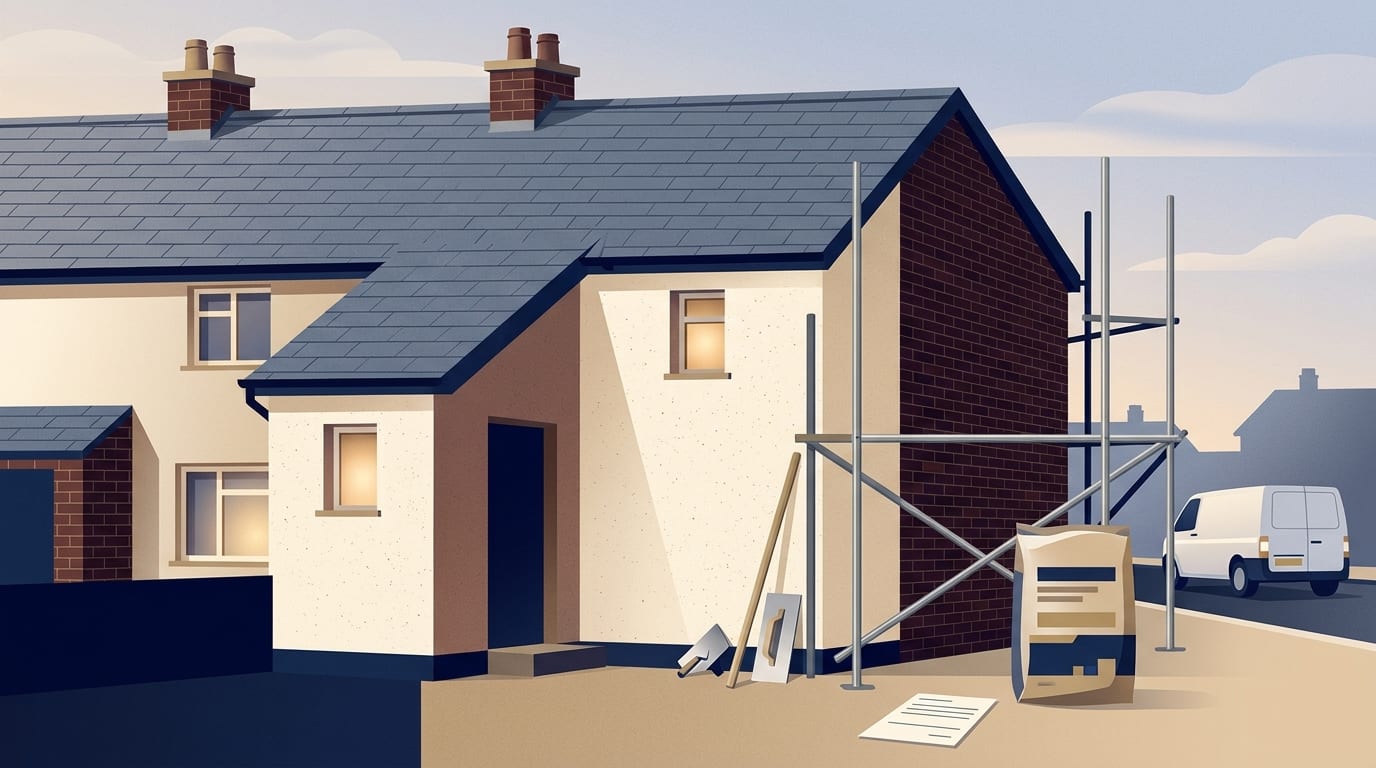
Monocouche is a pre-coloured dry powder mixed on site and applied to your external walls in a single layer by hand or spray. The name comes from the French for 'one coat'. Because the colour pigment runs all the way through the render, there is no separate painting stage at the end of the job.
What monocouche render is and how it works
Render is a protective coating applied to the outside of a building to shield the brickwork from the weather. Sand and cement render is normally painted with masonry paint, which has to be redone every five to ten years. Monocouche arrives as a pre-coloured dry powder, so there is no separate painting stage.
The defining feature of monocouche is that it creates a through-coloured finish. The pigment runs through the full depth of the render rather than just sitting on the surface. This helps prevent fading, and no separate painting stage is needed.
You will often hear builders and homeowners refer to K Rend when discussing these modern wall finishes. K Rend is a manufacturer's brand name that is often used loosely to describe silicone render. It is worth knowing the term, but a quote should say exactly which type of render is being proposed.
Monocouche is described as durable and low maintenance, although chips or damage are harder to disguise than on painted surfaces.
How monocouche is applied to your walls
Monocouche is described as a single coat system that is applied in two passes, by hand or by spray. The price figures below include a standard scrape finish, which leaves a textured surface.
DIY is not recommended. A wavy wall is something you will see every day, so this is work for a skilled renderer.
Typical 2026 prices per square metre
Plasterers price external rendering per job after seeing the property, usually basing their quote on the area in square metres. The price per square metre changes depending on where you live, how complex the building shape is, and how much preparation the underlying brickwork needs.
These are typical 2026 prices per square metre. The rows are not like for like, so do not average or combine them.
|
What the price covers |
Typical price per square metre |
|---|---|
|
Starting price to upper end (average £60) |
£45 to £75 |
|
Supplied and applied, with labour, materials, beads and a standard scrape finish |
£45 to £75 |
|
Supplied and applied, complex jobs |
Up to £90 |
|
Removing old render (extra) |
£8 to £15 extra |
|
Materials and labour |
£50 to £65 |
|
South region (excludes scaffolding, priming, old render removal and beading) |
£50 to £70 |
|
Midlands region |
£35 to £55 |
|
North region |
£35 to £50 |
|
Fully meshed system (extra) |
£2 to £5 extra |
Local quotes will differ based on your property.
The base price covers the powder and the labour to apply it, but extra steps push the final bill higher. Adding a fully meshed system costs an extra £2 to £5 per square metre.
If your house already has failed render on it, removing the old render adds £8 to £15 per square metre. If you want a bespoke colour outside the manufacturer's standard range, this can add around £500 to a project.
Whole house monocouche costs and scaffolding
Pricing a whole house depends heavily on the square metreage and the number of elevations being rendered. Small jobs usually carry a minimum charge.
These are typical 2026 whole house prices. The two groups of figures below disagree a lot, for example on the cost of a semi-detached house, so they are shown separately with the property size or elevations each gives. Do not combine them.
|
Basis and property |
Typical whole house price |
|---|---|
|
By floor area, 2-bed bungalow (100 square metres) |
£4,500 to £7,500 |
|
By floor area, 3-bed semi-detached (200 square metres) |
£9,000 to £15,000 |
|
By floor area, 4-bed detached (300 square metres) |
£13,500 to £22,500 |
|
By floor area, a typical home (around) |
£12,000 |
|
By elevations, terraced house (full external render) |
£3,500 to £6,000 |
|
By elevations, semi-detached (three elevations) |
£5,000 to £9,000 |
|
By elevations, detached (four elevations) |
£8,000 to £16,000+ |
Local quotes will differ based on access and preparation.
The time the job takes scales with the size of the house. A 100 square metre two-bed bungalow typically takes two to three days to finish. A larger 200 square metre three-bed semi-detached house takes four to five days, and a 300 square metre four-bed detached house takes five to seven days.
Scaffolding is often a separate line on your quote, so you must ask whether it is included. Scaffolding for a semi-detached house is £750 to £900 and for a detached house £900 to £1,150, based on a one-week minimum hire.
When comparing quotes, check carefully for hidden exclusions. Some initial prices might exclude scaffolding, priming the walls, removing old render and fitting the protective beading around your corners. Always ask a plasterer to confirm that waste removal, floor protection and VAT are included in the final written price.
Upkeep and maintenance compared with painted render
There is said to be no repainting for the life of the render. Painted sand and cement render needs masonry paint redone every five to ten years. No repainting cycle means no repainting costs for the walls.
Maintenance is minimal, but you must clean the walls correctly. Occasional gentle cleaning is enough. Do not use high-pressure jet washing on the walls, as it can damage the textured surface.
Hairline cracks should be dealt with promptly. You can read more about cracked render repairs if your walls already show signs of damage.
The drawbacks of choosing monocouche
The main drawback of a through-coloured system is that repairs are difficult because the colour must be matched exactly. If something has to be patched, such as the hole left when an external pipe moves, matching the colour is a challenge.
Because the finish relies on a textured standard scrape, chips or damage are harder to disguise than on painted surfaces.
Painting over monocouche is generally not recommended, so choose the colour carefully. Bespoke colours can add around £500 to a project.
Planning permission, regulations and older homes
In England, rendering or cladding may be carried out without having to first apply for planning permission if the materials are of a similar appearance to those used in the construction of the house. If you are changing a red brick house to bright white render, the council might argue the appearance is not similar. The policy in Wales may differ, so you should always check with your local authority.
There are strict exceptions where permission is needed first. You must apply for planning permission if you live in any of these designated areas:
- Conservation Areas
- National Parks
- Areas of Outstanding Natural Beauty
- The Broads
If your home is a listed building, you need listed building consent for any significant works, inside or out. You can read the official guidance on external walls from the Planning Portal before you start.
In England, building regulations apply to larger rendering jobs. Where 25 per cent or more of an external wall is re-rendered, re-clad, re-plastered or re-lined internally, the regulations would normally apply. Under these rules, the thermal insulation of the wall would normally have to be improved. You can check the Planning Portal building regulations rules to see how this affects your project.
If you own an older property with solid walls, modern materials might cause damage. Traditional guidance warns that a modern cement render is incompatible with the construction of most old buildings. Impervious cement render restricts evaporation, which can cause or accelerate decay. Whether monocouche is suitable for your home is a question to put to your renderer. A traditional limewash or lime-based finish is usually most suitable on old buildings. The Society for the Protection of Ancient Buildings offers detailed advice on why cement renders can trap damp, and you can explore lime render for old houses to understand your options.
Is monocouche render worth the cost?
That depends on your house and your plans. The price figures above differ between lists, and scaffolding, removing old render and a fully meshed system can all be extra. Monocouche has no painting stage, and it is said to need no repainting for the life of the render, whereas painted sand and cement render needs masonry paint redone every five to ten years.
Against that, repairs are difficult because the colour must be matched, and bespoke colours cost extra. If you are weighing monocouche against another finish, ask for written quotes for each so you can compare like for like, and do not assume either will be cheaper.
Common questions
Can you paint over monocouche render?
Painting over monocouche is generally not recommended. The product is designed as a through-coloured finish where the pigment runs through the full depth, removing the need for a separate painting stage. It also brings back a painting stage, which monocouche is chosen to avoid.
How long does monocouche take to apply?
A two-bed bungalow typically takes two to three days to finish. A larger three-bed semi-detached house takes four to five days, and a four-bed detached house takes five to seven days. These are typical timings.
Can I jet wash monocouche render?
No, high-pressure jet washing can damage the textured surface. Occasional gentle cleaning is enough to maintain the finish and remove surface dirt without harming the wall.
Is monocouche render suitable for old solid walls?
SPAB says a modern cement render is incompatible with the construction of most old buildings, and impervious cement render restricts evaporation, which can cause or accelerate decay. A traditional limewash or lime-based finish is usually most suitable on old buildings. Ask your renderer whether monocouche is suitable for your walls before you agree.
Next steps and questions to ask your renderer
Plastering is not a licensed trade, so there is no legal register of approved renderers. A CSCS card is for construction sites and is not proof of quality on domestic work. To find a skilled tradesperson, ask to see evidence of past work and get three written quotes to compare prices. A quote is a fixed price, while an estimate is just a rough guess.
When you speak to a tradesperson, ask them these specific questions to understand exactly what they are offering:
- Is scaffolding included in the final price, or is it billed separately?
- Does the quote cover hacking off the old render and taking the waste away?
- Are wall priming, corner beading and a fully meshed system included in the cost?
- Will the work trigger building regulations for thermal insulation, and will you notify the council?
- How do you match the colour if a repair is needed later?
- Is my home suitable for a modern cement-based render, or does it need a breathable lime finish?
Under the Consumer Rights Act 2015, work must be done with reasonable care and skill. Always ask for a written contract before the scaffolding goes up. Pay a deposit of no more than 25 per cent, and pay by card for better protection if a dispute arises. A trader who carries waste must be a registered waste carrier, and the register is public, so you can check their credentials easily. When you are ready to start gathering quotes, you can find a plasterer near you to inspect your walls and advise on the best finish for your home.
Find a top rated plasterer near you
1,036 plasterers across the UK, each ranked on their Google rating and the number of reviews behind it. Start with your county: