
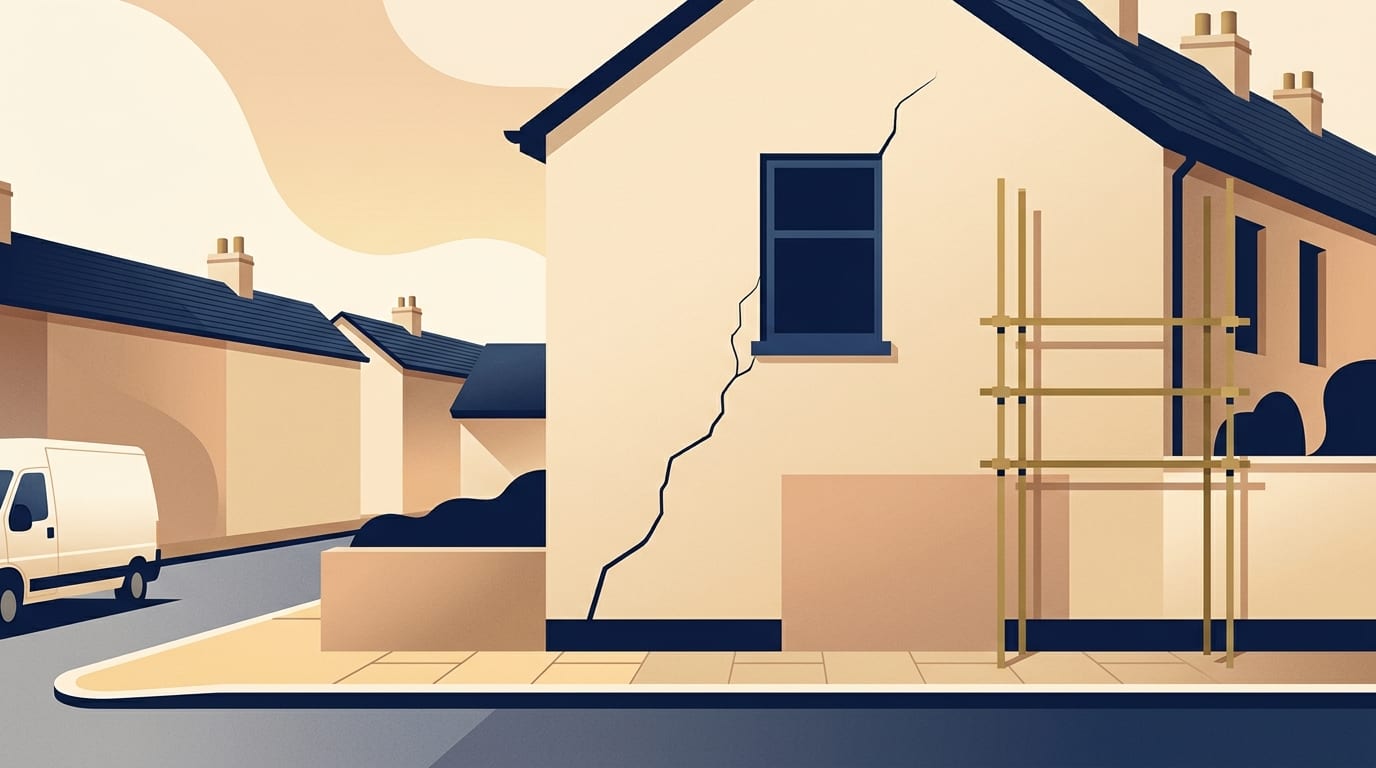
Repairing damaged render costs between £15 and £30 per square metre, but if the render sounds hollow when tapped, the hollow area usually has to come off rather than be patched. Cracked or hollow render can let rainwater into your walls, which can cause damp and mould inside the house. This guide explains how to tell a cosmetic crack from a structural problem, when the old render has to be stripped, and what typical 2026 prices look like for patch repairs and full replacements.
Why render cracks
Cement render provides a tough external coating for a house, but it is naturally inflexible. Hairline cracks often form over time simply because the cement is more rigid than the wall behind it. As the building experiences slight natural movement or changes in temperature, the rigid cement cannot flex to absorb the stress. This causes the surface to split and crack.
Once a crack opens up, it draws in rainwater. This moisture becomes trapped behind the cement surface and slowly soaks into the brickwork or blockwork underneath. Over time this trapped water can cause damp patches and mould on the inside walls of your home.
Hairline cracks compared with signs of movement
Not all cracks are caused by weathering or rigid cement. Some cracks point to structural movement in the ground beneath your home, known as subsidence. You need to know the difference before you pay a plasterer to cover up a problem that actually needs a structural engineer, and understanding when to worry about cracks is the first step.
According to the Federation of Master Builders, there are specific signs that indicate possible subsidence rather than simple render failure. You should look out for:
- Cracks wider than around 3mm
- Diagonal cracks spreading especially around doors and windows
- Cracks that are wider at the top than they are at the bottom
- Cracks that are visible on the inside walls as well as the outside
- Doors or windows that have started to stick in their frames
If the damage looks serious, active or structural, your buildings insurer may be the first call you should make. A structural engineer can then assess the cause of the movement. You should not rush into repairs if you suspect movement. Cracks from suspected ground movement should not simply be filled with new cement, and any repairs should follow the recommendations of your engineer, surveyor or insurer.
Signs the render has blown or come away
When render loses its grip on the wall behind it, tradespeople call this blown render. Water getting in through cracks and freezing in winter can help loosen it, and once the bond has failed the render can bulge or start to come away.
You can check for blown areas you can reach from the ground by gently tapping the wall around a crack with the handle of a trowel or a screwdriver. Solid render gives a dull, hard thud. Blown render produces a hollow or drum-like sound when tapped, which means the bond has failed.
You might also see areas where the surface is bulging outwards or actively detaching from the wall in large flakes. Where the wall sounds hollow around cracks, or the render has come off in chunks, the whole hollow area usually needs to come off.
Patch repairs and when they work
If the render around a crack is solid and well-bonded to the wall, a plasterer can often carry out a patch repair. This involves raking out the loose material from the crack, applying a suitable filler or a fresh mix of render, and smoothing it to blend in. Repairs to damaged cement render cost £15 to £30 per square metre. If you have an older property with lime render, patch repairs cost £15 to £30 per square metre, or £100 to £350 for an area of average damage.
Patch repairs have strict limits. The new patch will rarely match the colour or the exact texture of the original render, even if the plasterer is highly skilled. Weathering changes the colour of exterior walls over the years, meaning a fresh patch of cement will stand out clearly. The repaired area will look like an obvious patch until the whole wall is painted, and repainting costs about £20 per square metre.
You also need to allow plenty of time before you decorate. New render needs four to six weeks to dry fully before painting. Painting over it too soon traps moisture inside the new patch, which can cause the paint to peel and the new render to fail.
When the render needs to come off
If your tapping test reveals a hollow sound across large sections of the wall, patch repairs will not hold. The render has already detached and the whole area usually needs to come off. Solid, well-bonded render may take a new render system applied directly over it, and the options are worth reading up on before rendering a house. Render that has cracked badly, blown or started to detach usually needs removing first.
Render removal costs £25 to £45 per square metre, with an average price of about £35. Taking the old coating off a single elevation costs £900 to £1,600. If you are stripping a whole semi-detached house, the removal cost is £2,000 to £4,000. The removal work takes between one and seven days to complete depending on the size of the house. Tradespeople usually charge day rates for removal work of £180 to £250.
Taking off old render often reveals damaged brickwork underneath that needs attention before the new coat goes on. Repairs to the wall underneath cost £150 to £500 depending on the condition of the bricks and the mortar joints. Once the wall is sound, cement rendering costs £30 to £50 per square metre, with the raw materials making up £10 to £15 of that square metre price.
A full removal and re-render of a semi-detached house usually costs £4,000 to £9,000 depending on the render system you choose. External render comes in several forms, including traditional sand and cement, breathable lime, and textured pebbledash. Modern alternatives include monocouche, which is a single-coat coloured render, and thin-coat acrylic or silicone systems. You might hear plasterers talk about K Rend, which is simply a manufacturer's brand name often used loosely to describe silicone render.
Older houses and lime render
Houses built before the 1920s usually have solid walls without a cavity. These old buildings rely on their permeable nature to let water absorbed by the walls evaporate back out into the air. If your house has solid walls, applying an impervious cement render in place of a lime-based covering restricts this evaporation.
The Society for the Protection of Ancient Buildings advises that hairline cracks form because the cement is more rigid than the wall. These cracks draw in water that becomes trapped behind the hard cement layer. Timber-framed and earth buildings can suffer major structural damage if moisture builds up behind cement render in this way, which is why choosing between lime or gypsum plaster matters so much for historic properties.
Lime render suits older and historic properties because it lets moisture escape and is flexible enough to move with the building. This flexibility reduces the risk of cracking. Lime render can still crack, but where cement render tends to develop a few large cracks, lime produces many fine cracks. These fine cracks can heal themselves as free lime within the render dissolves in rainwater and re-deposits inside the crack.
The SPAB advises using a weaker, more permeable lime render without any cement in the mix. This must be applied by someone experienced with lime, and limewash is the usual finish. Applying lime render over a non-breathable material such as cement traps moisture and defeats the purpose of using lime, so any existing cement must come off first. Lime rendering costs £60 to £100 per square metre.
What render repairs cost
The price of fixing cracked render depends on the material, the size of the area, and whether you need scaffolding to reach it. Labour rates for rendering are about £200 to £300 a day, although these will be higher in London and the South East.
The table below shows typical costs for common repair and replacement jobs.
|
Type of work |
Cost per square metre |
|---|---|
|
Patch repairs to damaged render |
£15 to £30 |
|
Render removal |
£25 to £45 |
|
New cement rendering |
£30 to £50 |
|
New lime rendering |
£60 to £100 |
These figures are typical published prices for 2026 and your local quotes will differ.
Access and waste disposal will add to these base costs. Scaffolding costs £20 to £25 per square metre, or £200 to £800 a week. For larger jobs, scaffolding costs £600 to £1,200 for one elevation and £1,800 to £3,000 to wrap a detached house. Stripping heavy render generates a lot of heavy waste. Skip hire costs £200 to £300 for a 6 yard skip or £300 to £450 for a 12 yard skip. If the skip has to go on the public road, you will also need a council permit costing £30 to £70.
Building regulations and planning
Minor patch repairs do not normally trigger any official paperwork, but stripping and replacing large sections of render is different. Planning Portal guidance for England says that where 25 per cent or more of an external wall is re-rendered, re-clad, re-plastered or re-lined internally, the building regulations would normally apply. Under these rules, the thermal insulation of that wall would normally have to be improved at the same time.
Planning permission rules depend on where you live and what your house looks like. In England, cladding or rendering can usually be done without planning permission if the materials are of a similar appearance to those used in the construction of the house. Wales may have different rules, so you should check with your local council if you are unsure.
There are strict limits in designated areas. In conservation areas, National Parks, Areas of Outstanding Natural Beauty and the Broads, you need planning permission before cladding the outside with stone, artificial stone, pebble dash, render, timber, plastic or tiles. A listed building needs listed building consent for any significant works, internal or external. Conservation bodies advise repairing original lime plaster where possible and replacing like for like.
What a good repair quote includes
Citizens Advice suggests you get written quotes from at least three traders. You must understand the difference between a quote and an estimate before you agree to any work. A quote is a fixed price, while an estimate is a rough guess that can easily increase once the job starts.
A reliable plastering quote should list:
- What is causing the cracks to appear
- The extent of any hollow render found by tapping the wall
- The exact repair method and the materials being used
- A breakdown of the work and materials
- A fixed total price and whether VAT is included
- The cost of scaffolding and skip hire
- How long the quote is valid for
- The drying time required before painting can begin
Plastering is not a licensed trade, meaning there is no legal register like the one for gas engineers. Because of this, evidence of past work matters heavily. You might see plasterers holding a CSCS card, but this is designed for access to commercial construction sites and is not proof of quality on domestic work. You can look for membership of the FIS, which is the trade body for the finishes and interiors sector, or TrustMark, which is the government-endorsed quality scheme.
You should ask the plasterer for two or three recent examples of similar work and check they have public liability insurance. Agree a written contract covering timings, tidying up, materials and payment. Keep any deposit to 25 per cent at most and pay by card where possible.
Under the Consumer Rights Act 2015, all work must be done with reasonable care and skill. If the plasterer fails to meet this standard, you have the right to ask for the work to be put right or to seek a partial or full refund. Under consumer law, you might also be able to cancel within 14 days of agreeing the work. Finally, a trader who carries waste must be a registered waste carrier, and this register is public.
Common questions
Can cracks in render be repaired?
Hairline cracks in sound render can often be repaired by raking out the loose material and filling the gap, at about £15 to £30 per square metre. If the wall sounds hollow around the crack, the render has lost its bond, so a patch is unlikely to last and the blown area usually needs to come off.
Can cement render cracks be patched?
Cement is rigid and cannot flex when the building moves slightly or changes temperature, which is why it cracks. You can patch solid cement render, but the repair will rarely match the original colour and texture. You will usually need to wait four to six weeks for the patch to dry fully before repainting the wall for a seamless finish.
Why do cracks in render matter?
Cracks can let rainwater through the render and into the brickwork beneath. This trapped moisture can show up as damp patches and mould on your interior walls, so it is worth having cracks looked at early.
Can cracks in render be a sign of subsidence?
If cracks are wider than about 3mm, run diagonally around windows, or are visible inside the house as well as outside, they may point to ground movement rather than simple render failure. Do not just fill these cracks to hide them. Your buildings insurer may be the first call, and a structural engineer can assess the cause.
How do plasterers repair render cracks?
A skilled plasterer will check whether the crack looks cosmetic or could point to movement, and test the surrounding wall for a hollow sound. Sound areas are raked out and filled with a matching material, while blown sections are hacked off back to the bare brickwork. Older solid-walled houses usually need a breathable lime render repair rather than cement.
Next steps
If you have found cracks in your exterior walls, take these steps before agreeing to any work:
- Where you can reach from the ground, tap the wall gently around the crack with a screwdriver handle to check for a hollow sound
- Check the width of the cracks and look for sticking doors that might suggest subsidence
- Identify whether your house has cavity walls or older solid walls that need breathable lime
- Ask three local plasterers to visit the property and provide a fixed written quote
- Check that each quote includes the cost of scaffolding, skip hire and council permits
Taking the time to understand the problem means you will only pay for work that actually fixes the underlying cause. When you are ready to get fixed prices for your property, you can find a plasterer near you to assess the damage and recommend the right repair.
Related Guides
External Wall Insulation Costs, Grants and What Can Go Wrong
What external wall insulation costs in 2026, how it goes on under render, where to check for grants, what it could save and the quality checks to make before you sign.
How Much Does Floor Screeding Cost?
What floor screeding costs per square metre and per room in 2026, how traditional and liquid screeds differ, and how long a new screed takes to dry before flooring.

What Is Microcement and How Much Does It Cost?
What microcement is, where it works in a home, what floors, walls and wet rooms typically cost in 2026, how long it takes and what to ask a specialist before you book.