
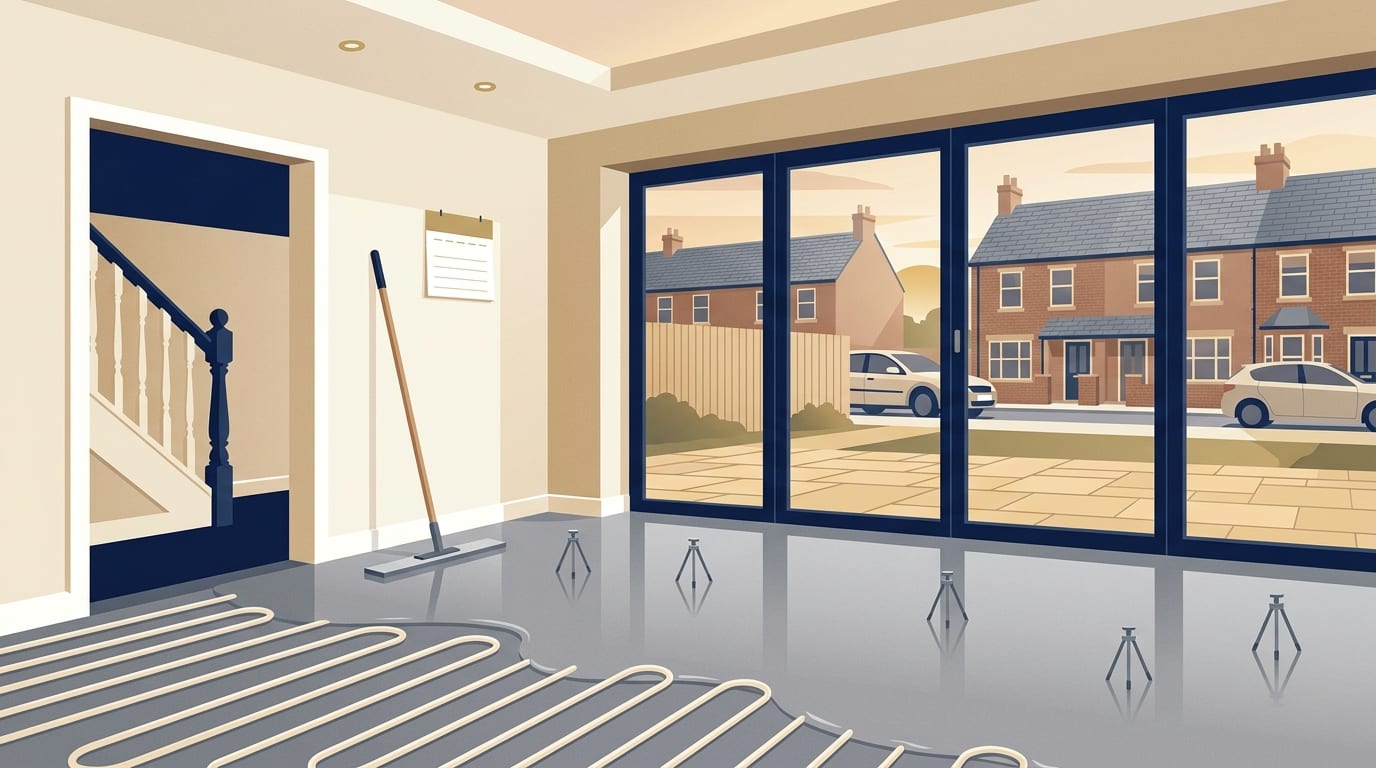
The typical 2026 installed price for standard floor screeding is £18 to £25 per square metre, or about £360 to £500 for an average 20m2 room. When you build an extension, convert a garage or strip a room back to bare brick, you are usually left with a rough concrete subfloor. This structural slab is strong, but it is rarely flat or smooth enough to take a final floor covering.
A floor screed is a dedicated levelling layer laid directly over that concrete base, or over a layer of rigid floor insulation. Its main job is to give a flat, level surface for your final floor coverings, and it is often used to cover underfloor heating pipes. Screed is not a structural element of your house. It does not bear the weight of the walls and it does not hold the building up. It simply bridges the gap between the rough structural concrete below and the decorative tiles, wooden boards or carpet above.
Some plasterers also lay screeds, and our guide to how much a plasterer costs covers their rates for wall and ceiling work. Most screeds are either a traditional mix of sand and cement or a flowing liquid screed based on calcium sulphate, also called anhydrite, or on cement. The type you choose will depend on the size of your room, your budget, and whether you are burying underfloor heating pipes within the floor.
Traditional, fast drying and liquid screeds
Conventional sand and cement screed is the traditional choice for UK homes and is usually the cheapest option. It can be mixed by hand on site using a forced action mixer, or delivered ready-mixed in a large lorry. This type of screed is trowelled into place by a skilled tradesperson using a straight edge to level it. It is a stiff, semi-dry mixture, which means it can be laid on a gradient or slope. This makes it well suited to wet rooms and walk-in showers, where the floor has to fall towards the drain.
However, traditional screed has a few drawbacks. Because it relies entirely on the tradesperson's eye and trowel skills, it can sometimes dry with a patchier finish than modern alternatives. It is also more prone to shrinking and cracking as the cement cures. The accepted standard for a sand and cement screed aims for a flatness that allows a 10 millimetre difference over a two metre distance.
Liquid screeds, which are also called flowing or self-levelling screeds, offer a different approach. Instead of being trowelled by hand, they are pumped into the room through a long hose. They find their own level naturally and guarantee a much flatter finish, usually allowing only a five millimetre difference over two metres. They shrink less than traditional mixtures and need fewer expansion joints cut into the floor.
Pumped screeds are usually made from anhydrite, which is a form of calcium sulphate, or a liquid cement mixture. Because they flow exactly like water, the room must be prepared like a watertight tank before the pour begins. This means laying a heavy polythene sheet membrane over the entire floor, lapping it up the walls and gluing it securely in place so the liquid cannot escape into the brickwork.
Anhydrite screeds need the surface preparing by sanding before tiling, to remove the weak layer that can form on top as they dry. Ask whether this is included in the screeding quote or left to the tiler, because tiles laid on an unprepared surface may not bond properly. It is also worth noting that pumped liquid screeds are usually only cost-effective on larger floor areas of at least 40 square metres. On smaller floors, a traditional screed usually works out cheaper, as the price table below shows.
How much floor screeding costs
The table below shows typical published prices for 2026, comparing the price per square metre and the total cost for an average 20 square metre room.
|
Type of screed |
Price per square metre |
Cost for an average 20m2 room |
|---|---|---|
|
Standard sand and cement screed |
£18 to £25 |
£360 to £500 |
|
Fast drying screed |
£20 to £28 |
£400 to £560 |
|
Flowing or liquid screed |
£24 to £31 |
£470 to £620 |
These figures are typical guide prices for materials and labour combined. Your actual quotes will differ based on where you live, the condition of your subfloor and how difficult the room is to access. Floor screeding costs in and around London are typically 25 to 35 per cent higher than elsewhere in the UK.
Laying a standard or fast-drying screed in an average room normally takes a screeder around six to seven hours of physical work. A flowing screed takes roughly six to eight hours. While the pumping itself is very fast, the extensive preparation, tanking and sealing required before the pump is turned on takes up most of the day.
Costs for a kitchen, room or garage
The table below shows typical 2026 guide figures for specific spaces and the extra jobs that often go alongside screeding.
|
Job or extra cost |
Typical price |
|---|---|
|
Kitchen floor (13.5m2) |
£245 to £340 |
|
Single garage floor (18m2) |
£325 to £450 |
|
Double garage floor (36m2) |
£650 to £900 |
|
Screeding labour only (per m2) |
£10 to £12 |
|
Screeding daily labour rate |
£120 to £200 |
|
Lifting and removing old flooring |
£150 to £400 per room |
|
Damp proof membrane |
£5 to £15 per m2 |
|
Skip hire for extra waste |
£150 to £400 |
The kitchen and garage prices work out at about the same rate per square metre as standard screed in the first table, so the size of the floor is what mainly changes the total.
Extra costs to plan for
A written quote from a tradesperson should outline exactly what is included in the price. A comprehensive quote for floor screeding usually covers the following elements.
- Surface preparation including sweeping and sealing the concrete base.
- Repairing small cracks or minor damage in the existing subfloor.
- The full cost of the screed materials and any required bonding agents.
- The labour required to mix, lay and level the floor.
- The removal and safe disposal of the tradesperson's own packaging and waste.
Quotes do not usually include major structural floor repairs or removing your old floor coverings. If the tradesperson has to lift and remove old timber flooring, heavy ceramic tiles or glued carpet, this typically adds £5 to £10 per square metre to the bill, or £150 to £400 for an average room.
You will also need to clear the room completely before the work begins. If the screeder has to move heavy furniture or appliances out of the way, they will often charge an extra £20 to £50 for the time and effort.
If your concrete subfloor does not have an existing damp proof membrane, one will need to be added before the screed goes down to stop ground moisture rising into your home. If damp has also affected your walls, our guide to replastering after damp explains what needs to happen before new plaster goes on. A new damp proof membrane laid over a concrete subfloor costs around £5 to £15 per square metre.
Waste removal can also add a significant amount to the final bill. If the job generates more heavy waste than originally quoted, perhaps because an old thick screed had to be broken up and removed, you might need to pay for skip hire. Hiring a skip typically costs £150 to £400 depending on the size required and your location. A trader who carries waste away in their van must be a registered waste carrier, and this register is public so you can check their credentials.
Screed thickness and underfloor heating
The depth of your screed depends entirely on what is underneath it. A traditional sand and cement screed bonded directly to a clean concrete slab is usually laid around 25 to 40 millimetres thick. If it is laid over a damp proof membrane, it is classed as unbonded. An unbonded standard screed must be at least 50 millimetres thick to give it enough strength to prevent it curling and cracking.
When a traditional screed is laid over underfloor heating pipes and rigid floor insulation in a home, it is typically laid 65 to 75 millimetres deep. The thick screed absorbs the heat from the water pipes and radiates it evenly into the room. This large thermal mass takes longer to heat up, but holds the heat for a long time after the boiler turns off.
Flowing screed is often the preferred choice for underfloor heating. Because it is a liquid, it flows completely around the heating pipes, leaving no insulating air gaps that could block the heat from reaching the room. It also requires much less depth. Pumped anhydrite screeds can be laid as thin as 35 millimetres in total. When covering underfloor heating, they only need around 30 millimetres of cover over the top of the pipes, making the total depth about 45 millimetres. This thinner layer allows the floor to heat up much faster and gives you closer control over the room temperature.
How long screed takes to dry
Getting a new floor ready happens in two stages, curing and then drying, and neither should be rushed. Curing means keeping the screed covered, usually with polythene, so the cement hardens properly. If a cement screed dries out too quickly at this stage, the surface can end up weak.
The second stage is drying, when the remaining moisture leaves the screed. Published advice is to dry it ideally at around 20°C in well-ventilated rooms, with the windows kept closed for the first 72 hours after laying. You can usually walk on a new screed safely after about 48 hours. Normal site traffic, such as other tradespeople working in the room, can resume after about a week. If you have underfloor heating installed, it can be set to its lowest temperature after the first week and turned up very gradually to help push the moisture out.
Your final floor coverings cannot go down until the screed is fully dry. As a rough guide, you should allow one day of drying time for every millimetre of depth for the first 40 to 50 millimetres. Beyond that depth, allow longer, about one and a half to two days per millimetre. On that basis a 50 millimetre traditional screed takes about seven weeks to dry, and a 75 millimetre screed laid over heating pipes can take nearly three months. Cold and damp winter weather conditions will make this process take even longer.
Liquid screeds dry at different rates depending on their chemical makeup. Cement based liquid screeds are claimed to dry in two to three weeks for a 40 millimetre floor in good conditions. Calcium sulphate anhydrite screeds take much longer, typically needing around 40 days for the same depth.
A sand and cement screed should be fully dry before tiling, which takes at least three weeks and, at most thicknesses, a good deal longer. Fully dry means less than 75 per cent relative humidity or a 0.5 per cent moisture content. Your screeder or flooring fitter should test this with a special moisture meter placed on the floor before any final covering goes down. Never let anyone guess whether a floor is dry by looking at it.
Building regulations when a floor is replaced
If you are digging up an old floor to lay a new one, you might be legally required to improve the thermal insulation of your home at the same time. Planning Portal guidance for England says that if you are renovating more than 25 per cent of a solid or suspended floor, which includes the replacement of the screed or a timber floor deck, the building regulations normally apply.
Under these energy efficiency standards, the floor would normally have to be upgraded to meet current insulation targets to prevent heat loss into the ground. If meeting the full modern standard is not technically or functionally feasible, perhaps because thick insulation would raise the floor level higher than your external doors, it should be upgraded to the best standard achievable within a simple payback period of no more than 15 years.
If you are unsure whether your renovation project triggers these rules and needs building control approval, you should always check with your local council before any old floors are broken up.
Common questions
What is anhydrite screed?
Anhydrite screeds are a type of flowing liquid screed made from calcium sulphate rather than traditional cement. They are pumped into the room through a hose, find their own level naturally, and are a very popular choice for covering underfloor heating systems.
Which screed is best for underfloor heating?
Flowing liquid screed is often preferred for underfloor heating. The liquid completely surrounds the heating pipes without leaving air gaps, and it can be laid thinner than traditional sand and cement, which helps the heat reach the room faster.
Can you lay standard screed in a wet room?
Yes, conventional sand and cement screed suits wet rooms. Because it is a stiff mixture, a tradesperson can trowel it onto a slope so that surface water drains correctly towards the shower waste.
How long does liquid screed take to dry?
Cement based liquid screeds are claimed to dry in two to three weeks for a 40 millimetre depth in good conditions. Calcium sulphate liquid screeds take longer, typically around 40 days for the same depth.
Questions to ask before you book
Before you agree to a price, you should ask the tradesperson a few specific questions to ensure you both understand the scope of the job and there are no hidden surprises.
- Ask which type of screed they plan to use and exactly how thick it will be laid over the concrete or insulation.
- Ask whether the quoted price includes the floor insulation and the required damp proof membranes, or if you need to buy these separately.
- Ask who is responsible for lifting the old flooring, hiring the skip and disposing of the heavy waste material.
- Ask what specific moisture testing they will do before signing off the floor as dry and ready for the next trade.
- Ask for a realistic estimate of when your final floor coverings can safely be fitted, based on the thickness they are laying.
Your next steps
When you are ready to find a tradesperson, take the time to gather detailed prices and protect yourself financially.
- Request written quotes from at least three different local screeding contractors to compare their prices and advice.
- Check that each document is a fixed price quote rather than an estimate, because an estimate is just a rough guess and you might end up paying more.
- Ensure the quote includes a fixed total price rather than just a daily rate, with a clear breakdown of the materials, labour and waste costs.
- Ask for two or three recent examples of similar floor work they have completed in your area.
- Verify that the tradesperson holds valid public liability insurance before they bring wet materials into your home.
The Citizens Advice consumer service suggests getting a clear written contract for the work before it begins. They advise avoiding upfront payments, but if a deposit cannot be avoided you should not agree to pay more than 25 per cent of the total bill. It is always safer to pay by debit or credit card if you can, as this offers better protection, and you should not pay with cash. Under the Consumer Rights Act 2015, the work must be done with reasonable care and skill. If it is not, you can ask for it to be put right or seek a partial or full refund. Depending on how and where you agree the contract, you might also be able to cancel it within a 14-day cooling-off period.
If you are ready to get started and want to compare local prices, you can find a plasterer near you to discuss your floor screeding options.
Related Guides
External Wall Insulation Costs, Grants and What Can Go Wrong
What external wall insulation costs in 2026, how it goes on under render, where to check for grants, what it could save and the quality checks to make before you sign.
What Is Microcement and How Much Does It Cost?
What microcement is, where it works in a home, what floors, walls and wet rooms typically cost in 2026, how long it takes and what to ask a specialist before you book.
How Much Does a Stud Wall Cost to Build?
What a new stud partition wall costs in 2026, timber or metal studs, the extras for doors, insulation and special boards, and the building regulations that apply.