
External Wall Insulation Costs, Grants and What Can Go Wrong
TopRatedPlasterers.co.uk · 7 October 2026
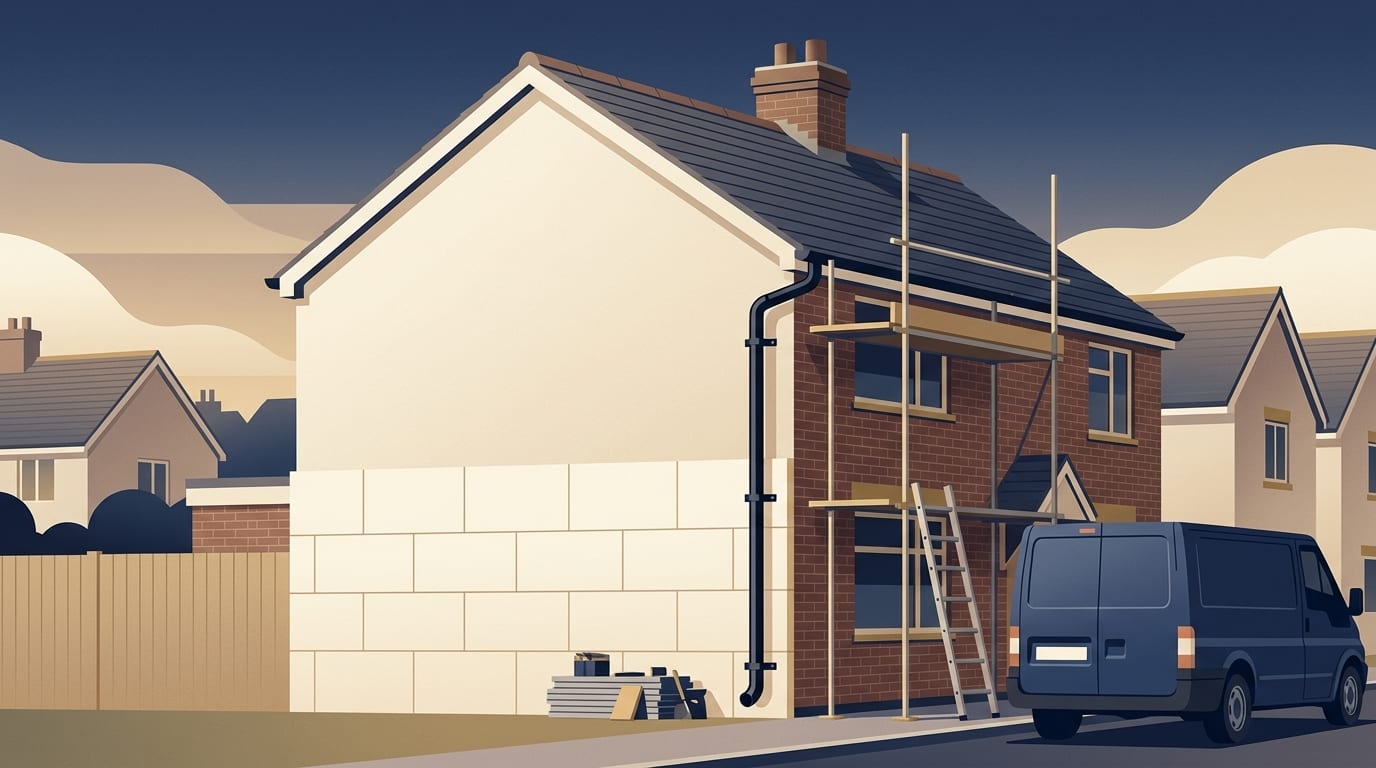
Fitting external wall insulation can cost around £15,000 for a typical three-bedroom semi-detached house in Great Britain, according to the Energy Saving Trust. It is a major, whole-house specialist job that involves fixing insulation boards to your outside walls and covering them with a reinforcing mesh and a render or cladding finish. If you own a house with solid walls that is hard to heat, this work can reduce your energy bills and make your home more comfortable. You do need to know exactly what the job involves, what the rules are and how to spot a bad installation before you start inviting quotes.
What external wall insulation is and how it works
Around 33 per cent of the heat lost in an uninsulated home escapes through the walls. External wall insulation tackles this by wrapping the outside of your house in a thermal layer. The system is made up of insulation boards fixed directly to the exterior of the wall, which are then covered with a protective layer of render or cladding.
You can choose from several different outer finishes to suit your street. The system can be finished smooth, textured, painted, tiled, panelled, pebble-dashed or covered with brick slips.
There are several benefits to choosing this method over lining the walls internally. The work can be applied without causing disruption inside your rooms, and it does not reduce your internal floor area. It renews the appearance of your outer walls and should improve both weatherproofing and sound resistance. It can also reduce condensation on internal surfaces.
It is significantly more expensive than cavity wall insulation and tends to cost more than internal wall insulation, which costs around £12,000 for a typical semi-detached house.
Is your house suitable for it?
Homes built before 1920 are more likely to have solid walls, making them the most common candidates for this type of insulation. The walls must be structurally sound before any work begins.
You cannot have external wall insulation installed before existing damp problems are fully resolved. Damaged brickwork or pointing, roofs, overhangs, gutters and downpipes must all be repaired before any wall insulation goes on. If you skip this preparation, damp may be trapped inside the masonry and the new insulation may fail.
Solid wall insulation might not suit homes that are exposed to extreme weather or flooding, or properties that are in poor condition.
The installer should also carefully assess the ventilation in your home. External wall insulation can reduce the air flow into your rooms, so existing ventilation might need to be improved.
How much external wall insulation costs
The total bill depends heavily on the size of your property and the amount of preparation needed. The cost is typically from £8,000 for a terraced house up to around £19,000 for a larger detached property.
The Energy Saving Trust's £15,000 figure for a semi assumes you are paying a company and insulating the whole house in one go. A simple rectangular house with few downpipes and meter boxes, projecting window sills and a generous roof overhang costs less to insulate.
Costs can be lower if the work is done alongside other jobs. If you already have scaffolding up for a new roof, new windows, solar panels or gutter repairs, you can save on the access costs for the insulation work.
Insulation boards and render finishes compared
The final price you pay per square metre is made up of the insulation layer and the outer finish you choose.
This table shows the typical cost per square metre for the different insulation boards and the separate cost for the outer finish. Extruded polystyrene is normally used below the damp proof course.
|
Component |
Material type |
Cost per square metre |
|---|---|---|
|
Insulation board |
Expanded polystyrene (EPS) |
£60 to £80 |
|
Insulation board |
Extruded polystyrene (XPS) |
£80 to £100 |
|
Insulation board |
Phenolic foam |
£90 to £120 |
|
Insulation board |
Polyurethane (PUR) |
£100 to £150 |
|
Outer finish |
Standard cement or polymer render |
£30 to £50 |
|
Outer finish |
Pebble dash |
£40 to £60 |
|
Outer finish |
Acrylic or silicone render |
£50 to £80 |
|
Outer finish |
Cladding |
£40 to £120 |
|
Outer finish |
Brick slips |
£80 to £150 |
These figures are typical published guide prices for 2025 and your local quotes will differ. You will need to consider these costs alongside the other expenses involved in planning a rendering job.
Extra work that adds to the bill
The basic square metre rates do not cover everything required to complete a whole house. You must budget for access and the cost of altering your roof and exterior fittings.
Scaffolding for a typical three-bedroom semi-detached house costs around £1,000, which includes the necessary permits and licences.
Because the insulation boards and render add thickness to your walls, the roof overhang often needs to be extended to protect the new surface from the rain.
There is also a cost for removing and replacing anything fixed to the walls. Rainwater pipes and cables fixed to the walls have to be taken off and refitted, and meter boxes often need to be moved.
What you could save on heating
Insulating solid walls reduces the amount of gas you need to burn to keep your rooms warm. The exact savings vary depending on the level of work required and the size of your property, from a small flat to a large detached home.
The Energy Saving Trust estimates the following yearly energy bill savings for a typical installation in a gas-heated home, based on fuel prices as of July 2026.
- Detached house saves £500 a year
- Semi-detached house saves £280 a year
- Detached bungalow saves £220 a year
- Mid-terrace house saves £150 a year
- Mid-floor flat saves £140 a year
These estimates apply to homes in England, Scotland and Wales.
Grants and funding in 2026
You might be able to get funding or grants for insulation, but the main schemes have changed recently. The service to check eligibility for the Great British Insulation Scheme has closed, and all installations had to be complete by 31 March 2026 when the scheme ended.
You might still get help through the Energy Company Obligation if you meet strict criteria. You could be eligible if you live in private housing and claim certain benefits, including Universal Credit, Pension Guarantee Credit, Child Benefit and Housing Benefit.
The scheme also covers social housing that has an energy efficiency rating of E, F or G. Owner-occupied homes must have an energy efficiency rating of D, E, F or G. Privately rented homes must be rated E, F or G and you must have the owner's permission to do the work.
You should contact your local council or an energy supplier to apply and look for the financial support available in your area. Installers or agents might contact you directly to offer funded work. If you are not sure an offer is genuine, you should always check with your council or the energy supplier they claim to represent.
If you own a property in England or Wales, you can use the GOV.UK service to find ways to save energy in your home. This gives you recommendations for home improvements, estimated costs, how much you could save on your bills and the next steps to take. You can do this online or by phoning an adviser. Homes in Scotland get different advice through Home Energy Scotland, and homes in Northern Ireland through NI Direct.
Planning permission and building regulations
Planning Portal guidance for England says you do not need planning permission for repairs, maintenance or minor improvements such as painting your house. If you live elsewhere in the UK, or are unsure, check with your council.
If you live in a Conservation Area, a National Park, an Area of Outstanding Natural Beauty or the Broads, you need planning permission before cladding the outside of your house with stone, artificial stone, pebble dash, render, timber, plastic or tiles. Outside these areas, cladding may be carried out without applying for planning permission provided the materials are of a similar appearance to those used in the construction of the house.
If you live in a listed building, you need listed building consent for any significant works, whether they are internal or external.
Building regulations apply differently. Planning Portal guidance for England says that where 25 per cent or more of an external wall is being renovated, the building regulations would normally apply and the insulation would have to meet the required standards. Renovation here means providing a new layer or replacing an existing layer, but it does not include decorative finishes.
Where a solid wall is upgraded with insulation, it must meet the minimum energy efficiency values set out in the Approved Documents. If that is not technically or functionally feasible for your house, the wall should be upgraded to the best standard achievable within a simple payback of no more than 15 years.
Why so many installations went wrong
There are serious quality issues with some solid wall insulation fitted through ECO4 since April 2022 and the Great British Insulation Scheme. These issues include poor installation and a failure to meet building regulations.
A National Audit Office report on the Energy Company Obligation extrapolated from government audits of 758 projects. It found that 98 per cent of homes with external wall insulation fitted under those schemes have major issues requiring remediation. This affects between 22,000 and 23,000 homes.
The report found that 92 per cent of those homes have major issues that will affect the insulation's performance. This poor workmanship often creates the risk of water ingress and mould. A further 6 per cent have health and safety risks that need immediate correction, such as inadequate ventilation.
Fixing these faults is expensive. Remediation should normally cost £5,000 to £18,000 per property for external wall insulation, provided it is done before major damage occurs.
Ofgem has written to affected properties. Every property with external wall insulation fitted under these schemes will be offered a home check. TrustMark is carrying out these free Find and Fix audits and will arrange for any problems found to be fixed at no cost to the homeowner. Faulty work will be fixed by the installer and you should not be asked to pay.
Affected homes should have had a letter from Ofgem in early 2026 containing a Unique Measure Reference Number. Only legitimate parties such as Ofgem and TrustMark will know that number, and genuine bodies will quote it when they contact you. Ofgem also runs a helpline if you need to check a caller is genuine.
How to choose an installer and check the quote
The widespread problems with recent government schemes show exactly why your choice of installer and the details in their quote matter.
The system should be fitted by a specialist installer who has been trained by an approved system designer. You should find a TrustMark registered installer and expect them to provide a 25-year guarantee. It is best to choose a guarantee backed by an insurance company or a guarantee agency, or a third-party warranty that still protects you if the installer stops trading.
Citizens Advice suggests trying to get written quotes from at least three different traders. Ask for two or three recent examples of similar work and check the trader has public liability insurance.
A quote is a fixed price, while an estimate is just a rough guess that means you might end up paying more. Your quote should include a fixed total price rather than a daily rate, how long the price is valid, whether it includes VAT and when the price can go up.
A detailed external wall insulation quote should list the following items.
- The insulation type and the thickness of the boards
- The U-value the finished wall will achieve
- The correct fixings for your wall type
- The starter, corner and stop beads
- A breakdown of the work and materials
- Separate costs for each material and part of the work
- Itemised costs for scaffolding, skips and making good
You should be wary of abnormally low quotes and check that every item above is included. You should get a written contract before the work starts. Avoid deposits or upfront payments, and if a deposit cannot be avoided, do not agree to pay more than 25 per cent. Pay by debit or credit card if you can and do not pay with cash. Under consumer law, you might be able to cancel within 14 days of agreeing the work.
Common questions
What are the disadvantages of external wall insulation?
The main disadvantage is the high initial cost, which is significantly more expensive than cavity wall insulation. It also changes the outer appearance of your home, requires extra work to move pipes and extend roofs, and can reduce natural air flow into your rooms so that existing ventilation needs upgrading.
Can you get government grants for external wall insulation?
The Great British Insulation Scheme ended on 31 March 2026, but you might still get help through the Energy Company Obligation if you claim certain benefits or live in a low-rated property. You should contact your local council or an energy supplier to find out what financial support is currently available in your area.
Is insulated render the same thing as external wall insulation?
Mostly. Insulated render usually means an external wall insulation system with a render finish, where insulation boards are fixed to the outside walls and covered with a reinforcing mesh and render. External wall insulation can also be finished with cladding, tiles or brick slips instead of render.
What are the most common external wall insulation problems?
The most common problems found by government audits were faults that affect how the insulation performs, often creating a risk of water getting in and mould. They were linked to poor installation and work that did not meet building regulations. A further 6 per cent of homes with external wall insulation under the schemes had health and safety risks needing immediate correction, such as inadequate ventilation.
Next steps for your insulation project
Before you commit to spending thousands of pounds on insulating your walls, follow these steps to protect your home and your money.
- Check your walls and roof for any existing damp, damaged brickwork or broken gutters, and have these repaired before getting insulation quotes.
- Check with your local council to see if you need planning permission for the render or cladding finish you want.
- Look for financial support through the Energy Company Obligation or use the GOV.UK energy saving service to see what help is available.
- Get written quotes from at least three TrustMark registered installers who are trained by an approved system designer.
- Check that your chosen quote lists the insulation thickness, the expected U-value, the beads, the fixings and the scaffolding.
- Ensure you will receive a 25-year guarantee backed by an insurance company or a guarantee agency.
Once your walls are repaired and you are ready to gather fixed prices for the work, you can use our directory to find a plasterer near you who specialises in insulated render systems.
Related Guides
How Much Does Floor Screeding Cost?
What floor screeding costs per square metre and per room in 2026, how traditional and liquid screeds differ, and how long a new screed takes to dry before flooring.
What Is Microcement and How Much Does It Cost?
What microcement is, where it works in a home, what floors, walls and wet rooms typically cost in 2026, how long it takes and what to ask a specialist before you book.
How Much Does a Stud Wall Cost to Build?
What a new stud partition wall costs in 2026, timber or metal studs, the extras for doors, insulation and special boards, and the building regulations that apply.