
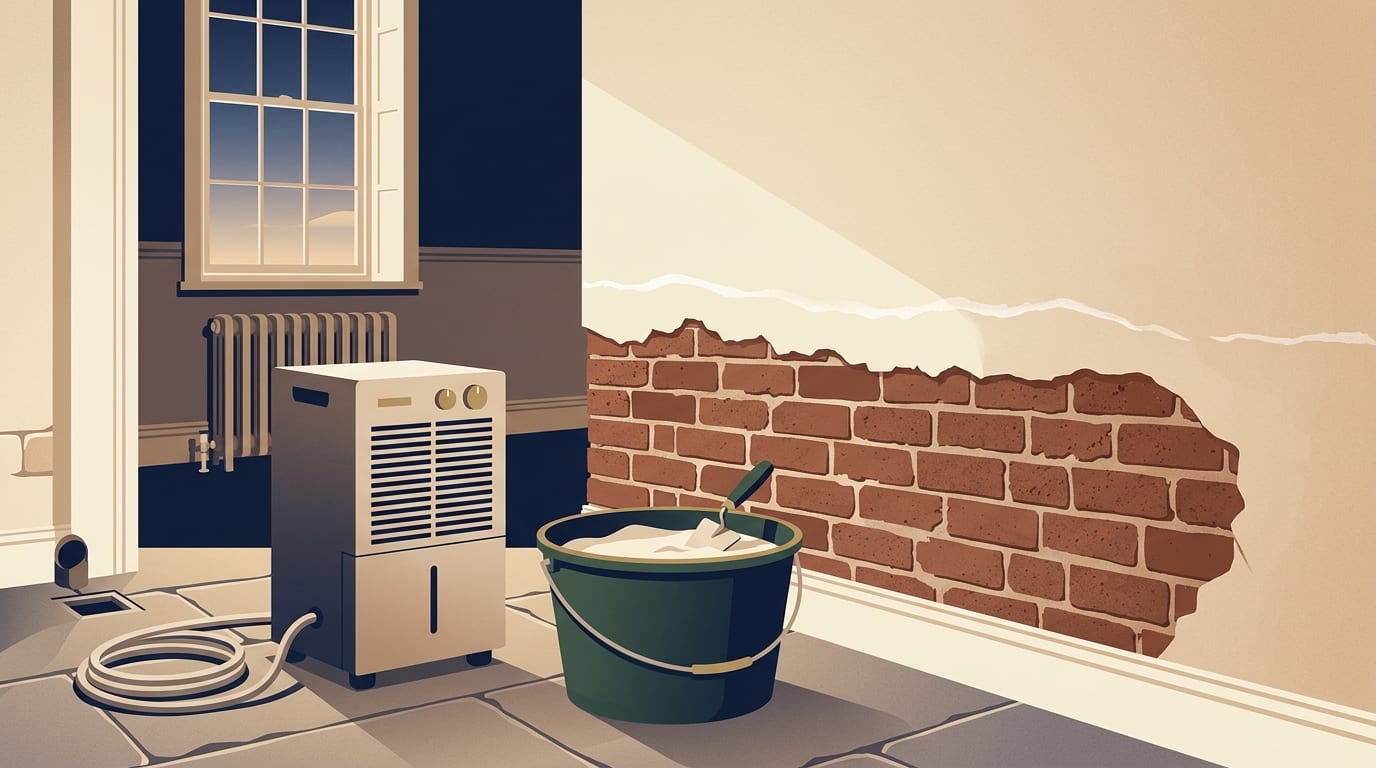
Damp walls are usually contaminated with hygroscopic salts that pull moisture from the air, meaning new plaster or paint put straight onto them simply fails. To stop the problem returning, the root cause of the damp has to be found and fixed completely before any internal wall is replastered. Salt-contaminated plaster then usually has to come off, and the bare wall needs time to dry before a suitable new plaster goes on.
Why damp walls need replastering
When a wall suffers from prolonged rising damp or a severe leak, the moisture does more than just wet the surface. It carries minerals from the ground or the building materials into the masonry and the plaster. As the water evaporates into the room, it leaves these minerals behind in the fabric of the building.
This contamination ruins the existing finish. You will often see flaking paint, or find the plaster coming away from the wall entirely. Even after the leak is fixed or a new damp proof course is installed, the old plaster usually stays contaminated, because the salts remain in it.
If you simply paint over the damage or apply a thin finishing coat over the top, the existing contamination will quickly ruin the new finish. You will have to decide whether your wall needs skim plastering or a full replaster, and where damp has left salts in the plaster, the affected area usually needs a full replaster rather than a skim.
Hygroscopic salts and why they matter
Hygroscopic salts, particularly chlorides and nitrates, are almost always present in groundwater. When moisture travels up a wall during prolonged rising damp, these salts are drawn up with the water and left in the brickwork and plaster.
The defining feature of hygroscopic salts is that they absorb moisture directly from the air when the room is humid. This means dampness linked to them actually increases in muggy conditions. The contaminated wall can look damp and feel wet to the touch even when no new water is leaking into the building.
You will often see salt banding, which is a horizontal line on a wall affected by rising damp. This band forms exactly where the moisture evaporates and leaves the hygroscopic salts behind. Because these salts keep absorbing moisture from the air, the wall can look damp at this exact same height even after the original problem is fixed.
If salt-contaminated plaster is left in place, new paint can blister, crack, peel or flake, and new plaster can struggle to stabilise.
White powder and efflorescence on plaster
Not all salts on a damp wall are hygroscopic. You might notice small white crystals or an off-white powdery deposit sitting on the surface of drying masonry. This is known as efflorescence.
Efflorescent salts are usually sulfates. While they look unsightly on your brickwork or plaster, they are seldom hygroscopic. They do not actively pull moisture from the muggy air in the way that chlorides and nitrates do.
Because they sit loosely on the surface as the masonry dries out, efflorescent salts can often simply be brushed away. They are usually a sign that a wet wall is drying out naturally, rather than a permanent cause of damp in themselves.
Fix the cause before any plaster goes on
A plasterer should never be asked to cover up an unsolved damp problem. Without a proper investigation by a suitably qualified surveyor, ideally one independent of any firm selling the treatment, it is impossible to say what is causing the moisture to enter the wall in the first place.
Rising dampness is widely misdiagnosed. This misdiagnosis often happens when a surveyor relies on high electrical moisture meter readings alone. These readings are often raised in old buildings that are not actually unduly damp, simply because of salts left behind from a previous historical problem.
If genuine rising damp exists, there will be visible signs alongside the meter readings, such as a clear tide-mark on the wall. To get an accurate diagnosis, the Property Care Association recommends using a surveyor who holds the CSTDB qualification.
Addressing the actual cause of the dampness is always preferable to dealing with the symptoms. Depending on what the investigation finds, that might mean repairing a leaking gutter or a broken pipe.
How much plaster has to come off
Damaged plaster is usually removed when it has stopped bonding to the wall, when there are visible signs of damp, or when it is hollow or blown. A plasterer finds blown plaster by tapping the wall and listening for a distinct, hollow drum-like sound.
Plaster often needs to come off beyond the obvious damage. One damp specialist recommends stripping it back 300 millimetres beyond the last visible signs of dampness, because salts can sit deeper in the wall and reappear even after surface treatments.
If you are having a retrofit damp proof course installed, damp treatment companies normally insist that the internal plaster is removed up to about one metre above floor level. They typically make this a strict condition of their guarantee.
Stripping a medium-sized single room back to bare brick usually takes three to eight hours. The waste is heavy and dusty, so a skip is often needed.
Which plaster goes back on
Because old plaster can contain hygroscopic salts that attract moisture even after a new damp proof course is installed, the replacement plaster has to be chosen carefully. Once the cause has been dealt with, what goes back on depends on the wall and its age.
Damp specialists often replaster using specially formulated salt-resistant plasters or render systems. You may see this called renovating plaster on a quote. Ask the plasterer which plaster they plan to use and why it suits your wall.
However, the Society for the Protection of Ancient Buildings warns that using these specialist salt-resistant plasters tends just to disguise dampness problems temporarily in old buildings.
You may also see quotes for tanking slurry, which is a waterproof coating applied directly to the bare masonry after the plaster is removed. This is mainly used on basements, cellars and below-ground walls to hold back water.
Older solid walled houses
If you live in a traditionally built, pre-1919 house with solid walls, modern damp proofing methods can cause more harm than good. There should be a strong presumption against inserting retrospective damp proof courses in these properties. Inappropriately installed, they can be damaging, ineffective and an unnecessary expense.
Using waterproof renders and coatings, or repointing and re-rendering with a cement-rich mortar, can actually make dampness in traditionally built buildings worse by trapping moisture inside the solid walls.
Instead, conservation bodies advise that lime plaster should normally be used for replastering in old buildings after work to combat hygroscopic salts. Lime is breathable and allows moisture to evaporate naturally. Our guide to lime or gypsum plaster explains how to choose for an older property.
If your home is a listed building, installing damp proofing will typically require listed building consent, inside or out. Conservation bodies advise repairing original lime plaster where possible and replacing it like for like.
Planning permission and regulations
Planning Portal guidance for England says that installing or replacing an external damp proof course is unlikely to need planning permission, provided it is not part of a larger project that changes the appearance or structure of the house.
However, the rules are stricter in certain areas. If you live in a Conservation Area, a National Park, an Area of Outstanding Natural Beauty or the Broads, you should contact your local planning authority. The Planning Portal advises checking this particularly if the outside appearance of the house will change.
Building regulations can also apply to major replastering work. Planning Portal guidance for England says that where 25 per cent or more of an external wall is re-rendered, re-plastered or re-lined internally, the regulations normally apply and the wall's insulation would normally have to be improved at the same time.
Asbestos in old wall coatings
When hacking off old plaster, you may uncover textured coatings, or you may be dealing with damp near an Artex ceiling. The Health and Safety Executive states that textured coatings such as Artex may contain asbestos in any building built or refurbished before the year 2000.
Work on these coatings does not normally need a licensed contractor, but it must be done by people trained to work safely with asbestos to prevent harmful fibres from becoming airborne.
Homeowners should not sand, scrape or drill suspect coatings. Before anyone strips a damp room back to bare brick, tell your tradespeople about any textured finishes.
How long to let walls dry
Patience is critical when recovering from a damp problem. Removing salt-contaminated plaster can help the wall out, but if the new plaster goes on before the bare wall has completely dried, it is highly likely to become contaminated by the salts still left in the brickwork.
Delaying the replastering lets the walls dry thoroughly and allows the remaining salts to come to the surface where they can be brushed away.
The standard rule of thumb is to allow about 25 millimetres of wall thickness per month to dry out. A thick solid brick wall will take many months to dry completely. You can check our guide on how long plaster takes to dry for details on the finishing coats, but the structural drying phase cannot be rushed.
What replastering after damp costs
The price of repairing a damp wall depends heavily on the preparation, the treatment required and the size of the room. Small jobs will usually carry a minimum charge, and prices in London and the South East cost more than the national average.
The table below outlines typical costs for treating damp and replacing the plaster.
|
Type of work |
Typical guide price |
|---|---|
|
Plaster removal (labour only) |
£20 to £35 per square metre |
|
Stripping a medium room back to brick |
£300 to £450 |
|
Chemical damp proof course, treatment only (three-bed semi) |
£650 to £950 |
|
Treating penetrating damp (internal wall) |
£400 to £600 per wall |
|
Tanking slurry |
£70 to £120 per square metre |
|
Replastering after damp proofing |
£450 to £800 per room |
|
Painting and decorating |
£230 to £450 per room |
These figures are typical published prices for 2026. Your local quotes will differ depending on your ceiling height, the state of the background and the access to the property.
When budgeting, remember that these treatments exclude the cost of a formal damp survey. You will also need to factor in skip hire for the heavy waste, which is about £150 to £350, and skirting board replacement, which typically costs £150 to £400 per room.
A chemical damp proof course is priced at about £60 to £90 per linear metre of wall. Treating penetrating damp on an internal wall, where replastering and decorating make up a large part of the cost, is roughly £120 to £200 per linear metre of wall treated to about one to one and a half metres high.
What can go wrong during replastering
Replastering after a damp issue is complex, and taking shortcuts will leave you with a wavy finish you will see every day once it is painted, or worse, a wall that fails again.
- Skimming over loose, damp or unsealed painted surfaces so the new coat simply cracks or peels off.
- Accepting cash-only deals with nothing in writing to protect you.
- Relying on poorly prepared quotes that omit the cost of preparation, ceilings, scaffolding or waste removal.
- Dry sanding or scraping Artex and old textured coatings.
- Applying modern gypsum plaster or cement on old lime walls, trapping moisture inside the structure.
Guarantees and who should do the work
Plastering is not a licensed trade, meaning there is no legal register like the one for gas engineers. Evidence of past work and clear, written agreements matter immensely. A CSCS card is for construction sites and is not proof of quality on domestic work.
Under the Consumer Rights Act 2015, all work must be done with reasonable care and skill. If it is not, the customer can ask for it to be put right or seek a partial or full refund. Any trader who carries waste away from your home must be a registered waste carrier, and this register is public.
Citizens Advice suggests getting written quotes from at least three different traders to protect yourself.
- Get a fixed total price rather than a daily rate, as an estimate is just a rough guess and you might end up paying more.
- Ask for a full breakdown of the work and materials, with separate costs for each part of the job.
- Check how long the price is valid, whether it includes VAT and under what conditions the price can go up.
- Ask for two or three recent examples of similar work and check the trader has public liability insurance.
- Get a written contract and pay by debit or credit card if you can. You might be able to cancel within 14 days of agreeing the work.
- Avoid upfront payments entirely, and if a deposit cannot be avoided do not agree to more than 25 per cent.
Common questions
What is blown plaster repair?
Blown plaster is plaster that has lost its bond with the masonry behind it, often leaving a hollow space. You can find it by tapping the wall and listening for a drum-like sound. Repairing it usually means hacking off the loose material back to the bare brickwork and applying a new backing coat and skim finish.
What is tanking a wall?
Tanking involves applying a waterproof coating directly to bare masonry to hold back moisture. A tanking slurry is commonly used on basements, cellars and below-ground walls. It costs around £70 to £120 per square metre and is applied after the old plaster is removed.
Why is there white powder on my walls?
White powder or small white crystals on drying masonry are efflorescent salts, usually sulfates. They are rarely hygroscopic, meaning they do not pull moisture from the air, and can usually simply be brushed away. They are a normal sign of a wet wall drying out.
What is renovating plaster?
Renovating plaster is a name you may see on quotes for the plaster used after damp treatment. Ask your plasterer which plaster they plan to use and why it suits your wall, and bear in mind that the Society for the Protection of Ancient Buildings warns salt-resistant plasters tend just to disguise dampness problems temporarily in old buildings.
Next steps for your wall
Before you hire anyone to hack off plaster or inject a chemical damp proof course, make sure you understand exactly what the problem is and how it will be resolved. Use this checklist to compare your quotes:
- Ask what caused the damp in the first place and confirm that it has been fixed.
- Check exactly how high the old plaster will come off the wall.
- Ask which plaster or render system will go back on and why it is suitable for your property.
- Find out how long the bare wall will be left to dry before the new plaster is applied.
- Ask what guarantee covers the plastering work, and what conditions apply to it.
- Check whether VAT, materials, waste removal and floor protection are included in the final price.
Once you know the root cause is solved and the walls have had time to dry, you can find a plasterer near you to restore the room.
Related Guides

Tyrolean Render Costs, Repairs and Painting Explained
What Tyrolean render is, what it costs to apply in 2026, and how tired or damaged Tyrolean can be repaired, painted, rendered over or removed.

When to Worry About Cracks in Walls and Ceilings
Most cracks in plaster are cosmetic, and this guide explains which hairline, diagonal and wider cracks need a closer look and who to call about them.

Plasterboard Repairs for Holes, Dents and Water Damage
How plasterers deal with holes, dents, cracked joints and leak damage in plasterboard, when a patch is enough, and what repairs typically cost in 2026.