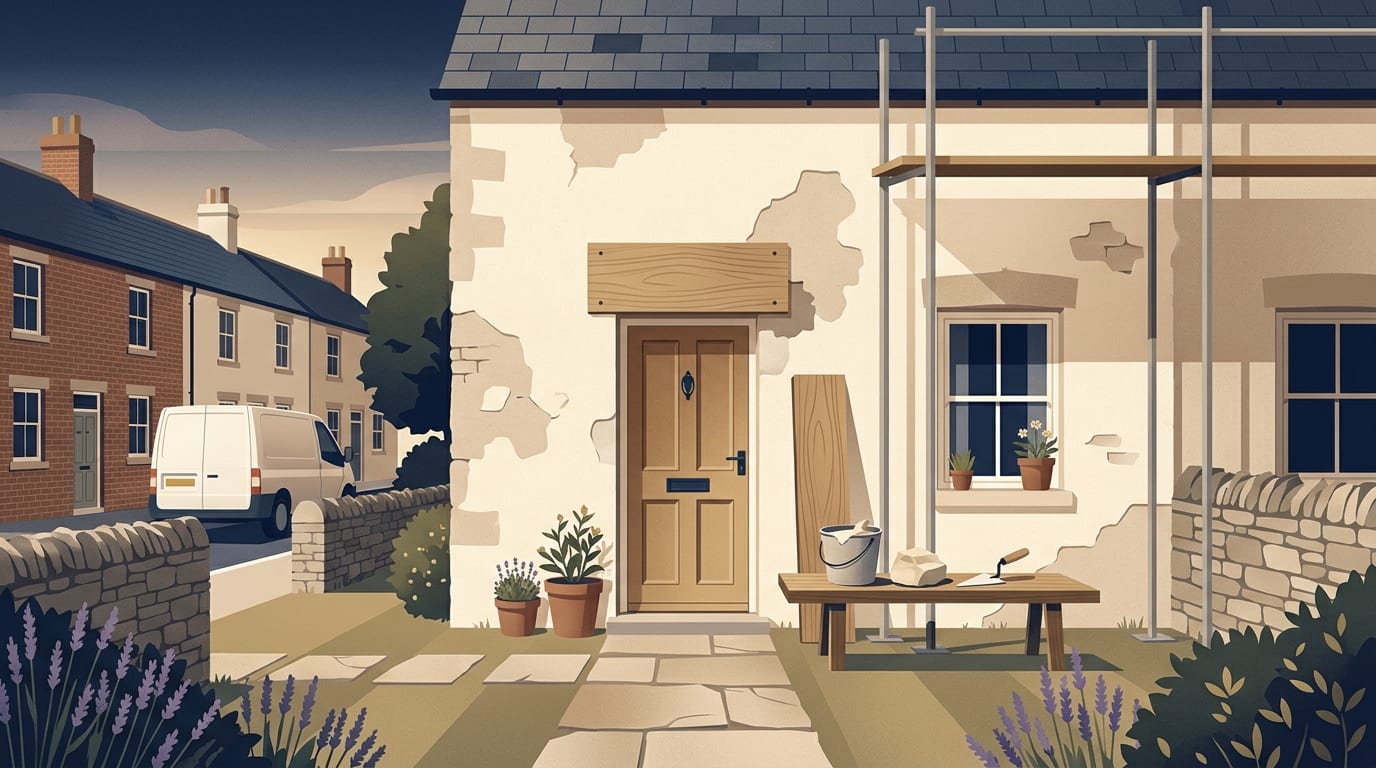
Most buildings from before 1919 were built to let moisture pass through and evaporate, and many have solid walls of brick or stone. Instead of keeping rain out completely, they manage it by absorbing it and letting it dry out again. This natural cycle of absorbing and releasing moisture is how older buildings breathe.
For this cycle to work the materials covering the walls must be porous. If you seal the outside of a solid wall, moisture can build up behind the seal and cannot easily escape. Modern houses rely on waterproof barriers and air gaps to stay dry, which means they behave in a completely different way to older properties.
What lime render is
Lime render is a traditional external finish made from lime, sand and water. It is highly absorbent and porous, which allows moisture to pass through it freely and lets the building breathe. This breathability is exactly what older solid walls need to stay dry and structurally sound. Lime also remains slightly flexible after it sets and can flex with the building.
This flexibility means the render can move slightly as the building expands and contracts with changes in temperature. Modern houses use rigid materials, but older homes shift over time and need a coating that moves with them. Lime renders typically have a more irregular profile on the wall than modern finishes.
Inside an older property you will often find traditional lath and plaster, which is lime plaster applied onto timber laths. Timber laths are thin strips of wood nailed across the structural joists or framing. If you are also decorating inside, you might wonder whether to use lime or gypsum plaster in an older home for your internal walls. The same breathable thinking applies inside, so ask the plasterer which finish suits your walls.
How cement render traps moisture
Portland cement is a modern building material that is impermeable and rigid. When it is applied to the outside of a solid old wall it restricts evaporation and stops the building from breathing. The Society for the Protection of Ancient Buildings explains that moisture builds up behind a cement render because it cannot escape. This is why cement render is a risk on old walls.
Because cement is more rigid than an old solid wall, hairline cracks form in the surface. Moisture can then become trapped behind the render, which restricts evaporation.
This trapped moisture is especially dangerous for certain types of traditional construction. Timber and earth buildings can suffer major structural damage if moisture builds up behind a cement render. You should never apply cement plaster or other waterproofing treatments to treat a damp problem on an older property.
The Cotswold District Council notes that applying cement plaster, render or other waterproofing treatments is unlikely to solve the damp problem and may exacerbate the problem. If you have damp in an older house you should arrange an independent survey to find the true cause. A plasterer is not the right person to diagnose damp, so take independent advice before work starts.
Internal plastering and modern materials
When tackling the inside of an old house, a skim will not solve an underlying damp problem. A skim is a thin finishing coat, a few millimetres thick, applied over sound plaster or plasterboard. Skimming over loose, damp or unsealed painted surfaces is a common mistake that causes the new coat to crack or peel. If internal walls are damp, a survey should find the cause before anyone decides how much plaster comes off.
A replaster means hacking off failed plaster and applying a backing coat plus a finish coat, or fixing new plasterboard and skimming it, which the trade calls board and skim. Dot and dab is where plasterboard is stuck on dabs of adhesive, and a conservation-minded plasterer should say whether it suits an old solid wall. Putting modern gypsum or cement on old lime walls is a common mistake.
Overboarding is another modern technique where new plasterboard is fixed directly under an old ceiling. Old plasterwork is worth conserving wherever possible, so ask a conservation-minded plasterer whether a lath and plaster ceiling can be repaired before it is covered.
Signs your house has the wrong render
It is not always obvious what kind of render is on your house just by looking at it. The way the render ages and fails can give you clues. Lime renders erode back gradually in a more even manner over many years.
Cement renders behave very differently when they reach the end of their life. They often fail in patches and detach from the wall. You might also see hairline cracks, which form because the cement is more rigid than the wall.
There is a simple test you can do if you find a loose piece of render on the ground. The Babergh and Mid Suffolk council heritage team suggest that if you apply a small amount of vinegar to a sample and it fizzes, it is likely lime-based. This fizz test is only a rough clue and should not be your only check. A conservation-minded plasterer or a specialist surveyor should always confirm exactly what materials are on your walls before you plan any work.
What the heritage bodies advise
You might assume that all cement render on an old house needs to be hacked off immediately. This is not always the case and removing hard cement can sometimes cause more damage than leaving it alone. The Society for the Protection of Ancient Buildings advises that sound, well-bonded cement render is probably best left to age naturally. You should monitor it for cracks and only act when it starts to fail and let water in.
Before any cement is removed, SPAB advises that a small area should be removed as a trial. Ask a conservation-minded plasterer or surveyor to do this and to say how the rest should come off.
If cement is stripped and a lime render applied, salts drawn out of the old walls can cause decay in the new finish. Some remedial re-rendering after a couple of years might be required to fix these salty patches once the wall has fully settled.
Repairing or replacing a render
If your old lime render is largely sound but has a few damaged areas, a patch repair may be possible. On a listed building, small patch repairs using matching materials and methods do not normally need Listed Building Consent. The new material should match the existing, and patching with cement on a lime wall is a common mistake.
Sometimes a full replacement is the only sensible option. For timber-framed or soft-brick buildings encased in hard cement, the best course of action is often to remove it all and then re-render it with a soft lime or clay plaster. SPAB says timber buildings can suffer major structural damage if moisture builds up behind a cement render.
If your house needs a complete overhaul, you might hear tradespeople talk about different rendering systems. External render comes in several different systems:
- Sand and cement.
- Lime render.
- Pebbledash.
- Monocouche.
- Thin-coat acrylic or silicone systems.
You might also hear K Rend mentioned, which is a manufacturer's brand name often used loosely for silicone render. For an old solid wall, ask a conservation-minded plasterer or surveyor which system suits it. Lime is described as breathable, flexible and recommended for older properties. When stripping old render, remember that a trader who carries waste must be a registered waste carrier, and the register is public.
What lime render costs in 2026
Lime is a specialist material and costs more than standard sand and cement. Plasterers price rendering jobs based on the area in square metres, the condition of the background and the height of the walls. Small jobs carry a minimum charge.
The table below compares the material costs of lime and cement, alongside the estimated price to render whole houses in lime.
|
Render material or job size |
Typical price range |
|---|---|
|
Lime render supply-only (per square metre) |
£25 to £30 |
|
Cement render supply-only (per square metre) |
£15 to £20 |
|
Whole house in lime (about 100 square metres) |
£2,500 to £3,000 |
|
Whole house in lime (about 200 square metres) |
£5,000 to £6,000 |
|
Whole house in lime (about 300 square metres) |
£7,500 to £9,000 |
These are typical 2026 prices and your local quotes will differ based on your location and the state of your walls.
You will also need to pay for scaffolding before the rendering can begin. Scaffolding for rendering roughly costs £800 to £1,800 for a semi-detached house, and is quoted separately. For a detached house you should expect to pay £1,000 to £2,000 or more. Inside, typical 2026 prices for lime plaster are £50 to £90 per square metre, and those figures give no separate lime render price.
Planning permission and listed buildings
In England, the Planning Portal states that rendering needs planning permission if you live in a Conservation Area, a National Park, an Area of Outstanding Natural Beauty or the Broads. Outside of these protected areas, you may go ahead without permission if the materials are of a similar appearance to the existing house. Rules in Wales and other parts of the UK may differ, so you should always check with your local council.
Listed buildings are protected by law and you need Listed Building Consent for any significant works, inside or out. You will normally need Consent for patch repairs that use different materials to the original wall. Small patch repairs using matching materials and methods do not normally need Listed Building Consent. Damp works on a listed building may also require formal consent before you start.
Building regulations are a separate set of rules. Where re-rendering, re-plastering or internal re-lining covers 25 per cent or more of an external wall, the building regulations would normally apply. When this happens the thermal insulation of that wall would normally have to be improved. You should talk to your local building control department early to find out exactly what they will require you to do.
Finding a plasterer who knows lime
Plastering is not a licensed trade and there is no legal register for plasterers like the one for gas engineers. A CSCS card is for construction sites and is not proof of quality on domestic work. Because lime behaves very differently to modern gypsum and cement, it is important that the render is applied by someone familiar with lime-based materials. You need to look for evidence of their past work on traditional solid-walled properties.
There are industry schemes that can help you find reputable tradespeople. FIS is the trade body for the finishes and interiors sector, and TrustMark is the government-endorsed quality scheme. When you invite a plasterer to quote, ask them how they plan to manage the drying time and protect the render while it cures.
Older properties can also hide hazardous materials that your plasterer needs to know about. The Health and Safety Executive says textured coatings such as Artex may contain asbestos in any building built or refurbished before 2000. Work on them does not normally need a licensed contractor but must be done by people trained to work safely with asbestos. Homeowners should not sand, scrape or drill suspect coatings and should tell tradespeople about them before work starts, as dry sanding or scraping Artex can release asbestos fibres if it contains asbestos.
Under the Consumer Rights Act 2015, all work must be done with reasonable care and skill. If the work falls short, you can ask for it to be put right or seek a partial or full refund. Citizens Advice suggests getting three written quotes, a written contract, deposits of no more than 25 per cent and paying by card. They also note that you might be able to cancel within 14 days of agreeing a contract.
Your written quotes should be detailed and cover every part of the job. You should look for these specific items:
- Whether scaffolding is included or priced separately.
- The cost of hacking off the old render and preparing the background.
- How waste will be removed and who is paying for the skip.
- Whether materials and VAT are included in the final total.
- What measures they will take to protect your windows and paths.
If you are comparing plastering quotes and one is much cheaper than the rest, check the details carefully. Quotes that omit preparation, scaffolding or waste can leave you paying those bills later. Cash-only deals with nothing in writing leave you with no proof of what was agreed if the render fails. Remember that a quote is a fixed price, whereas an estimate is just a rough guess.
Common questions
What is lime plastering?
Lime plastering is the traditional method of finishing walls using a mixture of lime, sand and water. It creates a breathable, flexible surface that allows older solid walls to absorb and release moisture naturally. It is used both internally and externally on buildings constructed before 1919.
Does lime render cure damp?
Lime render is not a damp cure. It is porous and lets a wall release moisture, but the cause of any damp needs finding first, and an independent survey is the place to start.
Can you paint over lime render?
Ask the plasterer what paint suits lime render. Waterproofing treatments are not advised on old damp walls, so avoid anything that seals the surface.
What does lime plastering cost?
Lime materials cost around £25 to £30 per square metre to supply, which is more expensive than standard cement. A whole house in lime of about 100 square metres costs about £2,500 to £3,000. Internal lime plastering typically costs £50 to £90 per square metre.
Next steps for your render
Deciding to replace your external render is a major commitment and you need to get the details right. Follow these steps to get your project moving safely:
- Check the age and construction of your house to see if it has solid walls.
- Look for signs of trapped moisture, such as blown cement patches or internal damp.
- Arrange an independent survey if you suspect structural damp or timber rot.
- Ask a conservation-minded plasterer or surveyor about removing a small area as a trial.
- Check with your local council to see if you need planning permission or listed building consent.
- Contact your local building control team to ask about insulation rules.
- Get three written quotes from tradespeople who specialise in traditional lime work.
Taking the time to understand your old walls will save you from making expensive mistakes with the wrong materials. When you are ready to get accurate prices for your property, you can find a plasterer near you to arrange a site visit and a detailed written quote.
Find a top rated plasterer near you
1,036 plasterers across the UK, each ranked on their Google rating and the number of reviews behind it. Start with your county: