When you compare plastering quotes side by side, the cheapest one is often the one that leaves out essential work like preparation, waste removal or scaffolding. To find the true cost of your job, you need to make sure all three quotes describe exactly the same level of finish and include all the necessary extras. A genuine quote gives you a fixed total price, unlike a rough estimate, where the final cost may be higher.
Why three quotes can look so different
Getting prices for a home improvement project can be confusing when the numbers come back completely different. You might be mid-renovation or simply trying to fix cracked walls, a sagging ceiling or tired render. Homeowners rightly worry about overpaying for a wavy finish they will see every day once it is painted. You also want to know how to tell a skilled plasterer from someone who just owns a trowel.
Quotes look different because tradespeople often assume different starting points for the job. One plasterer might quote for a quick skim over your existing walls. Another might look at the same room and decide the old plaster needs removing, which means stripping it back and applying new plasterboard first. If they do not explain this in their paperwork, you are left comparing two entirely different approaches.
Prices also vary heavily based on what happens when corners are cut. A cheap quote might involve skimming over loose, damp or unsealed painted surfaces. When this happens, the new coat often cracks or peels away. A more expensive quote may include the preparation work to seal surfaces and prepare the background before the new plaster goes on. You can ask a plasterer the right questions before they price the job to ensure they include everything you need.
The difference between a quote and an estimate
Understanding the terminology used by tradespeople is the first step to protecting your budget. A quote is a fixed price, so you will know exactly what you are getting and how much it will cost. An estimate is only a rough guess. If you accept an estimate, the final cost of the job may be higher.
You should try to get written quotes from at least three different traders before you decide on one. Plasterers might give you a rough estimate over the phone based on the dimensions you provide, but a fixed quote usually requires a visit. A plasterer must see the job to quote properly, check the condition of the background and measure the ceiling height.
Always insist on a written quote, as cash-only deals with nothing in writing leave you with no proof of what was agreed. Having a formal document makes it much easier to hold the tradesperson to their promises.
What a written quote should list
A professional document leaves no room for confusion about what is included. Citizens Advice says a quote should include a fixed total price rather than a daily rate. It should provide a clear breakdown of the work and the materials being used.
You should also check whether VAT is included in the final figure, because it changes the total you pay. The quote should state how long the price is valid for, giving you time to compare your options without pressure.
When looking at the paperwork, check that it covers all aspects of the work. It should outline the scope of the project and the cost of each part. It needs to detail the completion time so you know how long the dust and disruption will last. The document must also specify the payment method.
Finally, it should explicitly include costs for travel and parking, the removal of existing plaster, and waste disposal. If you are having exterior rendering done, the quote should clearly state whether scaffolding is included in the price.
The usual gaps in a cheap quote
The most common reason for a surprisingly cheap quote is that it omits the necessary preparation and finishing tasks. Supplying and fixing plasterboard is usually not included in a plasterer's quote, so you must ask about it separately. Ceilings are usually priced separately from walls, meaning a quote for a room might only cover the vertical surfaces. Small jobs also carry a minimum charge.
Waste removal is a frequent gap in paperwork. A trader who carries waste must be a registered waste carrier, and the register is public. You can search the register for England on the GOV.UK website to check their credentials, as a business can get an unlimited fine if they transport waste without registering. Northern Ireland, Scotland and Wales have their own separate processes.
The table below shows common extras often left out of basic quotes and what you should ask to clarify them.
|
Work often left out |
Typical extra cost |
What to ask the plasterer |
|---|---|---|
|
Wallpaper removal |
£40 to £120 for a single wall and £300 to £600 for a large room |
Will you strip the wallpaper or do I need to clear the walls first? |
|
Radiator removal |
£80 to £250 for removal and refitting by a plumber |
Does the quote include a plumber to take the radiators off? |
|
Furniture moving |
£50 to £100 |
Do I need to clear the room completely before you arrive? |
|
Ceiling overboarding |
£400 to £1,000 |
Are you skimming the old ceiling or fixing new boards over it? |
|
Supplying and fixing plasterboard |
£500 to £1,400 depending on area |
Does your price include the cost of the plasterboard and fitting it? |
|
Waste removal |
£60 to £130 for a small skip |
Are you taking the old plaster away and are you a registered waste carrier? |
These are typical 2026 figures, and your local quotes will differ based on the exact size of your room.
Skim, board and skim, or hack off and re-board
Plastering involves several different approaches depending on the state of your property. A skim is a thin finishing coat, a few millimetres thick, over sound plaster or plasterboard. If the existing surface is failing, you will need a replaster. This means hacking off failed plaster and applying a backing coat plus a finish coat, or fixing new plasterboard and skimming it, which is known in the trade as a board and skim.
There are other methods you might see on your quotes. Dot and dab is plasterboard stuck on dabs of adhesive directly to the brickwork. Overboarding is new plasterboard fixed under an old ceiling to create a fresh surface without pulling the original one down. In older houses, you might have lath and plaster, which is lime plaster on timber laths.
To understand why prices differ by multiples, you need to look at the three main levels of work. The figures below show typical 2026 prices per room.
- Skim one room over sound plaster £350 to £700
- Board and skim £700 to £1,400
- Hack off, re-board and skim £900 to £1,600
- Skim a ceiling £250 to £500
- Re-plaster a ceiling £450 to £900
You can read more about whether you need skim plastering or a full replaster to help you understand which method your walls require. If one quote is for a simple skim and another is for a full hack off and re-board, the prices will be completely different. You must ensure all your quotes describe the same level of intervention.
External render and how it is priced
If you are comparing quotes for the outside of your house, the terminology changes. External render comes as sand and cement, lime, pebbledash, monocouche and thin-coat acrylic or silicone systems. You might see the term K Rend on your quote, which is a manufacturer's brand name often used loosely for silicone render.
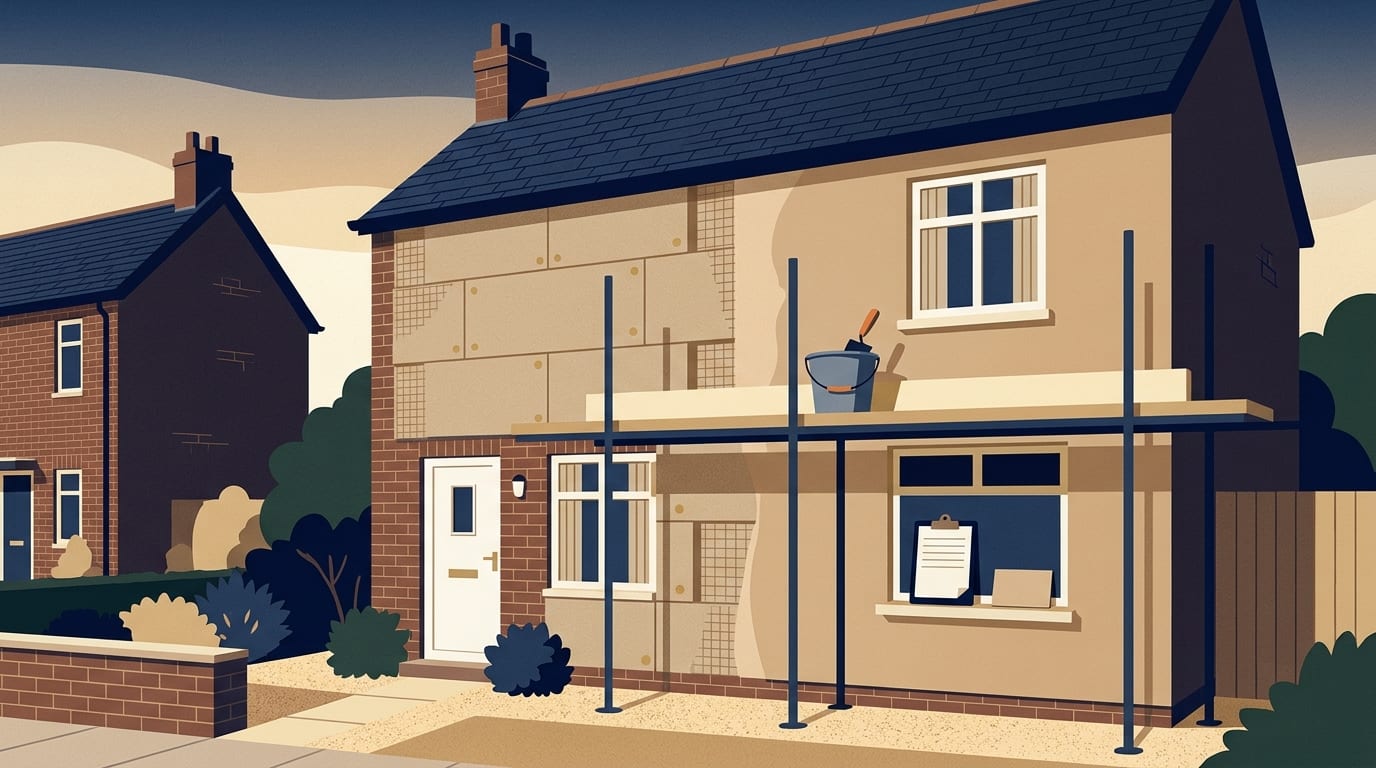
Render is priced per square metre, but scaffolding is often a separate line on the quote. You must check if your total price includes the scaffold hire or if you need to arrange it yourself. Quotes that omit scaffolding will look artificially cheap.
A common mistake that goes wrong is applying gypsum or cement on old lime walls. Always ensure the quote specifies the correct materials for your property age.
Why prices differ by region and working out the square metre rate
Location is a major factor in the cost of hiring a plasterer. London and the South East cost more than the rest of the country. Plasterer day rates are £150 to £250 across most of the UK, and £250 to £450 in London and the South East. Overall, being in London and the South East adds 15 to 25 per cent to the cost of a job.
Plasterers price per job after seeing it, based on the area in square metres, the state of the background, ceiling height and access. The table below outlines the square metre costs for different methods.
|
Type of plastering work |
Typical price per square metre |
|---|---|
|
Skimming |
£8 to £15 |
|
Board and skim |
£20 to £40 |
|
Backing coat on bare walls |
An extra £10 to £20 |
These are typical 2026 figures, and local quotes will differ based on the specifics of your property.
When you look at the total bill, the costs break down into three main areas. Labour makes up 55 to 65 per cent of the budget. Materials account for 15 to 25 per cent, and waste removal makes up 3 to 8 per cent.
Trade schemes regulations and your protections
When assessing the tradespeople who provided your quotes, you should know how the industry is regulated. Plastering is not a licensed trade. There is no legal register like the one for gas engineers, so evidence of past work matters. A CSCS card is for construction sites, not proof of quality on domestic work. FIS is the trade body for the finishes and interiors sector, and TrustMark is the government-endorsed quality scheme.
Planning rules matter for external work. In England, rendering needs no permission if materials are of similar appearance to the existing house, but it does in conservation areas, National Parks, Areas of Outstanding Natural Beauty and the Broads. Listed buildings need consent for any significant work, inside or out. Conservation bodies advise repairing original lime plaster where possible and replacing like for like. If unsure, check with your council.
Building regulations normally apply where 25 per cent or more of an external wall is re-rendered, re-plastered or re-lined internally. The wall's insulation would normally have to be improved.
Finally, the HSE says textured coatings such as Artex may contain asbestos in any building built or refurbished before 2000. Work on them does not normally need a licensed contractor but must be done by people trained to work safely with asbestos. Homeowners should not sand, scrape or drill suspect coatings and should tell tradespeople about them before work starts.
Deposits, payment and the contract
Once you have chosen a quote, formalise the agreement. You should always try to get a contract in writing. It should cover the timings, tidying up, materials, equipment, subcontractors and payment details.
Do not agree to more than 25 per cent as an upfront deposit, and make sure the final payment is only due when you accept the finished work. Pay by debit or credit card if you can.
You might be able to cancel within 14 days of agreeing a contract. However, if work starts in that time, you might have to pay for some or all of it.
When the job is complete, you should check the finish before paying the final balance. Look across the walls with a light to check for a flat, even surface, and ensure the plaster is completely dry before you attempt to decorate.
A checklist to compare three quotes
Before you sign a contract, put your three written quotes side by side and use this checklist. If any document is missing these details, ask the plasterer to update it so you can compare them fairly.
- Does the document give a fixed total price rather than a daily rate
- Is there a full breakdown of the work and materials
- Does it clearly state whether VAT is included in the total
- Does the price cover the removal of existing plaster and waste disposal
- Are travel and parking costs explicitly included
- Does it state how long the price is valid for
- Is the expected completion time written down
- Are the payment method and schedule clearly defined
Common questions
What happens if the plastering finish is poor?
Under the Consumer Rights Act 2015, work must be done with reasonable care and skill. If the finish is poor and the plasterer cannot or will not put it right, you can seek a partial or full refund. You should gather paperwork and receipts and take photos as evidence, and contact Citizens Advice for guidance on disputes.
Why are some quotes single round numbers?
A quote that just gives a single round number may be an estimate rather than a fixed price, and it does not show what is included. You should ask for an itemised breakdown so you know exactly what is included.
How long before I can decorate new plaster?
New plaster needs time to dry completely before you can paint or wallpaper over it. Thicker coats take longer to dry. Ask the plasterer when it is ready, and wait for an even, uniformly light colour before painting.
Does cheap plastering mean bad plastering?
Not always, but a very cheap quote can leave out preparation or extras like waste removal, so check what each quote covers. Skimming over loose, damp or unsealed painted surfaces causes the new coat to crack or peel.
Your next steps for hiring a plasterer
Comparing quotes is straightforward when you know exactly what the job involves and what a professional breakdown looks like. Take these final steps to secure the right tradesperson for your home improvement project.
- Invite three different plasterers to view the room in person to assess the background
- Ask each one to quote for the exact same level of work, whether that is a skim or a full replaster
- Request a written quote with a fixed total price, validity period and a clear breakdown of materials
- Confirm who is responsible for removing radiators, stripping wallpaper and supplying the plasterboard
- Check the public register to ensure they are a registered waste carrier if they are taking rubbish away
- Ask for a written contract and agree to an upfront deposit of no more than 25 per cent
Once you know exactly what your project requires and what should be included in a written contract, you can find a plasterer near you and request your three quotes.
Find a top rated plasterer near you
1,036 plasterers across the UK, each ranked on their Google rating and the number of reviews behind it. Start with your county: