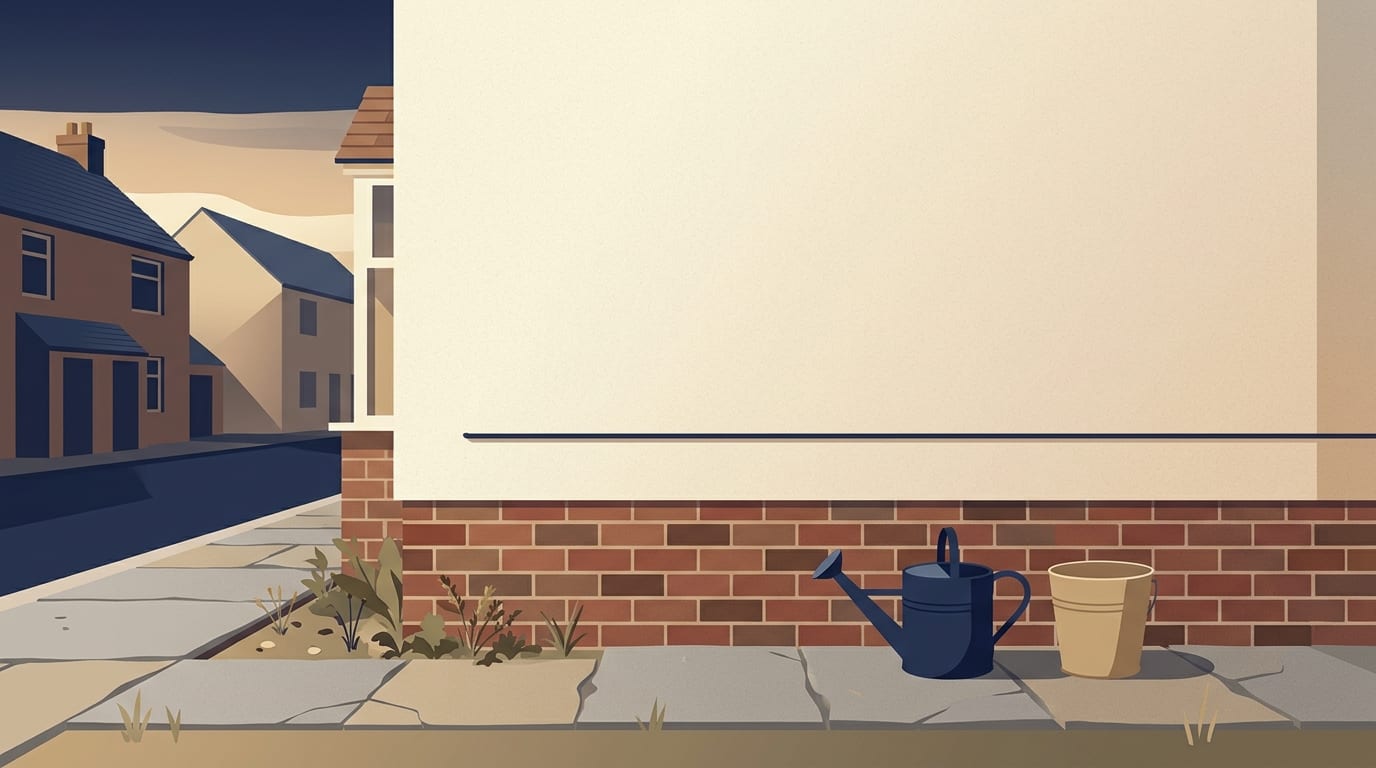
A damp proof course is a horizontal barrier built into your walls to stop ground moisture from rising through the masonry. If you apply exterior render right down to the ground, the render covers this barrier and gives the moisture a direct route around it. This creates a bridge for the damp, which can then travel up the wall and damage the plaster inside your home.
What a damp proof course does
A damp proof course is a physical layer designed to block water from moving up through your brickwork or blockwork. Ground water naturally wants to soak upwards through porous building materials. Without a barrier to stop it, this moisture will climb up the walls and eventually reach the inside of your home.
The barrier is usually a strip of plastic or bitumen felt built into the mortar joint between the bricks. In older houses you might find a layer of dense engineering brick or slate instead. Whatever material is used, its job is to draw a permanent line that water cannot cross.
The rules for where this barrier should sit are clear. Building Regulations Approved Document C (the version for England) states that an external wall will meet the requirement if built with a damp proof course, and that this course should be at least 150mm above the level of the adjoining ground.
The same rule applies if you are adding to your home. A government question and answer document on Part C of the regulations confirms that you will need to provide a damp proof course in extension walls at least 150mm above ground level. This must comprise impervious sheet material, engineering brick or slates in suitable cement mortar or equivalent materials.
How render can bridge the damp proof course
External render is a coating applied to the outside of a house to protect the brickwork and improve how it looks. You might choose traditional sand and cement, a lime render, pebbledash, monocouche, or a thin-coat acrylic or silicone system. K Rend is a manufacturer's brand name that is often used loosely to mean any silicone render. Whichever finish you choose, the rules about moisture remain exactly the same.
When a house is rendered, the coating should not run all the way down to the soil, patio or driveway. If the render crosses over the damp proof course and reaches the ground, moisture can get into the bottom edge of the render and travel upwards.
Because the render sits on the outside of the damp proof course, the moisture bypasses the barrier completely. Once the water travels higher than the barrier, it soaks back into the bricks or blocks and moves through to your internal walls. This process is known as bridging.
The Property Care Association lists bridging plaster render among the causes of bridging, along with raised ground levels and debris in the cavity. When the barrier is bypassed in this way, damp patches can start to appear on interior walls.
Why ground level matters just as much
Sometimes the render was applied correctly, but the environment around the house has changed. If you raise the ground level outside your home, you can accidentally create a bridge for moisture to cross.
Which? advises that a damp proof course is a horizontal strip built into the wall at least 15cm above ground level. Where the damp proof course is below ground level, you must ensure the ground level is at least 15cm below the damp proof course.
A damp proof course can also be bridged by landscaping. A new patio, a raised flower bed or a raised path against the house can bring the ground level too high. If the new paving sits above the damp proof course and touches the render, the moisture has a direct route into the wall.
This means you must check the ground levels around your entire property before you start looking at house rendering costs. If ground levels are too high, applying new render will not solve a damp problem.
The table below shows the common ways a damp proof course is bridged and how the moisture bypasses the barrier.
This table outlines the causes of bridging listed by the Property Care Association. Local site conditions will differ.
|
Cause of bridging |
How it bypasses the barrier |
|---|---|
|
Bridging plaster render |
Exterior coating runs past the barrier and touches the ground |
|
Raised ground levels |
New paving or soil is built up higher than the barrier |
|
Debris in the cavity |
Debris in the wall cavity can span the barrier |
Signs that exterior render is bridging the damp proof course
Because the moisture enters low down on the wall, signs tend to appear on the ground floor, just above the skirting boards.
You might notice damp patches that never seem to dry out, or a visible tide mark running horizontally along the wall. The moisture often brings natural ground salts with it. As the wall tries to dry, these salts are left behind on the surface, looking like a fluffy white powder.
- Damp patches appearing on internal walls just above the skirting board
- Horizontal tide marks visible on the paintwork or wallpaper
- Fluffy white salts forming on the surface of the plaster
- Wallpaper peeling or curling away from the bottom of the wall
Salts left on the surface can spoil the internal skim, which is the thin finishing coat of plaster applied over sound backing plaster or plasterboard, so it is worth having the cause diagnosed before redecorating.
Why bridging is often mistaken for other damp
Bridging can look like other kinds of damp, and it is often misdiagnosed. A wrong diagnosis can mean money spent on treatments that do not deal with the real cause.
Oxford City Council notes in its housing damp and mould policy that there are many cases of bridging dampness from render systems going below the damp proof course to ground level. The council policy also lists bridging among the causes that are often misdiagnosed as other types of damp.
If a contractor tells you that your damp proof course has failed and you need a chemical injection, you should always check the outside of the wall first. If the render runs straight into the soil or the patio is built up high, the bridge needs dealing with, and a specialist should confirm the diagnosis.
Because bridging is often misdiagnosed, an accurate diagnosis by a specialist is the best approach before you agree to expensive internal treatments.
How a good render job stops short of the ground
A good renderer keeps the exterior finish clear of the ground, stopping the render above the damp proof course and leaving a visible gap between the bottom of the render and the soil or paving.
No official source states exactly how high above the damp proof course the render should stop. The renderer and the system manufacturer's instructions set this specific detail, and you should ask for it in writing before the work begins.
To create a clean, straight edge at the bottom of the wall, the tradesperson will install a metal or plastic strip before applying the render. Manufacturer guidance states that render beads, also known as render stop beads, give a neat, bell cast lower edge to external finishes.
A bell cast edge flares outwards slightly at the bottom and helps to protect the masonry from run-off water. Using the right stop beads and angle beads is a clear sign that the tradesperson understands how to manage moisture.
What to check before rendering your house
Before you hire a firm to render your home, you must check the current condition of your walls and understand the rules that apply to your project. Plastering and rendering are not licensed trades, meaning there is no legal register like the one for gas engineers. Evidence of past work and a solid understanding of building rules matter greatly.
You must check if your project falls under building regulations. Where 25 per cent or more of an external wall is re-rendered, re-plastered or re-lined internally, the regulations normally apply. Under these rules, the wall's insulation would normally have to be improved at the same time.
You also need to check your planning permission status. The Planning Portal sets out clear guidelines for homes in England. Replacing existing render with a similar finish will not require planning permission as it is considered permitted development.
However, changing the type or colour of the render is likely to change the external appearance. If you live in a Conservation Area, National Park, Area of Outstanding Natural Beauty or the Broads, you must apply for planning permission before cladding with render. Listed buildings need listed building consent for any significant works, inside or out. Conservation bodies advise repairing original lime plaster where possible and replacing it like for like.
The table below shows how planning rules apply to different rendering projects.
This table outlines the Planning Portal's guidance for England. Check with your council if you are unsure or live elsewhere.
|
Situation |
Planning permission status |
|---|---|
|
Replacing render with a similar finish |
Considered permitted development |
|
Changing the type or colour of render |
Likely to change appearance, check with council |
|
House in a Conservation Area or National Park |
Must apply for planning permission before cladding |
|
Rendering a listed building |
Needs listed building consent for significant works |
What to do if you already have bridging damp
If you have found damp patches inside your home and suspect the exterior render is causing a bridge, you must address the outside before fixing the inside. Do not waste money decorating over the damp patch, as the moisture will simply push through the new paint.
The Property Care Association advises that if bridging is the cause, removing the bridge should hopefully be sufficient. This means the connection between the ground and the render above the damp proof course must be broken.
If the damp proof course has failed rather than been bridged, the association says you should consult a qualified damp specialist and arrange a survey. Because bridging looks so much like rising damp, a specialist survey is the safest way to know exactly what is happening inside your walls.
Do not attempt to cut back the render or dig out the ground yourself. Leave it to a professional, who can remove the bridge without damaging the damp proof course. If old render is being hacked off, the trader who carries the waste away must be a registered waste carrier, and this register is public.
Once the bridge is removed, the wall will need time to dry out. You may need some internal repair work if the finish has been damaged. This can involve a replaster, which means hacking off the failed plaster and applying a backing coat plus a finish coat, or fixing new plasterboard and skimming it. If your home was built or refurbished before 2000 and has textured coatings like Artex, the Health and Safety Executive says these may contain asbestos. Work on them must be done by people trained to work safely with asbestos, and you should never sand, scrape or drill suspect coatings yourself.
Questions to ask your plasterer or renderer
When you are ready to hire a professional to apply exterior render or handle replastering after damp, you need to ask the right questions. A good tradesperson will price the job after seeing it, basing their figures on the area in square metres, the state of the background, and the preparation required.
Ask them exactly how they plan to detail the bottom edge of the render. They should be able to explain how they will find the damp proof course, how they will keep the render above it, and what type of bell cast stop bead they will use.
Under the Consumer Rights Act 2015, work must be done with reasonable care and skill. If it is not, the customer can ask for it to be put right or seek a partial or full refund. To protect yourself, Citizens Advice suggests getting three written quotes, a written contract, and paying deposits of no more than 25 per cent. They also advise paying by card, and note that you might be able to cancel within 14 days of agreeing a contract.
- How will you locate the damp proof course before starting work?
- What distance above the barrier will the render stop, based on manufacturer instructions?
- Will you install a bell cast render stop bead at the bottom edge?
- Is the cost of scaffolding included in the final price?
- Are you a registered waste carrier, and is waste removal included?
- Is this document a fixed price quote or just a rough estimate?
- Does the price include VAT, materials and protecting the ground?
Common questions
Does all exterior render cause damp?
No, exterior render does not cause damp on its own. It is designed to protect your home from the weather. Render can contribute to damp if it bridges the damp proof course by running down to the ground.
Can you fix bridging damp from the inside?
Bridging damp has to be dealt with at its source outside the house. If bridging is the cause, removing the bridge should hopefully be sufficient, and a specialist can confirm that. Once it is removed, let the wall dry and then repair the internal plaster.
Does K Rend cause damp problems?
K Rend is a manufacturer's brand name often used loosely for silicone render systems. Like any render, it can contribute to damp if it is allowed to bridge the damp proof course, so the same detail at the bottom edge applies.
Do building regulations apply to re-rendering?
Yes, if you are re-rendering a large area. Where 25 per cent or more of an external wall is re-rendered, the building regulations normally apply. When this happens, the wall's insulation would normally have to be improved.
Next steps for your rendering project
Fixing a bridged damp proof course or planning a new render job requires careful preparation. If you suspect your render is causing damp, or you want to ensure a new finish is applied correctly, follow these steps to protect your home.
- Walk around your house and locate the physical damp proof course in the brickwork.
- Check if any existing render, patios, or soil levels cross over this barrier.
- If you find a bridge, hire a specialist to remove it safely without damaging the wall.
- Wait for the internal walls to fully dry before paying for any replastering inside.
- Ask three different firms for a written quote that details exactly how they will finish the bottom edge.
- Check that scaffolding, waste removal, materials and VAT are all listed on the quote.
When you are ready to get fixed prices from professionals who understand how to protect your home from moisture, you can find a plasterer near you.
Find a top rated plasterer near you
1,036 plasterers across the UK, each ranked on their Google rating and the number of reviews behind it. Start with your county: