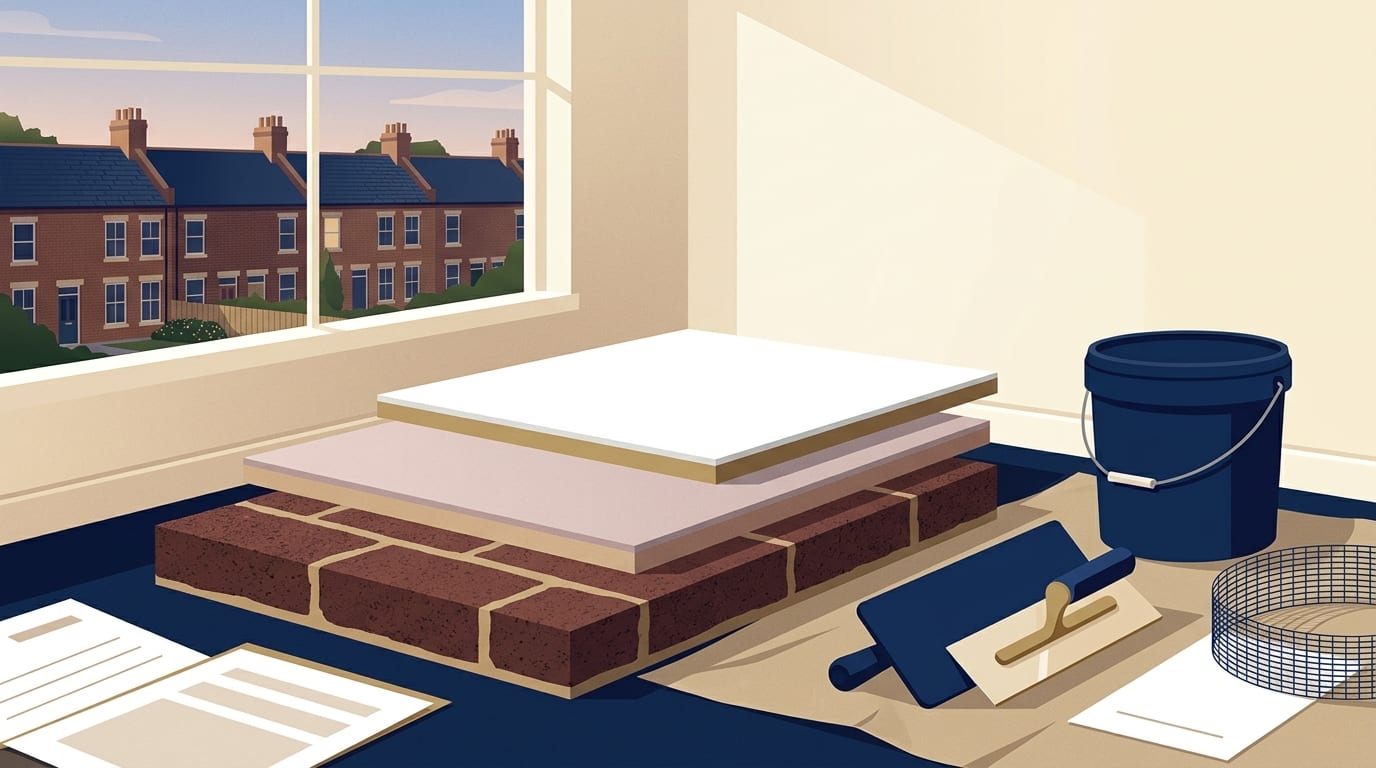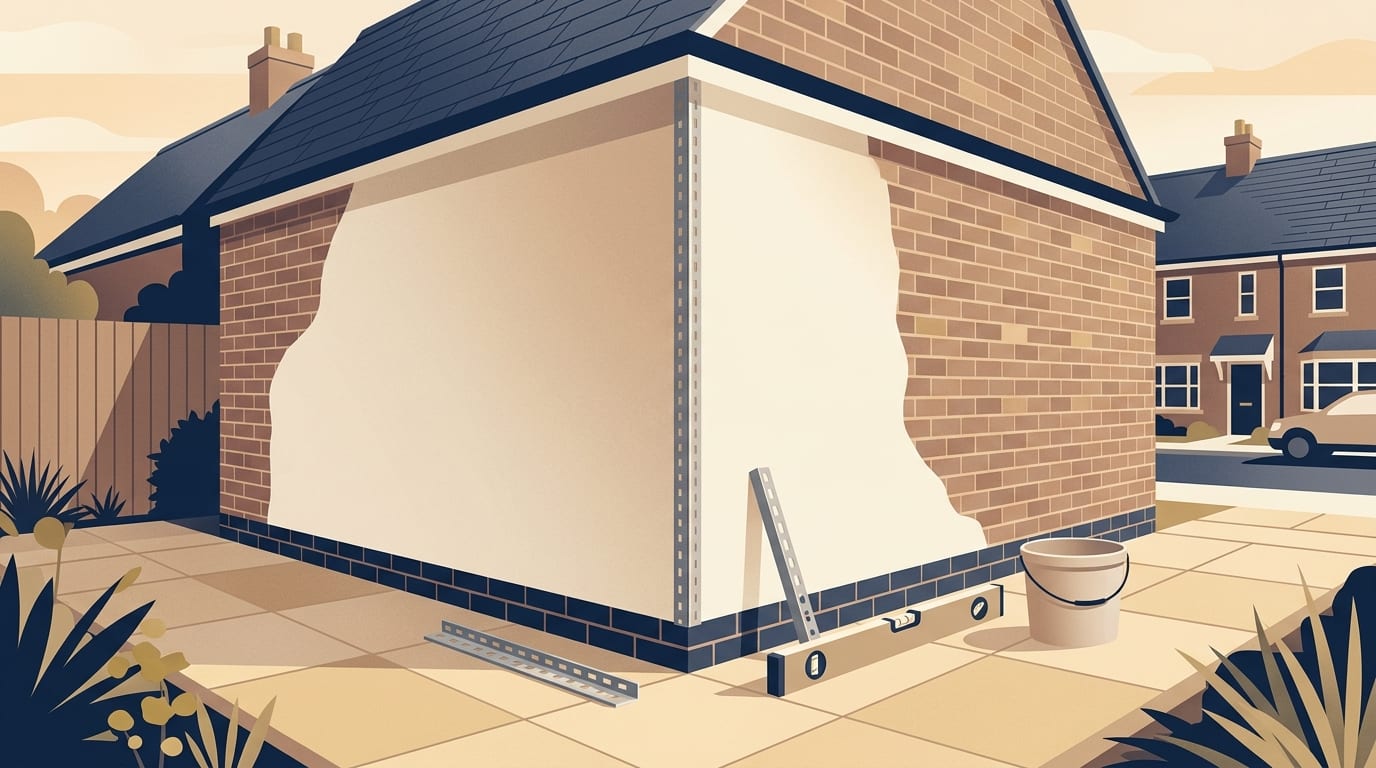
A bead is a metal or plastic trim fixed to a corner or edge before plastering so the plaster has a straight, protected finish. They give the plasterer a straight line to work to. A skim is a thin finishing coat, a few millimetres thick, applied over sound plaster or plasterboard. An undercoat is a thicker backing layer used to build up bare brick or blockwork. Render is a durable external coating applied to outside walls to protect the masonry from the weather.
Plasterers fix beads to the wall to create a sharp boundary for the wet plaster to sit against. Beads appear on your quote because they dictate how crisp and durable your corners and edges will be once the paint is applied.
You will see beads used whether you are having a simple skim or a full replaster. A replaster means hacking off failed plaster and applying a backing coat plus a finish coat. Alternatively, it means fixing new plasterboard and skimming it, which tradespeople call a board and skim. Plasterers also use beads when installing dot and dab, which is plasterboard stuck on dabs of adhesive, or when overboarding, where new plasterboard is fixed directly under an old ceiling.
Angle beads for external corners
Angle beads provide true and straight corners which are resistant to chipping and cracking. You use angle beads on walls that require both undercoat and skim coats to reinforce the heavy joint. Conversely, skim beading is enough where only a thin skim layer is applied. Stronger, more rigid beads make straight edges easier to achieve and waste less plaster during the application.
Corners should not be plastered without beading. If you leave a corner exposed without a metal or plastic trim, everyday knocks from moving furniture or vacuum cleaners can chip or crack the plaster edge. Angle beads give corners resistance to chipping and cracking.
When you hire a professional to carry out skim plastering or a full replaster, they will assess every external corner in the room. The plasterer chooses the type of bead for each corner and edge.
Stop beads where plaster ends
Stop beads provide clean, neat edges at openings or abutments onto other wall surfaces or ceiling finishes. A stop bead can be used where plaster meets a door frame, a window reveal or another wall surface, giving the plaster a clean, straight edge.
Where plaster finishes against a ceiling or another surface, a stop bead gives a clean, neat edge.
In older houses, you may meet lath and plaster, which is traditional lime plaster pushed onto timber laths. If your ceiling has a textured coating instead, extreme care is needed before any work is done near it. The Health and Safety Executive says textured coatings such as Artex may contain asbestos in any building built or refurbished before 2000.
Work on these ceilings does not normally need a licensed contractor but must be done by people trained to work safely with asbestos. Homeowners should not sand, scrape or drill suspect coatings and should tell tradespeople about them before work starts. Dry sanding or scraping Artex is highly dangerous. If you are unsure what a coating is, a professional asbestos survey is the way to find out, not a home test.
Render beads and other trims
Render beads, often called a renderstop, give a neat, bell cast lower edge to external finishes. A bell cast profile flares outward at the bottom and helps protect the masonry from run-off water. External render comes as sand and cement, lime, pebbledash, monocouche and thin-coat acrylic or silicone systems. K Rend is a manufacturer's brand name often used loosely for silicone render, but the requirement for a render bead remains the same regardless of the brand.
Beyond angle and stop beads, plasterers use several other specialised trims. Movement beads allow minor movement between surfaces, which helps prevent cracking. Depth gauge beads help ensure a consistent minimum plaster thickness across an uneven wall. Architrave beads create a decorative shadow gap around doors and windows, while arch beads bend to create curves and arch forms.
When planning external work involving render beads, remember that in England rendering needs no planning permission if materials are of similar appearance to the existing house. However, it does require permission in conservation areas, National Parks, Areas of Outstanding Natural Beauty and the Broads. Listed buildings need consent for any significant work, inside or out. Conservation bodies advise repairing original lime plaster where possible and replacing like for like. Using gypsum or cement on old lime walls traps moisture and causes the finish to fail.
Choosing between galvanised, stainless steel and PVC
The plasterer chooses the bead for the plaster and the room based on the manufacturer's guidance. The material you need depends on moisture levels and whether the work is inside or outside.
The table below shows where different bead materials are designed to be used.
|
Bead material |
Best environment |
Manufacturer guidance |
|---|---|---|
|
Galvanised steel |
Internal plasterwork |
The zinc coating protects the steel from corrosion but is generally unsuitable for use in exterior areas. |
|
Stainless steel |
External use and higher moisture areas |
Suited to external use and internal areas with higher moisture, but not suitable internally with gypsum based plasters. |
|
PVCu |
Damp or coastal conditions |
Recommended for applications with the most challenging environmental conditions both externally and internally. Unaffected by moisture, salt and weathering. |
These are manufacturer statements, and the plasterer chooses the bead for the plaster and the room.
Why plasterers use beads
Beads help achieve a crisp, neat, durable finish that stands the test of time. Depth gauge beads help ensure a consistent minimum plaster thickness.
Stronger, more rigid beads make straight edges easier to achieve and waste less plaster.
Corners should not be plastered without beading under any circumstances. Without a bead, the result can be chipped corners, cracks and uneven edges.
Where beads can go wrong
Leaving out beads can lead to chipped corners, cracks and uneven edges. Even when beads are used, poor technique can cause problems. When fixing a stop bead, the plasterer must wipe any surplus plaster from corners before it sets.
Scraping the plaster away later may damage the zinc coating on the metal, which is why surplus plaster is wiped away before it sets.
Other common plastering failures happen long before the bead is fitted. Skimming over loose, damp or unsealed painted surfaces means the new coat will crack or peel away from the wall. Using gypsum or cement on old lime walls traps moisture and can damage the finish. Cash-only deals with nothing in writing leave you with little to go on if these defects appear.
Rules and protections for your project
Plastering is not a licensed trade. There is no legal register like the one for gas engineers, so evidence of past work matters greatly. A CSCS card is for construction sites, not proof of quality on domestic work. The trade body for the finishes and interiors sector is FIS, and TrustMark is the government-endorsed quality scheme.
Building regulations apply to some plastering work. Where 25 per cent or more of an external wall is re-rendered, re-plastered or re-lined internally, the regulations normally apply and the wall's insulation would normally have to be improved.
Under the Consumer Rights Act 2015, work must be done with reasonable care and skill. If not, the customer can ask for it to be put right or seek a partial or full refund. Citizens Advice suggests getting three written quotes, a written contract, paying deposits of no more than 25 per cent and paying by card. They also note you might be able to cancel within 14 days of agreeing a contract. For any disputes, you should consult Citizens Advice.
What to look for on a quote
Plasterers price per job after seeing it, based on the area in square metres, the state of the background, ceiling height and access. The cost also depends heavily on preparation, such as stripping wallpaper, removing loose plaster, sealing painted surfaces, and dealing with Artex. Ceilings are usually priced separately and small jobs carry a minimum charge.
External render is priced per square metre, with scaffolding often appearing as a separate line. London and the South East cost more. Quotes that omit preparation, ceilings, scaffolding or waste are a common reason jobs go wrong and costs spiral. A quote is a fixed price, while an estimate is a rough guess.
There is no reliable published source for the cost of individual beads, so no guide prices are given here. Beads normally sit inside the main plastering price, but you should ask whether they are included. If you are unsure about a price, you can read more about how to compare plastering quotes and spot what is missing.
A thorough written quote should list:
- Whether VAT and all materials are included in the final price.
- If waste removal is covered by a registered waste carrier, as the register is public.
- Whether floor protection is provided for the duration of the work.
- If scaffolding is priced separately for external render jobs.
- Whether preparation work like stripping wallpaper or sealing painted surfaces is included.
Questions to ask your plasterer
Asking the right questions before you hire a plasterer helps you check what you are paying for. Use this list to check they understand the materials required for your walls.
- Which beads will you use and where will they go on the walls.
- What material the beads are made from and why that suits the room.
- Whether the cost of all beads and mechanical fixings is included in the price.
- How the edges at doors, windows and skirting boards will be finished.
Common questions
What is a plaster stop bead used for?
A stop bead provides a clean, neat edge at openings or abutments onto other wall surfaces. You use them around door frames, window reveals, or where wet plaster meets an exposed brick wall to create a sharp boundary.
Can you plaster a corner without a bead?
Corners should not be plastered without beading. Without a metal or plastic trim to reinforce the joint, the plaster edge will be highly vulnerable to cracking and chipping from everyday knocks.
Do you need a bead for skimming?
Skim beading is enough where only a thin skim layer is applied. Angle beads are used on walls that receive both an undercoat and a skim coat.
What happens if you use the wrong metal bead?
The manufacturer says galvanised steel is generally unsuitable for exterior areas, and that stainless steel beads are not suitable for internal use with gypsum based plasters.
Next steps
Before you agree to a price or pay a deposit, take the time to check exactly what your tradesperson is providing. A detailed quote makes hidden costs less likely.
- Check your quotes to confirm that beads, materials, waste removal and floor protection are included.
- Ask your plasterer which bead materials they plan to use and why they are suitable for your walls.
- Have any suspect textured coating checked through a professional asbestos survey before work begins.
- Get three written quotes and a written contract before paying a deposit.
Taking the time to understand the trims and materials on your quote helps you judge the job, and when you are ready to start your project, you can find a plasterer near you to assess your walls and price the work accurately.
Find a top rated plasterer near you
1,036 plasterers across the UK, each ranked on their Google rating and the number of reviews behind it. Start with your county: