In most cases you can plaster over a painted wall, provided the paint is sound and firmly stuck to the surface beneath. You cannot plaster over wallpaper, which must be stripped completely before any skimming can happen. A professional plasterer will look at your walls and decide the right preparation on site.
Plastering over sound painted walls
A skim is a thin finishing coat, a few millimetres thick, applied over sound plaster or plasterboard. If your painted walls are solid, the plasterer can apply this thin coat directly. The old paint acts as the background for the new plaster.
If the paint is flaking or peeling, the answer is no. You cannot skim over loose, damp or unsealed painted surfaces, because the new coat will crack or peel. The old paint provides the anchor for the new plaster. If that anchor is weak, the heavy, wet plaster will simply pull the failing paint away from the wall.
To prevent this, plasterers will scrape the wall to remove any loose or flaky areas before they start. They need to get back to a solid, stable edge. If the entire wall is peeling, the surface preparation will take much longer, and the plasterer will price the job accordingly after seeing it.
How plasterers test and prepare painted walls
Plasterers price per job after seeing it, based on the area in square metres, ceiling height, access, and the state of the background. To check the background, they need to know exactly how well the old paint is bonded. A decorator suggests testing for loose paint by sticking a piece of tape over the mark and pulling it off quickly. If the paint comes away on the tape, it is loose and must be scraped off.
If your walls are covered in glossy or silk paint, the surface is often too smooth for new plaster to grip. Plasterers usually sand the walls down to dull the finish and create a textured key. This helps the new plaster grip.
Once the loose paint is gone and shiny surfaces are dulled, plasterers use a bonding product or a suitable sealing treatment. Tradespeople differ on the bonding method. Some use PVA, which is a liquid adhesive painted onto the wall. However, one plasterer says many now avoid relying on PVA over painted walls because it can fail if the timing or moisture is not right.
Instead of PVA, other plasterers name an SBR bonding product or a grit-based product, which provides a rough, textured surface for the new plaster to grab. Because opinions and techniques vary, you should always let your plasterer choose the bonding method and not tell them how to do it.
Why wallpaper always has to come off
Wallpaper needs to be stripped before any skimming can be done. You cannot plaster over it to save time or money. This is why plasterers ask for it to come off before any skim goes on.
Every layer of paper has to come off before the plasterer starts.
Stripping wallpaper is a tedious job, and plasterers will charge for it if you ask them to do it. Typical published prices for 2026 show that stripping wallpaper on a single wall costs between £40 and £120. Stripping a large room costs between £300 and £600.
If a ceiling is covered in stubborn woodchip wallpaper, a plasterer may suggest overboarding instead of stripping. Overboarding is new plasterboard fixed directly under an old ceiling. The new boards create a flat, clean surface ready for a skim, completely burying the old paper.
Dealing with Artex and textured coatings
Textured coatings have had various trade names over the years, such as Artex, and some homes still have them.
The Health and Safety Executive states that asbestos may be part of any commercial or domestic building which was built or refurbished before the year 2000. If asbestos in good condition is strongly suspected, the advice is to leave it in place and check it periodically.
Homeowners should not attempt repairs or removal themselves without training. You must not dry sand, scrape or drill suspect coatings. If you are hiring a professional, you should tell any builders or contractors about asbestos before they start work.
The official guidance is that work on textured coatings is low-risk and can be carried out by non-licensed workers. However, they must be trained to recognise and work safely with asbestos. Large-scale removal using steaming or gelling methods requires notification as non-licensed work. Removal using energetic methods such as wet abrasive blasting needs a licensed contractor.
Because of these safety rules, Artex work costs extra and the plasterer must see the job to price it. Never try to sand a textured ceiling yourself to save money on preparation.
What the preparation adds to a quote
A plastering quote is built on the preparation required. Surface preparation is normally included in a quote, but removing stubborn materials or clearing the room will increase the final bill. Ceilings are usually priced separately and small jobs carry a minimum charge.
Plastering is a messy job that creates dust and disruption. If your room needs clearing, radiators taking off the walls, or minor holes fixing before the walls can be skimmed, these tasks take time. The table below shows what these preparation tasks typically add to your quote.
|
Preparation task |
Typical cost range |
|---|---|
|
Wallpaper stripping (single wall) |
£40 to £120 |
|
Wallpaper stripping (large room) |
£300 to £600 |
|
Minor repairs |
£100 to £300 |
|
Ceiling overboarding |
£400 to £1,000 |
|
Radiator removal and refitting |
£80 to £250 |
|
Furniture moving |
£50 to £100 |
|
Skip hire |
£60 to £130 |
These figures are typical published prices for 2026. Local quotes will differ based on your specific job, and London and the South East cost more.
When you look at your quote to calculate the cost to plaster a room, check whether VAT, materials, waste removal and floor protection are included. If a trader carries your waste away, they must be a registered waste carrier, and the register is public.
When replastering beats skimming
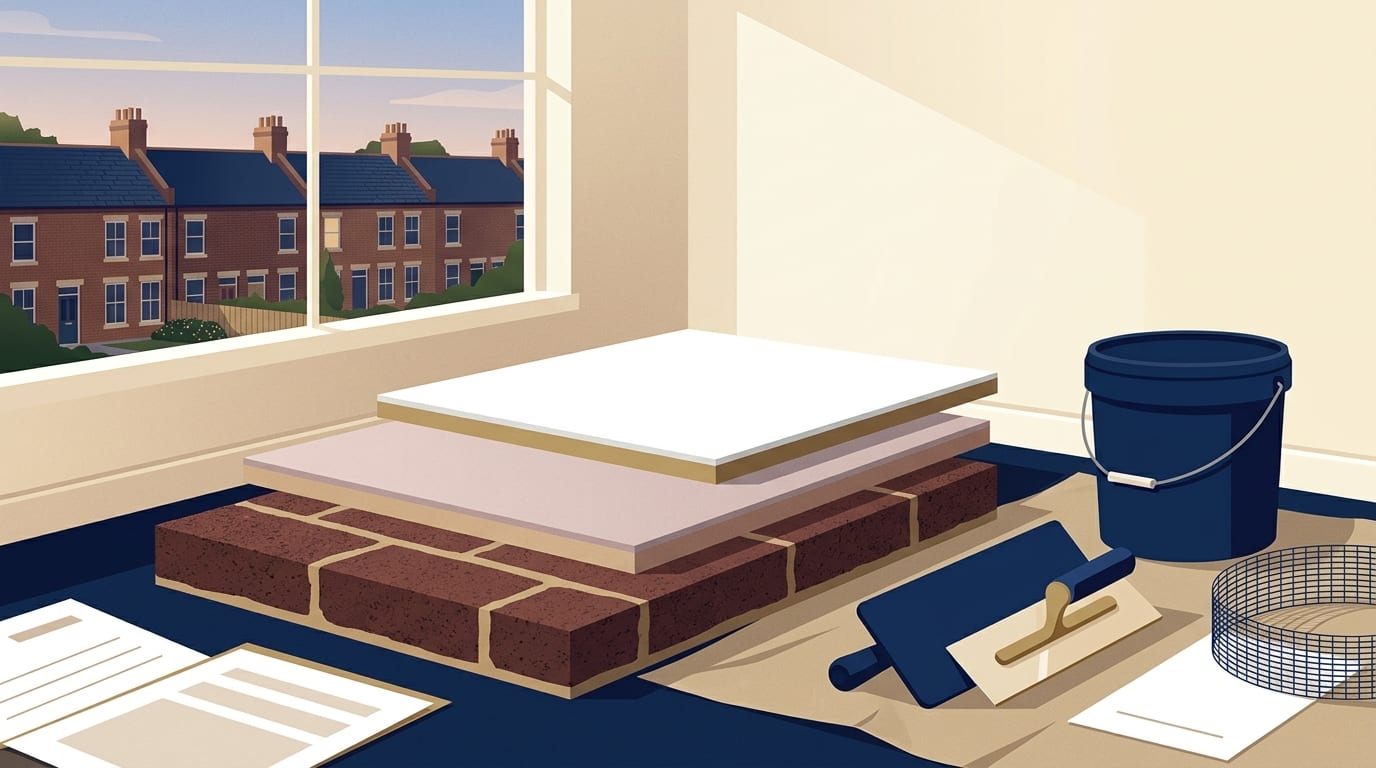
Sometimes a painted wall is in such poor condition that a thin skim coat will not save it. If the old plaster is crumbling, blown, or blowing off the brickwork, you will need a full replaster. A replaster means hacking off the failed plaster and applying a thick backing coat plus a thin finish coat.
Alternatively, the plasterer might fix new plasterboard to the bare masonry and skim it, which is known as board and skim. Plasterboard can be stuck directly to the walls on dabs of adhesive, a method called dot and dab.
If you are working on an older house, you might find lath and plaster behind the paint. This is traditional lime plaster spread over timber laths. Conservation bodies advise repairing original lime plaster where possible and replacing it like for like. Modern gypsum plaster or cement on old lime walls is a common cause of problems, because it can trap moisture.
If you are dealing with exterior painted walls, the tradesperson will use external render rather than indoor plaster. External render comes in several different systems:
- Sand and cement
- Traditional lime
- Pebbledash
- Monocouche
- Thin-coat acrylic or silicone systems
You might hear builders mention K Rend, which is a manufacturer's brand name often used loosely for silicone render. Render is priced per square metre, with scaffolding often listed as a separate line on the quote.
Rules and protections for domestic plastering
Plastering is not a licensed trade. There is no legal register like the one for gas engineers, so evidence of past work matters greatly. A CSCS card is for construction sites, not proof of quality on domestic work. The trade body for the finishes and interiors sector is FIS, while TrustMark is the government-endorsed quality scheme.
If your project covers a large part of an external wall, building regulations might apply. Where 25 per cent or more of an external wall is re-rendered, re-plastered or re-lined internally, the regulations normally apply. Under these rules, the wall's insulation would normally have to be improved at the same time.
In England, according to the Planning Portal, rendering needs no planning permission if the materials are of similar appearance to the existing house. It does require permission in conservation areas, National Parks, Areas of Outstanding Natural Beauty and the Broads. Listed buildings need consent for any significant work, inside or out. If you live outside England, or if you are unsure, you should check with your local council.
Under the Consumer Rights Act 2015, all work must be done with reasonable care and skill. If a tradesperson leaves you with a wavy finish or cracked walls, they may not have met this standard. In these cases, the customer can ask for the work to be put right or seek a partial or full refund.
Questions to ask before the plasterer starts
Before you agree to any work, you need to know exactly what the tradesperson plans to do with your painted walls. A cash-only deal with nothing in writing leaves you with nothing to rely on if something goes wrong. Remember that a quote is a fixed price, while an estimate is just a rough guess.
Consumer groups suggest you try to get written quotes from at least three different traders before you decide on one. When the plasterer comes to view the job, ask them these questions:
- What surface preparation is included in this quote?
- How will you check the existing paint to see if it is loose?
- Who is responsible for stripping the wallpaper?
- Are ceilings, scaffolding and waste removal included in the final price?
- Will you use a bonding product over the paint before you skim?
Citizens Advice also recommends getting a written contract, paying deposits of no more than 25 per cent, and paying by card. You might be able to cancel within 14 days of agreeing a contract.
Common questions
How to plaster a painted wall
You should not attempt to plaster a painted wall yourself unless you are a trained plasterer. Plasterers usually scrape away loose paint, sand glossy or silk paint to dull it, and use a bonding product or a suitable sealing treatment, but methods vary and the plasterer chooses.
Can you plaster over backing paper?
Wallpaper needs to be stripped before any skimming can be done. Ask your plasterer on site what to do about lining paper.
What happens if you plaster over loose paint?
If a plasterer skims over loose, damp or unsealed painted surfaces, the new coat will crack or peel. The wet plaster relies on the old paint to hold it to the wall. If the paint fails, the heavy plaster falls off with it.
Do I need to wash painted walls before plastering?
Your plasterer will decide on site what preparation the walls need before skimming, including whether they need cleaning. Ask what preparation is included in the quote.
Your next steps
Getting a smooth finish over old paint requires careful preparation and the right bonding agents. If you skip the preparation, you will be left with a wavy finish you will see every day once it is painted, or a wall that cracks and peels.
To keep your project moving smoothly, follow this checklist before you hire a tradesperson:
- Agree who will strip any wallpaper, because it has to come off before skimming.
- Do not sand or scrape textured ceilings if your home was built before 2000.
- Let the plasterer test the paint and choose their own bonding method.
- Get three written quotes that clearly list the preparation work, waste removal and materials.
- Check the finish is smooth and flat in natural light before making your final payment.
Once the new skim coat is applied, you must allow it to dry before painting, and your plasterer will tell you how long to leave it. When you are ready to start your renovation, you can find a plasterer near you to test your walls and provide a detailed written quote.
Find a top rated plasterer near you
1,036 plasterers across the UK, each ranked on their Google rating and the number of reviews behind it. Start with your county: