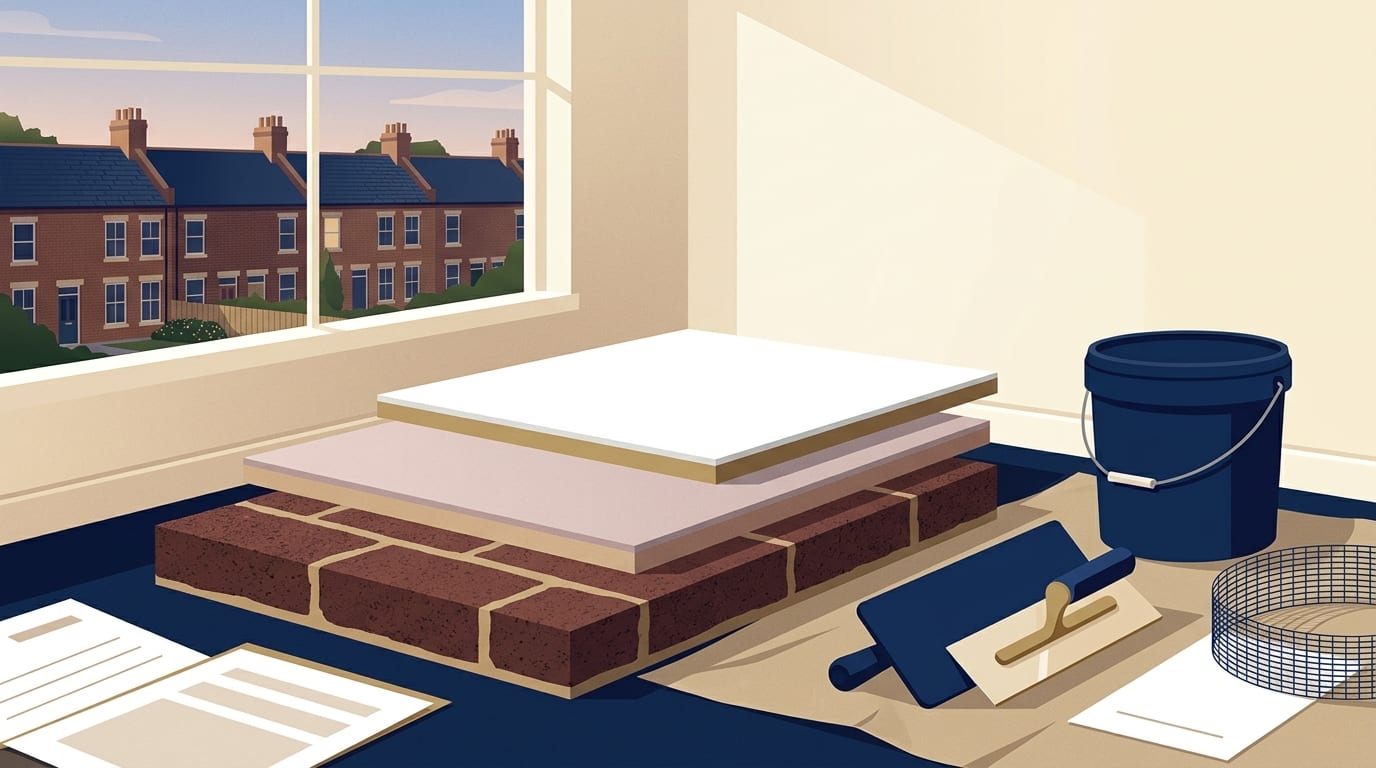
Both drywall and wet plastering end with the same smooth skim finish, so the real choice is what sits behind it. Wet plaster builds up layers directly on bare masonry, while plasterboard offers a faster route that requires less drying time. Your decision will come down to the condition of your walls, your budget and how quickly you need to decorate.
Two ways to finish a wall
When you are mid-renovation or fixing cracked walls, a sagging ceiling or tired render, you want a flat result. You will often hear one tradesperson tell you to board a wall and another tell you to wet plaster it. Both methods are designed to give you a smooth surface that is ready for paint or wallpaper.
The difference lies in how the plasterer builds out the wall before applying the final thin layer. This final layer is called a skim, which is a finishing coat a few millimetres thick applied over sound plaster or plasterboard. A full replaster means hacking off failed plaster and applying a backing coat plus a finish coat, or fixing new plasterboard and skimming it, which tradespeople often call board and skim.
Wet plastering is the traditional method used on solid masonry walls. The plasterer applies a thick backing coat of wet material directly onto the brick or block, followed by the top skim coat. Plasterboard skips the wet backing coat entirely.
Instead, rigid boards are fixed to the wall or timber stud work, and the plasterer then skims over the joints and the face of the boards. Overboarding is another common term you will hear, which means new plasterboard is fixed directly under an old ceiling before skimming. Whichever route you take, a wavy finish is something you will see every day once it is painted, so the skill of the person holding the trowel matters more than the method they use.
What wet plaster means
This method involves applying layers of wet material straight onto a brick or block wall. A plasterer will usually apply a backing coat to level out the masonry. Once this undercoat is firm, they apply a top skim coat to create a smooth finish.
Because it requires building up layers, wet plaster uses more material and takes more time than boarding. It introduces a lot of moisture into the room, which means you have to wait much longer before you can decorate. It is the traditional route on solid masonry, and it is built up in layers directly on the wall.
Which route suits better depends on the wall, so ask the plasterer to explain why they favour one over the other. If you are dealing with painted walls, preparation is vital. A common issue that goes wrong is skimming over loose, damp or unsealed painted surfaces so the new coat cracks or peels.
The plasterer must ensure the background is sound and properly sealed before any wet plaster is applied. Proper preparation includes:
- Stripping old wallpaper completely from the wall
- Removing loose or blown plaster back to the brickwork
- Sealing painted surfaces to give the new coat a proper key
- Fixing any underlying penetrating damp issues
If you are unsure whether your walls need to be taken back to brick, reading about skim plastering or a full replaster will help you understand the preparation required.
What plasterboard and skim means
Using plasterboard is a faster way to cover a wall because there is no wet backing coat to apply or wait for. The boards are screwed to a timber frame or stuck directly to masonry using dabs of adhesive, a method known as dot and dab. Once the boards are secure, the plasterer tapes the joints to prevent cracks and applies a thin skim coat over the whole surface.
This approach requires less labour from the plasterer, but supplying and fixing the plasterboard is often not included in a standard plastering quote. You should always ask your tradesperson if their price covers buying and fitting the boards. Fitting new plasterboard before skimming costs roughly £500 to £1,400 depending on the area.
When a plasterer quotes for this work, they will price it per job after seeing the area in square metres, the ceiling height, the access and the state of the background. Ceilings are usually priced separately. Quotes that omit preparation, ceilings or waste removal are a common trap for homeowners, so you must check exactly what is listed in writing.
Cost compared
Masonry costs more per square metre because it needs an undercoat and a finish coat, which takes more material and labour. Skimming plasterboard uses less material and takes less time. Small jobs also carry a minimum charge, and prices in London and the South East cost more.
This table shows typical costs for wet plastering directly onto masonry compared with skimming over plasterboard.
|
Method |
Cost per square metre |
Small room labour |
|---|---|---|
|
Wet plaster on masonry |
£25 to £40 |
£300 to £450 |
|
Skimming plasterboard |
£13 to £30 |
£200 to £300 |
These are typical 2026 prices, and your local quotes will differ based on the exact condition of your walls.
If your walls need extra preparation, replastering from scratch costs £25 to £40 per square metre. This rises to £35 to £55 per square metre where more preparation work is required. Always check whether VAT, materials, waste removal and floor protection are included in the price.
Other typical 2026 prices put boarding and skimming one room at £700 to £1,400. If you need to hack off the old plaster first, re-board and skim that same room, the price rises to £900 to £1,600. Skimming one room over sound plaster costs £350 to £700.
A Which? survey of nine Which? Trusted Traders in November 2025 found that plastering a medium room of about 3.3 metres by 3 metres costs £750 to £3,200. This price includes removing old plaster, dry lining and skimming. Re-skimming that same medium room costs £400 to £1,250. These specific medium-room figures exclude VAT and cover both labour and materials.
Time and drying compared
The time the tradesperson spends in your home varies based on the method and the size of the space. On masonry, a single wall takes half a day to one day, a small room takes one to two days, and a large room takes three to four days. Skimming the walls of a small room with plasterboard takes about one day.
For a medium room requiring old plaster removal, dry lining and skimming, the work will take three to four days in total. Simply re-skimming that same medium room takes two days.
Drying times also differ significantly between the two methods. Gypsum plaster sets within one to two hours, but setting is not the same as drying. It takes three to five days to dry, with full curing taking up to two weeks. Thicker coats take longer to dry, and wet plaster on masonry is built up from thicker coats than a skim over plasterboard.
Ask your plasterer how they want the room dried. Thicker coats take longer, so allow for that in your timetable.
You must wait for an even, uniformly light colour across the whole wall before you start painting. If you try to paint while there are still darker, damp patches, the plaster is not ready. Understanding how long plaster takes to dry helps you plan when to decorate.
Finish, sound and strength
Both drywall and wet plastering should leave you with a perfectly smooth finish ready for decoration. Before paying your plasterer, you should check the finish by shining a light across the wall to highlight any hollows, bumps or trowel marks. A skilled plasterer will leave a surface that feels like glass, whereas someone who just owns a trowel might leave ridges that require heavy sanding.
A plasterboard wall can sound different from a wet plastered wall when you knock on it, depending on what is fixed behind the boards.
The strength of the wall depends entirely on what sits behind the finish. If you plan to hang heavy items such as televisions or large radiators, tell the plasterer and the person fitting them what sits behind the finish so the right fixings are used.
Neither finish is inherently stronger or quieter unless the specific background structure or acoustic insulation behind the board makes it so. If you are building a new stud wall and want to reduce noise travel between rooms, you must tell the plasterer before they start. They can advise on what to put behind and in front of the frame.
Which suits your walls
The right choice often comes down to the condition of the underlying wall and the type of property you own. Plasterboard is commonly used on timber stud partitions and ceilings, where there is no masonry to plaster onto. It has no wet backing coat, so it is the faster route.
Wet plaster is the traditional route on solid masonry. Ask the plasterer whether the brickwork is flat enough for boards, and whether you can spare the thickness a board and its fixings add.
Keep in mind that building regulations might apply to your project. Where 25 per cent or more of an external wall is re-rendered, re-plastered or re-lined internally, the regulations normally apply. In these cases, the wall's insulation would normally have to be improved to meet current standards.
External walls and older homes
While drywall and wet plastering apply to the inside of your home, the outside of your walls is protected by external render. External render comes in several forms:
- Sand and cement render
- Traditional lime render
- Pebbledash finishes
- Monocouche coloured systems
- Thin-coat acrylic or silicone systems
You might hear tradespeople refer to K Rend, which is a manufacturer's brand name often used loosely for silicone render, rather than a specific method.
If you live in a house built before 1919, it was likely constructed with solid walls designed to let moisture pass through and evaporate. Inside the home, the plasterer should tell you whether a traditional lath and plaster ceiling or a lime plaster wall is the right choice. Lath and plaster is lime plaster on timber laths, commonly found in older houses.
Lime and clay plasters are porous and flex with the building, whereas modern cement and gypsum are impermeable and rigid. According to the Babergh and Mid Suffolk council, applying modern rigid materials to historic buildings can trap moisture and cause damp problems. Applying gypsum or cement on old lime walls is a common mistake that leads to failure.
The Society for the Protection of Ancient Buildings advises that old plasterwork is worth conserving wherever possible, and repair rather than replacement is commonly possible. Old plaster is often inappropriately replaced with gypsum-based products, so discuss breathable options before agreeing to standard wet plaster or plasterboard. You can read more about choosing lime or gypsum plaster if you own a historic property.
Planning rules and asbestos risks
If your interior renovation involves removing or covering old textured coatings such as Artex, you must proceed with caution. The Health and Safety Executive states that textured coatings may contain asbestos in any building built or refurbished before 2000.
Work on them does not normally need a licensed contractor but must be done by people trained to work safely with asbestos. You should never dry sand, scrape or drill suspect coatings and must tell tradespeople about them before work starts.
You should also consider planning permission for exterior work. In England, according to the Planning Portal, rendering needs no permission if materials are of similar appearance to the existing house. However, it does require permission in conservation areas, National Parks, Areas of Outstanding Natural Beauty and the Broads. If you live elsewhere or are unsure, you should check with your council.
Listed buildings need consent for any significant work, inside or out. Conservation bodies advise repairing original lime plaster where possible and replacing like for like.
Common questions
Plaster versus drywall and which is cheaper?
Skimming over plasterboard is generally cheaper per square metre than wet plastering because it uses less material and less labour. Wet plaster requires a thick undercoat and a final skim, which takes more time to apply and dry. However, if your quote does not include the cost of supplying and fitting the plasterboard, the total price of dry lining might end up higher than expected.
Is drywall or plaster better for soundproofing?
Neither finish is automatically quieter than the other. The soundproofing quality depends on the wall structure, the density of the blocks or the acoustic insulation placed behind the boards. Ask the plasterer what sits behind the finish and whether the wall is likely to carry sound between rooms.
Plastering vs drywall for a DIY renovation?
The skim coat is a skilled job, so the finish is best left to a professional. Plastering is not a licensed trade and there is no legal register like the one for gas engineers, so ask to see evidence of past work. Poorly applied plaster will leave a wavy finish, and dry sanding it flat creates huge amounts of dust and disruption.
Will plastering over drywall stop cracks?
Skimming over plasterboard provides a continuous, smooth surface, but it will only resist cracking if the boards are fixed securely. The plasterer must tape all the joints between the boards before applying the skim coat. If the boards move or flex because they are poorly fitted, the thin skim coat on top will eventually crack.
Next steps and questions to ask
Before you hire a plasterer, you need a clear written quote that details exactly what is included. A quote is a fixed price, whereas an estimate is just a rough guess. Under the Consumer Rights Act 2015, all work must be done with reasonable care and skill. If it is not, you can ask for it to be put right or seek a partial or full refund.
When checking a plasterer's credentials, remember that a CSCS card is for construction sites, not proof of quality on domestic work. You can look for membership of FIS, which is the trade body for the finishes and interiors sector, or TrustMark, which is the government-endorsed quality scheme. If a trader carries waste away from your home, they must be a registered waste carrier, and this register is public.
Ask these questions before you agree to a contract:
- What is the condition of the background wall and what sits behind the finish?
- Does the price include supplying and fixing the plasterboard?
- How many coats of plaster are included in the price?
- Are waste removal, floor protection and materials included?
- How long will the specific plaster you are using take to dry?
- Will ceilings or scaffolding be priced separately?
Citizens Advice suggests getting three written quotes, having a written contract, paying deposits of no more than 25 per cent and paying by card. They also note that you might be able to cancel within 14 days of agreeing a contract. Cash-only deals with nothing in writing leave you with no proof of what was agreed. Take the time to compare your options, check their past work and find a plasterer near you who understands exactly what your walls need.
Find a top rated plasterer near you
1,036 plasterers across the UK, each ranked on their Google rating and the number of reviews behind it. Start with your county: