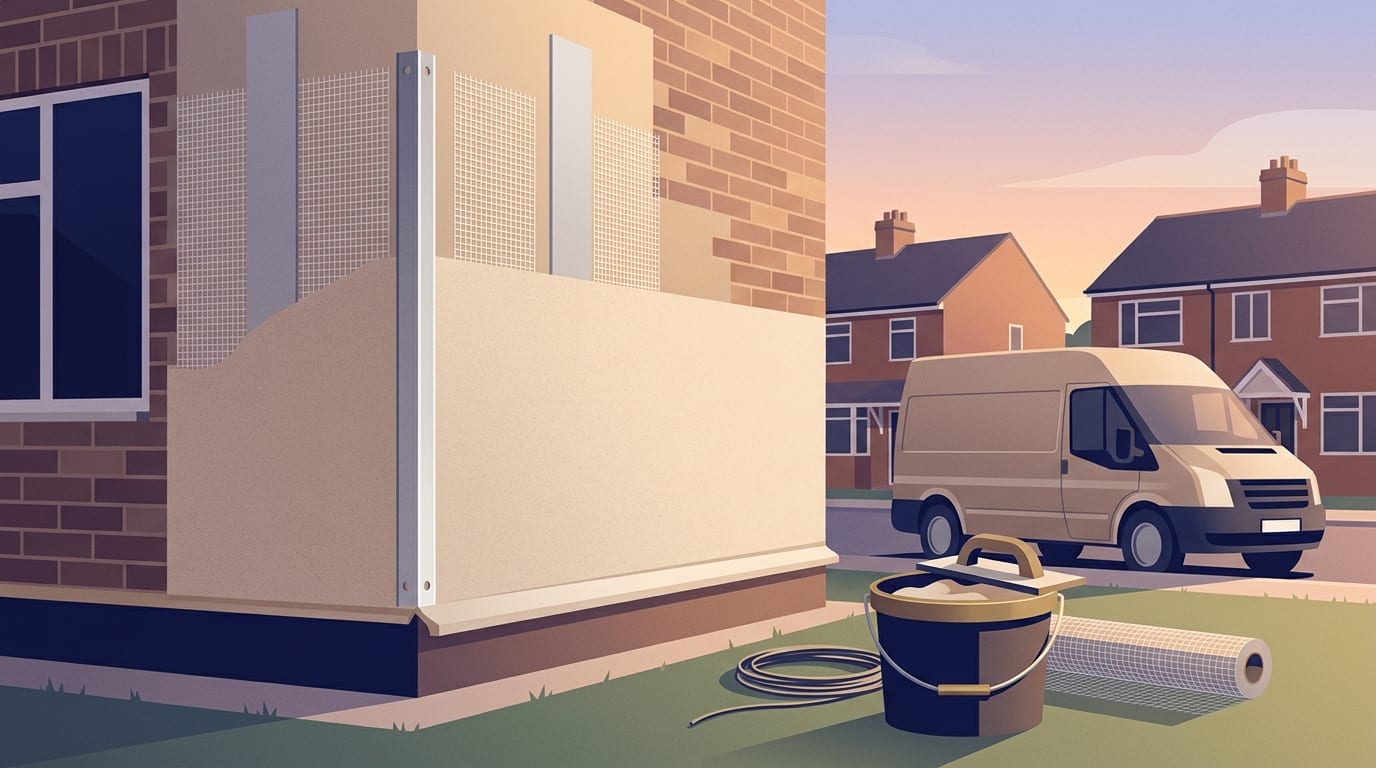
Render mesh is a glass fibre mesh bedded into the base coat to resist cracking and impact, while render beads are metal or plastic profiles that form straight edges and protect corners, edges and joints. You will see these terms on any professional quote for external rendering. A good render job lists both to ensure the finish can withstand the weather and minor structural movement.
What external render is and how it differs from plaster
Internal plaster gives a smooth finish for decorating inside your home. A typical internal job involves a skim, which is a thin finishing coat a few millimetres thick over sound plaster or plasterboard. Alternatively, a replaster means hacking off failed plaster and applying a backing coat plus a finish coat, or fixing new plasterboard and skimming it.
External render protects the outside of your house from the weather, and it comes in several different systems:
- Traditional sand and cement.
- Lime for older breathable properties.
- Pebbledash.
- Monocouche.
- Thin-coat acrylic or silicone systems.
Silicone render is one of these systems, and the plasterer should explain which one is being used and why.
Plastering is not a licensed trade. There is no legal register like the one for gas engineers, so evidence of past work matters deeply when choosing someone to apply external render. A CSCS card is for construction sites and is not proof of quality on domestic work. Instead, look for membership of the FIS, which is the trade body for the finishes and interiors sector, or TrustMark, which is the government-endorsed quality scheme.
What render mesh does in the base coat
In thin coat render systems, the base coat is the first, reinforcing layer. It is applied directly to the prepared wall before the final coloured or textured finish goes on. Render mesh is a glass fibre reinforcement that is usually embedded into this base coat.
The mesh adds crucial resistance to cracking and impact damage at stress points and areas of high traffic or impact. The base coat and mesh are described as essential for crack resistance.
Diagonal strips of render mesh should be used at the corners of all reveals that are rendered. Reveals are the flat inner sides of window and door openings, so check that your quote covers them.
Mesh reinforcement is part of the preparation work, which can account for up to 30 per cent of labour costs on a job. Once the base coat is installed with the mesh, it is allowed to cure for 24 to 72 hours before the final render finish goes on.
While mesh and beads reduce the risk of cracks significantly, they cannot promise none will ever appear.
Corner beads and why external edges need protection
Corner beads, also known as angle beads, are used on the corners and returns of external rendered elevations. They serve two vital purposes by producing a straight edge and providing protection against impact.
These beads are used on all external corners on render-only systems to reinforce and protect them. This includes the corners around windows and doors. They give a sharp 90-degree finish. Corner beads are not required in internal corners, only external ones.
Corner beads are made of rigid PVC with mesh wings that sit in the adhesive layer. Whether you see them on the finished house depends on the system you choose. Beads for thin coat systems are covered by the base coat so they are not seen once finished. This is unlike monocouche or scratch renders, where the corner bead is visible in the system.
Stop beads and bellcast beads at edges and the base
Render needs a clean, square border where it meets another material. Stop beads create a square finished edge for external render systems. Plasterers fit them at window and door frames and at changes to the facade.
At the bottom of the wall, managing rainwater is the priority. Bellcast beads, also known as drip beads, provide a stop to the render just above the damp proof course and above reveals. The damp proof course is the barrier built into your brickwork that prevents ground moisture from rising up the wall.
The bellcast bead is normally set above the damp proof course level. Its lip directs water away from the wall and lets rain running down the face of the render drip off onto the ground. You can read more about why render must stop above the damp proof course if you are checking an existing wall for damp issues.
Movement beads and cracks from thermal expansion
Movement joints, or expansion beads, are designed to prevent cracking to render through thermal expansion and compression. They give the render room to move.
They are mainly used where the underlying substrate changes. A substrate is the material the wall is built from. Where an extension in one material meets an original house in another, a movement bead can sit over the join.
Using cement render on old lime walls is a common mistake, whatever beads are used. Conservation bodies advise repairing original lime plaster where possible and replacing like for like.
Preparing the wall and what goes wrong
Before the base coat and mesh go on, the background must be prepared properly. Plasterers price per job after seeing it, and their price is heavily based on the state of the background. Preparation might involve hacking off failed render, removing loose plaster, or sealing painted surfaces.
A common reason for render failing is applying a new coat over loose, damp or unsealed painted surfaces so the new coat cracks or peels. If your home has textured coatings on the exterior or interior, you must be careful. The HSE says textured coatings such as Artex may contain asbestos in any building built or refurbished before 2000.
Work on them does not normally need a licensed contractor but must be done by people trained to work safely with asbestos. Homeowners should not sand, scrape or drill suspect coatings and should tell tradespeople about them before work starts. Dry sanding or scraping Artex is highly dangerous.
Building regulations and planning rules for render
When you render a house, you are changing its exterior appearance and its thermal performance. Where 25 per cent or more of an external wall is re-rendered, re-plastered or re-lined internally, building regulations normally apply. Under these rules, the wall's insulation would normally have to be improved.
Planning permission depends heavily on where you live and the type of property you own. In England, according to the Planning Portal, rendering needs no permission if materials are of similar appearance to the existing house. However, it does need permission in conservation areas, National Parks, Areas of Outstanding Natural Beauty and the Broads. If you live elsewhere in the UK, or if you are unsure, you should check with your local council before any work begins.
Listed buildings need consent for any significant work, inside or out.
Typical 2026 render prices and what mesh adds
Plasterers price per job after seeing it, based on the area in square metres, ceiling height and access, and the preparation required. Ceilings are usually priced separately if internal work is involved, and small jobs carry a minimum charge. London and the South East cost more.
Beads and mesh are normally inside the total render price rather than billed as an extra, but they must be detailed on the quote so you know they are being used. Render is priced per square metre, with scaffolding often appearing as a separate line. The table below shows typical costs for the different stages of an external render job.
|
Part of the render job |
Price per square metre |
|---|---|
|
Base coat and mesh |
£15 to £25 |
|
New render finish |
£30 to £70 |
|
Scaffolding |
£20 to £40 |
|
Total including removal and waste |
£80 to £180 |
These are typical published prices for 2026 and your local quotes will differ based on the condition of your walls and your location in the UK. The base coat and mesh are essential for crack resistance, so you should never ask a plasterer to leave them out to save money.
What a reliable render quote should list
A quote is a fixed price, while an estimate is just a rough guess that can easily spiral out of control. Citizens Advice suggests getting written quotes from at least three traders before you agree to a contract. You might be able to cancel within 14 days of agreeing a contract, but having everything in writing protects you from the start.
A written quote should include:
- A fixed total price and not a daily rate.
- A breakdown of all the work to be done and the materials needed.
- Separate costs for each material and part of the work.
- How long the price is valid for and when the price can go up.
- Whether the price includes VAT.
- Mesh in the base coat and beads at corners, edges and reveals.
- Bellcast beads at the base and movement joints where the wall needs them.
- Costs for scaffolding, waste removal and floor protection.
A trader who carries waste must be a registered waste carrier, and the register is public. Never accept a cash-only deal with nothing in writing. Quotes that omit preparation, scaffolding or waste are one of the things that go wrong. To compare quotes, you can read the guide on how to compare plastering quotes.
Under the Consumer Rights Act 2015, work must be done with reasonable care and skill. If it is not, the customer can ask for it to be put right or seek a partial or full refund. Citizens Advice also suggests paying deposits of no more than 25 per cent and paying by card for extra protection.
Common questions
Are render beads visible when the job is finished?
It depends entirely on the render system being used. Beads for thin coat systems are covered by the base coat so they are not seen once finished. However, the corner bead is visible in monocouche or scratch renders, which is why it matters how neatly it is fitted.
Do I need mesh for all external rendering?
The base coat and mesh are essential for crack resistance. Mesh is usually embedded into the base coat at stress points, high traffic areas and around window and door reveals to resist cracking and impact damage.
What is a render stop bead?
A stop bead creates a square finished edge for external render systems. Plasterers use them at window and door frames and at changes to the facade to stop the wet render neatly and provide a crisp border.
Do internal corners need render beads?
Corner beads are not required in internal corners. They are only used on external corners to provide a straight edge and protect the render from impact damage caused by everyday knocks and bumps.
How long does the base coat take to dry?
Once the base coat is installed with the glass fibre mesh, it is allowed to cure for 24 to 72 hours. Only after this curing period does the final render finish go on.
What to do next
Before you hire a plasterer for external rendering, check that their proposed method will protect your home from cracking, impact and damp. Use this checklist to review your quotes and ensure nothing essential has been left out.
- Check the quote includes a base coat with glass fibre mesh.
- Look for corner beads, stop beads and bellcast beads in the materials list.
- Ask the plasterer if movement joints are needed for your specific walls.
- Confirm that scaffolding, waste removal and VAT are in the final price.
- Ensure you have a fixed total price in writing rather than an estimate.
A solid base coat with the right mesh and beading helps the render resist cracking and impact, although no system can promise that it will never crack. When you are ready to get your property measured up and quoted, you can find a plasterer near you to look at the walls and advise on the right system.
Find a top rated plasterer near you
1,036 plasterers across the UK, each ranked on their Google rating and the number of reviews behind it. Start with your county: