
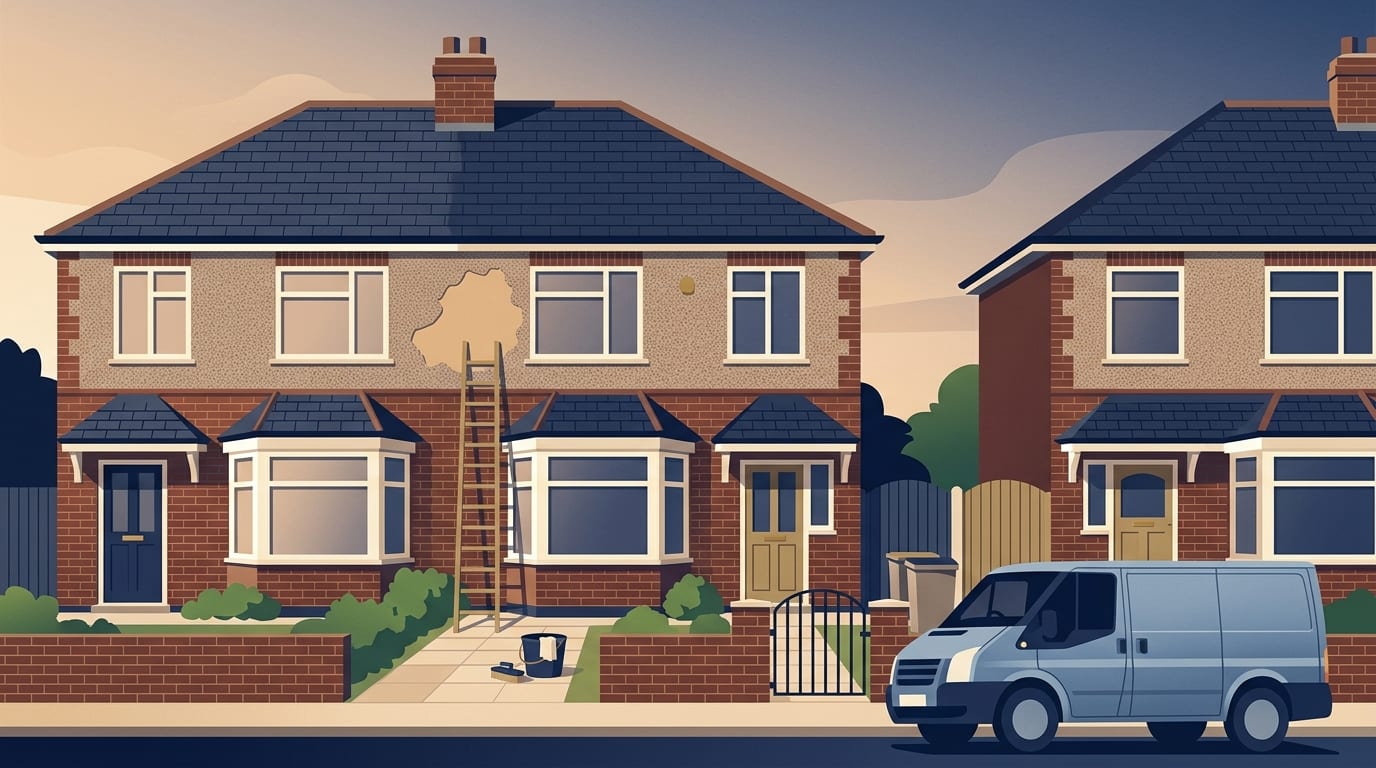
If your house has old pebbledash, you have four main options. You can repair damaged patches for a few hundred pounds, paint it to refresh the look, render over the top if the surface is sound, or strip it off entirely. Professional pebbledash removal typically costs an average of £4,500 and takes five to 14 days. This is rarely the end of the job because the wall underneath usually needs a new finish, so you must budget for both stages before you start.
What pebbledash is and why so many houses have it
Pebbledash is an exterior render where small stones are thrown onto a wet cement base coat and pressed in. The stones give the wall a textured finish that hides poor quality brickwork and uneven surfaces. It became popular in the UK because it is hard-wearing. Pebbledash typically lasts 20 to 40 years or more with maintenance.
Applying new pebble dashing costs £30 to £60 per square metre. It has long been a cost-effective way to protect external walls from driving rain. However, older applications can start to look dated, and the stones naturally hold onto dirt and pollution over the decades. When the cement base coat finally starts to fail, the finish begins to crack and drop off, leaving the wall beneath exposed to the weather.
Signs your pebbledash needs attention
Before you decide whether to repair, paint, cover or remove your pebbledash, you need to know what condition it is in. A renderer will check the wall to see how well the base coat is stuck to the brickwork underneath.
Look for these signs that your render needs work:
- Cracks running across the surface or stepping down the wall.
- Large patches where the small stones have fallen away to leave a bald cement patch.
- Hollow sounding areas when you tap the wall, which mean the render has come away from the brickwork.
- Loose chunks of cement that you can pull away by hand.
- Damp patches showing up on the inside of your external walls.
If the render is mostly sound and firmly attached, you can usually repair or paint it. If large areas sound hollow or the cement is crumbling, painting or covering it will not fix the problem and the loose render usually needs to come off.
Repairing damaged patches
When your pebbledash is firmly bonded to the wall, a patch repair is the cheapest way to fix small damage. This involves hacking off the loose render around a crack or bald spot, applying a fresh cement base coat and throwing new stones onto the wet patch. Small patch repairs cost £200 to £350 in labour plus £40 to £80 in materials, or about £300 per five square metres.
The main drawback of patch repairing is that it is very hard to match the old finish. The new stones will be clean and brightly coloured, while the surrounding wall will have decades of weathering and dirt. The new cement base might also dry to a slightly different shade.
If you only have one or two damaged spots, a repair stops water getting in and prevents the damage spreading. You can then paint the whole house to hide the repaired sections. If you are dealing with widespread cracked render repairs, patching will leave your house looking like a patchwork quilt and a new finish makes more sense.
Painting pebbledash
Painting pebbledash is a popular way to refresh a tired house without the cost of removing the render. It covers up patch repairs, brightens dirty stones and seals the surface against the weather. Painting pebble dash costs £10 to £25 per square metre, depending on the height of your house and how much preparation the wall needs.
You must use masonry paint, and the wall must be sound. Painting over loose or hollow pebbledash only hides the problem, and the paint can fail along with the render underneath. The painter must clean the wall thoroughly and repair any cracks before applying the paint.
Once painted, the wall will need repainting over time. The textured surface takes more paint and time to cover, pushing the cost up compared to painting flat render. To get a good result, the painter has to work the paint into all the gaps between the stones so no bare cement shows through.
Rendering or cladding over pebbledash
If the pebbledash is in excellent condition, you might be able to leave it in place and cover it up. You can choose either rendering over the existing finish, which typically costs £3,000 to £6,000, or cladding over it, which costs about £3,800.
Rendering over pebbledash involves applying a thick base coat directly onto the old stones to level the wall, followed by a smooth top coat. This gives you a modern finish with far less mess than hacking the old render off. However, this is only an option if the existing dash is completely sound and well bonded to the wall. A renderer must check the wall first. If new render goes over weak pebbledash, the new and old layers can come away from the wall together.
Cladding over the wall with timber or plastic boards is another alternative. The installer fixes timber battens to the wall through the pebbledash and attaches the cladding to the battens. This hides the old finish and gives you a chance to add external insulation, but it will change the depth of your external walls, meaning your windows and doors might sit further back in their reveals.
Removing pebbledash completely
Removing pebbledash completely is disruptive and expensive, but often the only choice if the old render is failing, hollow or letting damp in. Professional removal typically costs £2,000 to £10,000 depending on the size of the house, and takes between five and 14 days.
Removing pebbledash carries a real risk of damaging the wall beneath, especially if the render or brickwork is old or fragile. The tradespeople have to use hammer drills and chisels to hack the cement off. Because it is so labour intensive, pebbledash removal can run to about £150 to £400 a day. You should always ask the tradesperson to remove a test section first to see how easily the cement comes away and what condition the bricks are in.
You may find breeze blocks rather than brick underneath the render. The total cost can rise if the removal exposes damaged bricks, missing stones, damp or weak lime mortar.
If you want to leave the brickwork exposed, restoring it can add £1,000 to £2,000 for cleaning, repointing and replacing damaged bricks. In most cases, the wall is not good enough to leave bare, which means removal needs a plan for the new finish. You will have to pay for the removal and then pay again for a new coat of render, which is why you must budget for both stages of the job before you begin.
What each option costs
Plasterers and renderers price pebbledash jobs based on the area in square metres, the condition of the wall, access and the size of your house. Prices in London can be 20 to 30 per cent higher than in the north.
This table shows typical whole house costs for painting and removing pebbledash based on property size.
|
Property size |
Painting pebbledash |
Pebbledash removal |
|---|---|---|
|
Two-bed bungalow |
Not listed |
£2,100 to £3,000 |
|
Two-bed terrace |
£700 to £1,000 |
£2,000 to £4,500 |
|
Three-bed semi |
£900 to £1,200 |
£3,800 to £5,200 |
|
Four-bed semi |
Not listed |
£6,300 to £7,800 |
|
Four-bed detached |
£1,000 to £1,300 |
£6,000 to £10,000 |
These figures are typical published prices for 2026, and local quotes will differ.
If you are comparing quotes for specific parts of the job or smaller repairs, tradespeople will often break their prices down by the square metre or by the day. This table shows typical rates for materials, labour and access.
|
Type of work or cost |
Typical price range |
|---|---|
|
New pebble dashing |
£30 to £60 per square metre |
|
Painting pebble dash |
£10 to £25 per square metre |
|
Old render removal |
£20 to £60 per square metre |
|
Render specialists (labour) |
£130 to £250 a day |
|
Pebbledash removal (labour) |
£150 to £400 a day |
|
Scaffolding |
£300 to £1,000 |
|
Waste removal and skip hire |
£200 to £440 |
These are typical published prices for 2026, and local quotes will differ.
Remember to check whether your quote includes VAT, waste removal and scaffolding, as these can add a significant amount to the final bill.
Planning permission and building regulations
In England, cladding or rendering can be done without planning permission if the materials are of a similar appearance to those used in the construction of the house. However, if you live in a conservation area, a National Park, an Area of Outstanding Natural Beauty or the Broads, you need planning permission before cladding the outside with stone, artificial stone, pebble dash, render, timber, plastic or tiles. If your home is a listed building, you need listed building consent for any significant works, internal or external. If you live in Wales, Scotland or Northern Ireland, or are not sure whether the new finish will look different from the old one, check with your local council.
You also have to follow the building regulations when you take on a large rendering job. In England, where 25 per cent or more of an external wall is re-rendered, re-clad, re-plastered or re-lined internally, or 25 per cent or more of the external leaf is rebuilt, the building regulations would normally apply. Under these rules, the thermal insulation of the wall would normally have to be improved.
Older houses and solid walls
If your house was built before the 1920s, it likely has solid walls rather than cavity walls. Old buildings rely on their permeable nature to let water absorbed by the walls evaporate.
Applying an impervious cement render in place of a lime-based covering restricts this evaporation. Because the cement is more rigid than the wall, hairline cracks form as the building moves. These cracks draw in water, which then becomes trapped behind the cement because it cannot evaporate. Over time, timber-framed and earth buildings can suffer major structural damage if moisture builds up behind cement render.
If you are removing pebbledash from an older house, the Society for the Protection of Ancient Buildings advises using a weaker, more permeable lime render without cement. This must be applied by someone experienced with lime, and limewash is the usual finish. You should always ask a specialist whether you should use lime rather than standard sand and cement if your home has solid walls.
What to check in a quote
Plastering is not a licensed trade and there is no legal register, so evidence of past work matters. Citizens Advice suggests getting written quotes from at least three traders before you choose one.
A quote is a fixed price, while an estimate is just a rough guess. A written quote should list:
- A fixed total for the whole job.
- A clear breakdown of the work, the method and the materials.
- How long the quote is valid for.
- Whether VAT is included in the final price.
- The cost of scaffolding and who is arranging it.
- Waste removal, and proof they are a registered waste carrier.
- Repairs to the wall underneath once the old dash is removed.
- The type of finish being applied and the expected drying time.
Ask the renderer for two or three recent examples of similar work they have done, and check they have public liability insurance. Once you choose a firm, agree a written contract covering timings, tidying up, materials and payment terms. Keep any deposit to 25 per cent at most and pay by card where possible. Under consumer law, you might be able to cancel within 14 days of agreeing the work.
Common questions
Can you render over pebbledash?
You can render over pebbledash, but only if the existing stones and base coat are entirely sound and firmly bonded to the wall. A renderer will apply a thick base coat to level the texture before adding a smooth top coat. If the old pebbledash is loose or hollow, it is not a sound base, and the new and old layers can come away from the wall together.
How much is pebbledash removal?
Professional pebbledash removal costs an average of about £4,500, with typical prices ranging from £2,000 to £10,000 depending on the size of the house. The exact cost depends on how easily the cement comes off and whether the brickwork underneath needs extensive repairs. You also need to budget for scaffolding, waste removal and the cost of the new render.
What happens if removing it damages the bricks?
Removing pebbledash carries a real risk of damaging the wall beneath, especially if the render or brickwork is old or fragile. If the bricks are damaged, restoring exposed brickwork can add £1,000 to £2,000 for cleaning, repointing and replacing the broken bricks. You might also find breeze blocks under the render, which will force you to apply a new covering anyway.
Does painting pebbledash last?
Painting pebbledash seals the surface and refreshes the look of the house, but a painted wall needs repainting over time. Use masonry paint and have the wall repaired first, because paint over loose or cracked render can peel and will not stop the render failing.
Next steps
Before you contact a renderer, decide whether you want to save money with a repair or invest in a completely new finish. Follow this short checklist to get started:
- Walk around your house and look for cracks or missing stones, and tap any pebbledash you can reach from the ground to find hollow spots.
- Decide if you want a patch repair, a painted finish, or to remove the render entirely.
- Check if you live in a conservation area or a listed building and need permission.
- Ask three different renderers to visit the house and assess the condition of the wall.
- Ask them to remove a small test patch if they are quoting for full removal.
- Get three fixed-price written quotes that include scaffolding, waste removal and the new finish.
When you are ready to compare prices and get advice on the state of your external walls, you can find a plasterer near you to look at the job.
Related Guides
Internal Wall Insulation and Insulated Plasterboard Explained
How internal wall insulation and insulated plasterboard work on solid walls, what they typically cost in 2026, what you could save and the damp risks to avoid.
How to Soundproof a Wall and What It Costs
What really cuts noise through a wall, from acoustic plasterboard to an independent wall, what each option typically costs in 2026, and where acoustic plaster fits in.
When Do You Need Fire Rated Plasterboard?
Where building regulations call for fire rated plasterboard, from attached garages to loft conversions and stairways, what the ratings mean and what the boards add to a quote.