Making good plaster means repairing the damage left by other trades so the surface is ready to decorate. Quotes for new wiring or pipework do not always include a finished surface, which can leave you to hire a plasterer to fix the holes and channels left behind. Typical 2026 prices for making good and plastering after a full house rewire run from £500 to £2,500, depending heavily on the damage.
What making good means
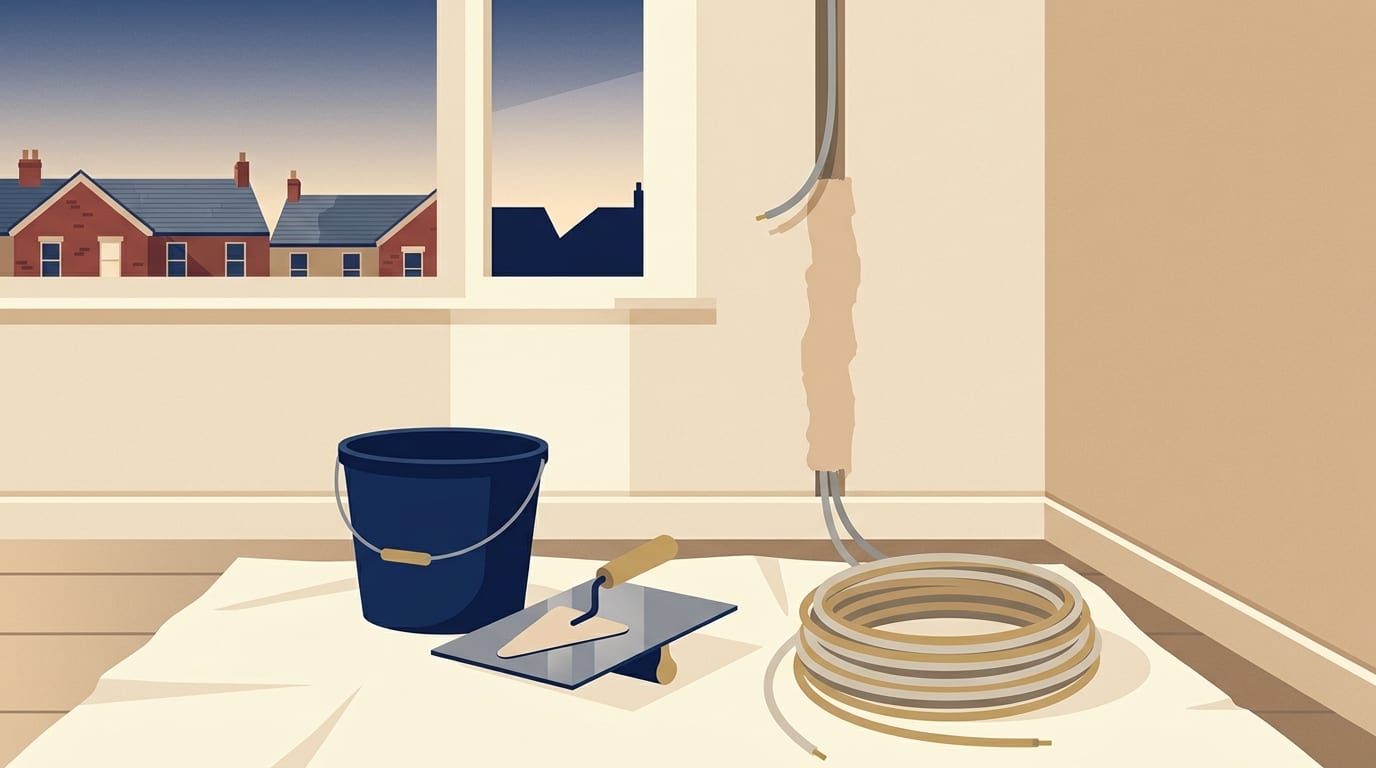
Electricians and plumbers cut into walls to hide cables and pipes. Making good is the process of filling and smoothing these cuts so the wall looks untouched once painted. You will often hear the term chasing, which means cutting a channel into the wall for a cable or pipe to sit inside. Once the pipe or wire is in place, the channel must be filled and smoothed over.
A quote for making good can mean three different things depending on who writes it. The first level is a basic fill, where the tradesperson packs the hole with a backing plaster or filler but leaves the surface rough. The second level is patching and skimming the repairs, where a plasterer fills the damage and applies a skim to blend it with the old wall. A skim is a thin finishing coat, a few millimetres thick, applied over sound plaster or plasterboard.
The third level is a full skim of the entire wall or room. This happens when the damage is too extensive for a patch to blend in invisibly. Your quote should state exactly which of these three levels you are paying for. A rough fill is not ready for paint and will need a plasterer to finish the job. Knowing the difference stops you from paying for a finished wall and only getting a basic fill.
Why walls need repair after rewiring or plumbing
Running new cables and pipes through an existing house is a destructive process. Tradespeople have to lift floorboards, drill through joists and cut into the plaster to reach sockets, switches and radiators. Chasing walls creates damage that must be repaired before you can redecorate.
The type of wall you have dictates how much damage occurs. Solid brick and concrete walls are harder to chase than modern timber stud walls. This extra difficulty increases the labour time required for the electrician and creates wider, deeper channels that take more time and material to fill.
Old plaster often crumbles when a tradesperson cuts into it. What starts as a narrow channel for a single cable can quickly become a wide strip of loose, blown plaster that falls away from the brickwork. The plumber or electrician will secure their fittings, but the surrounding wall may still need repair, so confirm who is responsible.
You must book a registered electrician for any electrical work and a Gas Safe registered engineer for any gas pipework. Do not attempt to chase walls, run cables or alter gas pipes yourself. Once the registered professionals have safely installed and tested their work, a plasterer can repair the surface damage safely.
Who is responsible for the finish
Homeowners may assume the person who made the holes will fix them. Typical rewire prices do not always include extensive making good, plastering, or premium finishes, so check exactly what the electrician's price covers.
You must confirm plastering and making good responsibilities with your tradespeople before any work starts. If you assume the electrician is doing it and they assume you are hiring a plasterer, your project will stall. Ask the electrician if their price includes making good and ask them to define exactly what that finish will look like.
When you hire a separate plasterer to follow the electrician, the cost is driven by the amount of damage left behind. Plasterers price per job after seeing it, based on the area in square metres, the state of the background, ceiling height and access. If another trade has hacked away large sections of wall or left cables protruding too far, the plasterer will have to do extra work to fix it.
Always get responsibilities written down. A plasterer may charge for extra labour and materials if the background is left in a worse state than expected. Knowing who is responsible for the final surface stops arguments later on.
Do not rely on site cards to judge a domestic plasterer. A CSCS card is for construction sites, not proof of quality on domestic work. Plastering is not a licensed trade, meaning there is no legal register like the one for gas engineers, so evidence of past work matters. You can look for members of FIS, the trade body for the finishes and interiors sector, or TrustMark, the government-endorsed quality scheme.
Patch repair or a full skim
You have two choices when fixing walls damaged by new pipes or cables. You can ask a plasterer to patch only the chased channels, or you can ask them to skim the entire wall. Patching is usually the cheaper route only when the surrounding plaster is sound and firmly attached to the brickwork.
A plasterer decides whether a patch will show once painted. If your wall has a dozen chases running up to new sockets, patching each one individually will leave a wavy finish you will see every day once it is painted. In these cases, it is faster and gives a better result to skim the whole room.
When you only have one or two small chases, a patch repair makes sense. The plasterer will fill the channel and blend the edges of the new skim coat into the old wall.
If a ceiling is damaged during a rewire, a patch can be harder to hide. Ceilings are usually priced separately. The tradesperson might suggest overboarding, which means fixing new plasterboard under an old ceiling before applying a fresh skim coat.
The table below shows typical prices for different types of making good and plastering work in 2026.
|
Type of work |
Typical 2026 price |
Time required |
|---|---|---|
|
Hairline and settlement crack repairs |
£10 to £20 per square metre |
Not stated |
|
Hairline crack repair and repaint |
£100 to £250 |
Not stated |
|
Small plaster patch repair |
£150 to £400 |
Not stated |
|
Small patch and repair work |
£150 to £200 |
Not stated |
|
Re-skimming small room (about 2.1m x 2.2m) |
£300 to £1,000 |
1 to 2 days |
|
Re-skimming medium room (about 3.3m x 3m) |
£400 to £1,250 |
2 days |
|
Re-skimming large room (about 6.1m x 5m) |
£600 to £2,500 |
3 days |
These figures are typical 2026 prices, and local quotes will differ based on the extent of the damage. The three room re-skim rows exclude VAT and include labour and materials. The other rows do not say whether VAT is included.
What a plasterer does
When a plasterer arrives to make good, they first check the depth of the chases and the condition of the surrounding wall. They will strip any wallpaper near the damage and remove loose plaster. They will also seal painted surfaces to ensure the new plaster sticks properly.
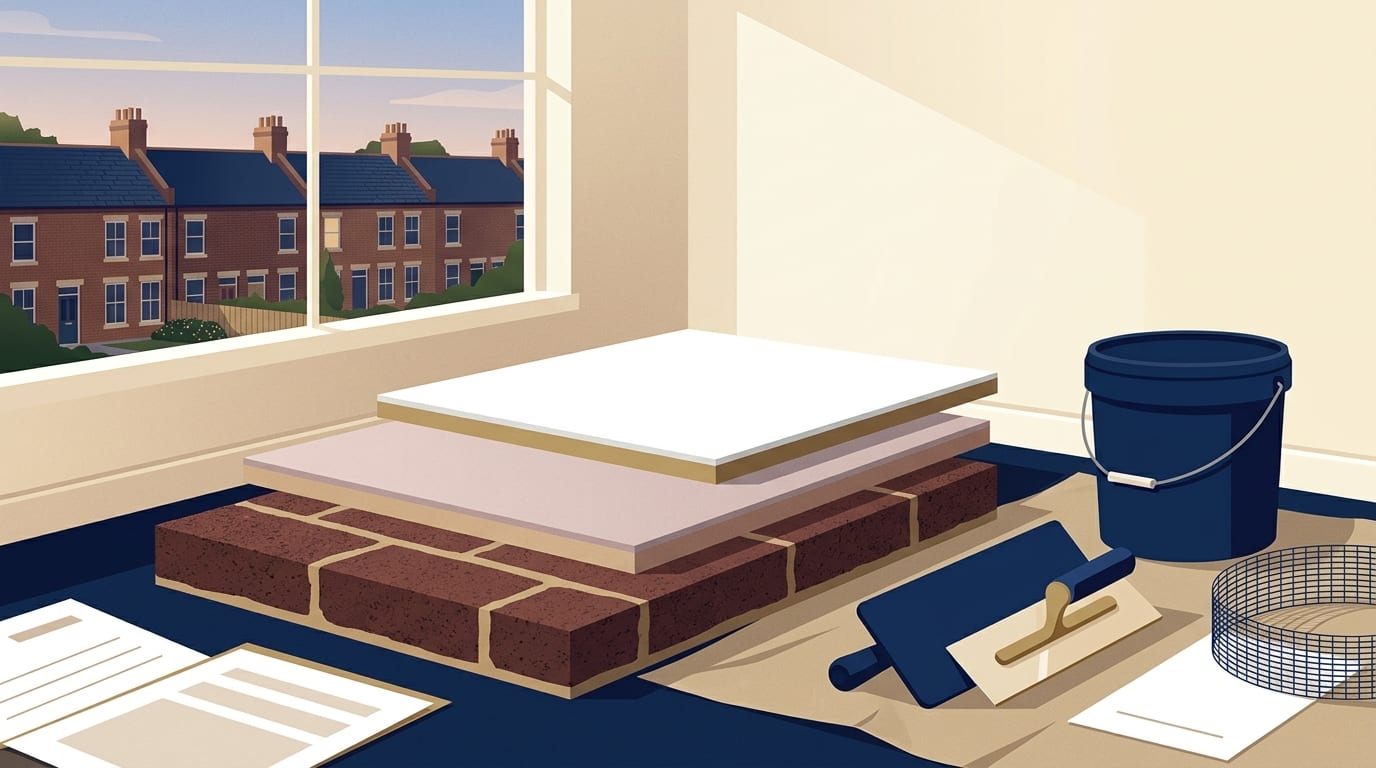
For deep chases, they use a bonding undercoat. This is an undercoat plaster designed for smooth or low suction backgrounds. The data sheet describes it as suited to new walls or to making good old walls before skimming.
One manufacturer's bonding undercoat is built up to no more than 8 millimetres thick and then finished with 2 millimetres of finish plaster. Other products differ, so the plasterer follows the instructions for the product being used.
The aim is a patch that sits flush with the rest of the wall and blends in with the original surface once painted.
If the old wall requires a full replaster, they will hack off the failed plaster entirely and apply a backing coat plus a finish coat across the whole area. Alternatively, they might use a dot and dab method, which is plasterboard stuck on dabs of adhesive, before skimming over the top.
What can go wrong when making good
Fixing damaged walls looks simple, but poor preparation leads to failure. Watch out for these common mistakes:
- Skimming over loose, damp or unsealed painted surfaces.
- Accepting cash-only deals with nothing in writing.
- Accepting quotes that omit preparation, ceilings, scaffolding or waste.
- Dry sanding or scraping Artex ceilings.
- Applying heavy gypsum or cement on old lime walls.
If the old plaster is falling away from the brickwork, a new skim coat will not hold it in place. Skimming over an unprepared painted wall will cause the new plaster to crack or peel off entirely.
You must be careful with older properties. If your house has lath and plaster ceilings, which consist of lime plaster on timber laths, modern materials can cause problems. Using heavy gypsum or cement on old lime walls traps moisture and damages the fabric of the building. Conservation bodies advise repairing original lime plaster where possible and replacing like for like.
Ceilings with textured coatings require extreme caution. The HSE says textured coatings such as Artex may contain asbestos in any building built or refurbished before 2000. Homeowners should not sand, scrape or drill suspect coatings and should tell tradespeople about them before work starts. Work on them does not normally need a licensed contractor but must be done by people trained to work safely with asbestos.
Finally, be aware of building regulations if your making good involves exterior walls. Where 25 per cent or more of an external wall is re-rendered, re-plastered or re-lined internally, the regulations normally apply and the wall's insulation would normally have to be improved.
Typical 2026 prices
The cost of making good depends heavily on how much of the house was disturbed. For a full house rewire, typical prices for making good and plastering range from £500 to £2,500. This is highly variable depending on the damage caused during the electrical work.
If you are only re-skimming individual rooms, the price is based on the room size. Re-skimming over existing plaster with a 5 to 8 millimetre cosmetic finish in a small room costs between £300 and £1,000. A medium room costs between £400 and £1,250, while a large room ranges from £600 to £2,500.
The room re-skim figures cover labour and materials but exclude VAT. London and the South East cost more, and small jobs carry a minimum charge.
You also need to budget for the final decoration. Plastering and decorating are excluded from typical rewire durations and may extend the total project time. Decorating after a rewire will cost between £300 and £2,000 or more depending on the property size.
Timing, drying and decorating
You must schedule your trades in the correct order to avoid ruining new plaster. Plasterers need the electrician and plumber to finish their first fix entirely before the plastering starts. If the plasterer finishes a wall and the electrician returns the next day to cut a new socket hole, the plasterer may have to come back.
Once the plasterer has made good the walls, you have to wait before you can paint. New plaster has to dry before decorating, so ask the plasterer how long to wait. Painting too soon can trap moisture in the wall.
When the repairs are dry, you cannot paint them with standard emulsion straight from the tin. You must apply a mist coat first to seal the porous surface. Read the guide on how to paint new plaster for more.
Keep the room well ventilated while the plaster dries. Do not turn the heating up to maximum to speed the process along. Forcing the moisture out too fast will cause the new patches to crack and pull away from the wall.
What to get in writing before work starts
Cash deals with nothing in writing leave you completely unprotected if the plaster fails. You should ask for three written quotes from different plasterers to compare prices and scope. A quote is a fixed price, whereas an estimate is a rough guess that can increase later.
According to Citizens Advice, a written quote should include a fixed total price and not a daily rate. It should also provide a breakdown of all the work to be done and the materials needed. The document must state how long the price is valid for and whether the total includes VAT.
Check your quotes for these specific details before agreeing to the work:
- Who is responsible for filling the deep chases.
- What level of finish the price includes.
- Whether the price covers a patch repair or a full skim.
- Who is responsible for waste removal and floor protection.
- Who pays if the new skim fails over a patch.
Under the Consumer Rights Act 2015, work must be done with reasonable care and skill. If a plasterer skims over an unsealed surface and the plaster cracks, you can ask for it to be put right or seek a partial or full refund. You might also be able to cancel within 14 days of agreeing a contract. If you have a dispute, Citizens Advice offers guidance on your rights.
Finally, check how the tradesperson handles rubbish. A trader who carries waste must be a registered waste carrier, and the register is public. Quotes that omit waste removal often result in a pile of heavy plaster rubble left on your driveway.
Common questions
Do electricians plaster after a rewire?
Some electricians offer only a rough fill, and rewire prices do not always include plastering, so ask exactly what making good is included. You may need to hire a plasterer to skim the walls smooth before you can paint.
Why are my newly plastered chases cracking?
Cracks can appear when the plaster dries too quickly or when it is applied over a dusty, unsealed background. If a tradesperson skips the primer or turns the heating up high, the moisture escapes too fast. This causes the plaster to shrink and crack along the line of the old chase.
Can I just use filler on chased walls?
Standard decorator filler may suit very narrow, shallow cuts. For wide or deep channels, ask a plasterer, as deep chases usually need a bonding undercoat and a finishing skim.
Does a patch repair always show through paint?
A patch repair will show if the existing wall is uneven or if the plasterer does not feather the edges correctly. A skilled plasterer will assess the wall and tell you if a patch will blend in. If the wall is heavily textured or very old, a full skim may be the better option.
Next steps
Before you book a plasterer to make good after your rewire or plumbing work, make sure your project is ready. Use this checklist to keep the job on track:
- Confirm your electrician or plumber has completely finished their first fix.
- Ask your electrician exactly what level of filling they will do before they leave.
- Decide whether you want to patch the chases or skim the entire room.
- Get three written quotes from local plasterers that detail exactly what is included.
- Check that waste removal, floor protection and VAT are listed on the quote.
Finding a reliable tradesperson to fix damaged walls is easier when you can read reviews from previous customers in your area. You can search our directory to find a plasterer near you and read their feedback before asking for a quote.
Find a top rated plasterer near you
1,036 plasterers across the UK, each ranked on their Google rating and the number of reviews behind it. Start with your county: