
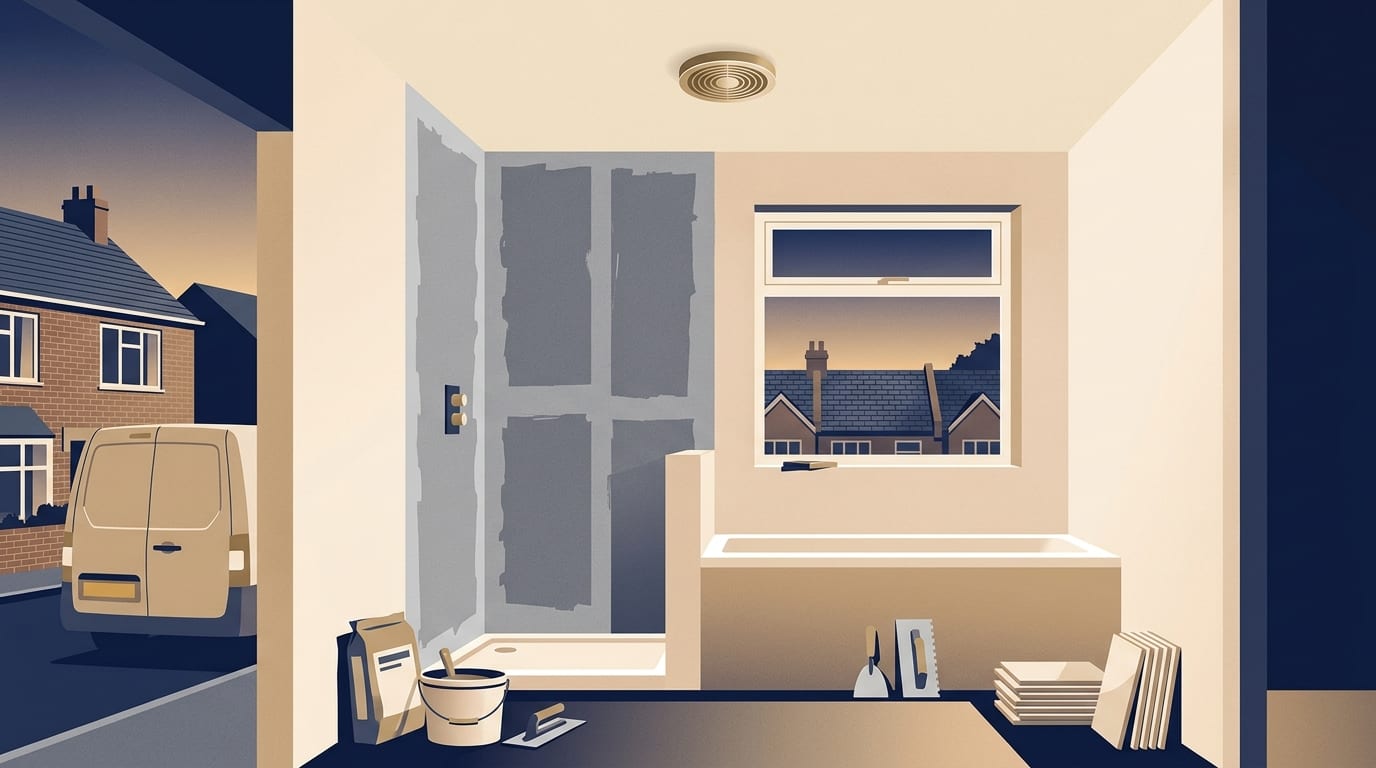
Ordinary plaster and plasterboard are not waterproof. Standard plastering works perfectly well on bathroom walls and ceilings away from direct water, as long as the room is properly ventilated. For areas that get soaked, such as inside a shower enclosure or right around a bath, you need a completely waterproof tanking system behind the tiles before any water hits the wall.
Are plaster and plasterboard waterproof?
Gypsum plaster, the standard finish on most interior walls in the UK, is not designed for damp or exterior conditions. If it stays wet it softens and breaks down, and standard plasterboard weakens in the same way.
For anything persistently damp, lime plaster or a dedicated moisture-resistant system is the safer choice. Waterproofing below-ground walls is specialist damp-proofing work rather than standard plastering, and falls outside the scope of this guide.
Exterior walls are protected by external render rather than interior plaster. You can read more about exterior work in our guide on what to know before rendering a house.
For everyday interior rooms, ordinary plaster works perfectly well. When renovating a bathroom, the main threats are condensation from steam and direct water from the shower. Managing these moisture levels means treating different parts of the room in different ways and understanding exactly what materials should go on the walls.
Wet areas and what goes behind shower tiles
You should divide your bathroom into wet areas and dry areas. Wet areas are the places where water directly hits the walls on a daily basis. This means the inside of a shower enclosure, the walls immediately around a bath with a shower over it, and the floor of a wet room.
An unwaterproofed background is one of the most common causes of tiling failures in bathrooms. Tiles, tile adhesive and grout are not waterproof on their own. Water will eventually find its way through hairline cracks in the grout, or through failed silicone seals around baths and shower trays. Hidden pipe leaks behind the wall can also cause the exact same damage from the inside out.
When water gets through the grout and reaches standard plaster or plasterboard, the background can break down and the tiles can lose their grip and come loose. To prevent this, shower and wet areas need a waterproof tanking system applied before the tiling begins.
This rule applies regardless of the background material you are building on. Whether your walls are solid brick, existing plaster or newly fitted boards, the wet areas must be tanked before the first tile is laid. In a wet room, the demands are even higher. All tiling in the wet areas of a wet room should be fully sealed with a waterproof membrane beneath it to stop water escaping into the structure of the house.
Using ordinary plaster and paint in a bathroom
The rest of the bathroom is considered a dry area, even though the air gets humid when the hot tap runs. Walls behind a toilet, around a window or opposite the bath do not need to be completely waterproofed. A normal skim coat of plaster is fine for these spaces, although moisture-resistant plasterboard is commonly used in bathrooms where new boards go up. A skim is a thin finishing coat, a few millimetres thick, applied over sound plaster or plasterboard to create a smooth surface for painting.
If the old walls are in poor condition, you may need a full replaster. A replaster means hacking off the failed plaster and applying a thick backing coat plus a smooth finish coat. Alternatively, the plasterer might fix new plasterboard and skim over it, known in the trade as board and skim.
Once this plaster is completely dry, you decorate it with a suitable bathroom paint designed to withstand steam. The paint acts as the protective barrier for the plaster underneath. As long as the room has good ventilation, condensation that forms on the painted surface can dry off again before it causes problems.
Bathroom ceilings take a lot of punishment from rising steam. If you live in a period home, you might have a lath and plaster ceiling, which is traditional lime plaster pushed onto timber laths. If an old ceiling is heavily cracked, the options include repairing it or overboarding. Overboarding is the process of fixing new plasterboard directly under an old ceiling and skimming it, providing a fresh surface without pulling the old ceiling down.
Many older bathroom ceilings are covered in textured coatings like Artex. The Health and Safety Executive (HSE) says textured coatings such as Artex may contain asbestos in any building built or refurbished before the year 2000. Work on them does not normally need a licensed contractor, but it must be done by people trained to work safely with asbestos. Homeowners should not sand, scrape or drill suspect coatings and should always tell tradespeople about them before any work starts.
Moisture resistant boards and tanking explained
When stripping a bathroom back to the bare walls, tradespeople often use moisture resistant plasterboard for the new surface. Bathrooms, kitchens and utility rooms commonly use these boards because they are designed to cope with higher humidity in the air.
These boards are often fitted using a method called dot and dab, which means the plasterboard is stuck directly to the masonry walls using dabs of strong adhesive. Moisture resistant boards cost slightly more than standard boards but offer better protection against general dampness. However, they resist humidity rather than standing water, so they are not a substitute for tanking where water directly hits the wall.
Tanking is a waterproof membrane or system, such as a liquid coating or a waterproof sheet, that goes on the wall under the tiles in the wet areas. Tiling also needs a flat surface, so the background has to be flat and sound before the tanking and tiles go on.
Decorative plasters that handle water
If you want a continuous, tile-free look in a bathroom, standard gypsum plaster will not work. Instead, you need specialist decorative finishes that are designed to resist water. These are highly skilled trades, and you should always use an installer who can show a portfolio of the specific finish you want.
Tadelakt is a waterproof decorative lime plaster from the Marrakesh region of Morocco, commonly used in bathrooms, showers and wet rooms. The installer rubs olive oil soap into the surface, which reacts with the lime to form a water-resistant layer. It needs specialist application, is cleaned with water rather than bleach or harsh solvents, and is recoated with a soap solution from time to time to maintain its protection.
Venetian plaster is another popular choice for high-end interiors. Standard Venetian plaster is not waterproof. To use it in a wet environment, bathrooms need a sealed finish to protect the surface from moisture, which adds an extra stage and cost to the job. You can learn more about this in our guide to what Venetian plaster is and what it costs.
Microcement is a seamless layered coat used in wet rooms and modern interiors. It provides a tough surface that can cover both walls and floors. Because it has no grout lines, it is easy to keep clean, but it is highly specialised work.
Ventilation and electrical safety
Condensation is a major cause of bathroom damp and mould. It happens when warm moist air from the bath or shower hits cold surfaces like mirrors, windows and exterior walls. Extractor fans, trickle vents and opening windows all help to prevent it by removing the moist air before it settles.
Under the building regulations for England, the minimum intermittent extract rate for a bathroom is 15 litres per second. Where building work is carried out in an existing bathroom, existing fans should be retained or replaced and checked that they work. If the room had no ventilation system it is not necessary to add one, unless the work would make the building less compliant than before. You can read the full rules in Approved Document F.
Fitting or replacing an extractor fan involves electrical work, which must be done safely. Sockets are not allowed in bathrooms, apart from shaver supply units, unless they are at least 2.5 metres from the edge of a bath or shower tray. All circuits in or passing through bathrooms must have RCD protection to prevent electric shocks.
Electrical installation work in a bathroom must comply with Part P of the Building Regulations and should be done by a registered electrician, not your plasterer. For more details on keeping your bathroom safe, you can read the guidance from Electrical Safety First.
What bathroom plastering and waterproofing costs
Plasterers price per job after seeing it in person. The total cost is based on the area in square metres, the state of the background walls, ceiling height, access and the amount of preparation required. Ceilings are usually priced separately from walls, and small jobs always carry a minimum charge to cover the tradesperson's time and travel. You will usually pay more if you live in London and the South East.
Preparation work pushes the price up and can include:
- Stripping old wallpaper and removing loose or blown plaster
- Sealing painted surfaces so the new plaster bonds correctly
- Dealing with textured coatings such as Artex safely
- Hacking off old tiles and removing the waste from the site
The table below outlines typical costs for the materials and specialist finishes used in bathroom waterproofing and plastering.
|
Material or finish |
Typical cost |
|---|---|
|
Standard plasterboard walls |
£10 to £18 per square metre supplied and fitted |
|
Moisture or fire-rated boards |
Adds £3 to £6 per square metre |
|
Moisture resistant boards |
About £15 a sheet to buy |
|
Tanking shower kit |
£130 to £180 to buy |
|
Full room tanking |
£300 to £800 |
|
Microcement wet room flooring |
£80 to £120 per square metre |
|
Microcement generally |
£90 to £160 per square metre |
|
Venetian plaster generally |
£90 to £150 per square metre |
|
Bathroom in sealed Venetian plaster |
£2,000 to £4,000 |
These figures are typical published prices for 2026. Your local quotes will differ depending on the size of your room and the exact specification of the finish. Always check whether your quote includes VAT, the cost of materials, waste removal and floor protection.
Consumer rights and questions to ask
Plastering is not a licensed trade, which means there is no legal register like the one for gas engineers, so checking evidence of past work really matters. A CSCS card is for construction sites, not proof of quality on domestic work. Look for tradespeople who are members of FIS, which is the trade body for the finishes and interiors sector, or TrustMark, which is the government-endorsed quality scheme.
Under the Consumer Rights Act 2015, any work you pay for must be done with reasonable care and skill. If it is not, the customer can ask for it to be put right or seek a partial or full refund. Citizens Advice suggests getting three written quotes, a written contract, paying deposits of no more than 25 per cent and paying by card. They also note that you might be able to cancel within 14 days of agreeing a contract.
If a tradesperson is taking away your old tiles and plaster, they must be a registered waste carrier, and you can check the public register to confirm this. If your home is listed, you need consent for any significant work, inside or out.
Planning Portal guidance for England says that where 25 per cent or more of an external wall is re-rendered, re-plastered or re-lined internally, the building regulations normally apply and the wall's insulation would normally have to be improved.
To ensure you get a thorough job, ask these questions before you agree to a contract:
- What material is going behind the tiles in the wet areas?
- Who is responsible for supplying and applying the waterproofing?
- Which type of plasterboard are you using for the dry areas and the ceiling?
- How will the room be ventilated once the work is finished?
- Does the quote include hacking off the old plaster and removing the waste?
- Is the electrical work for the fan being done by a registered electrician?
Common questions
What is tadelakt plastering?
Tadelakt is a waterproof decorative lime plaster from the Marrakesh region of Morocco. It is commonly used in bathrooms, showers and wet rooms to create a seamless, tile-free finish. The installer rubs olive oil soap into the surface, which reacts with the lime to form a tough, water-resistant layer that is cleaned with water rather than harsh chemicals.
Can you use ordinary plaster when plastering a bathroom?
You can use a standard gypsum skim coat for the dry areas of a bathroom, such as the ceiling, the wall behind the toilet and the wall opposite the bath. As long as the room is well ventilated and the plaster is decorated with a suitable bathroom paint, it will cope with temporary steam and condensation perfectly well.
How do you make shower walls waterproof?
Ordinary plaster and plasterboard cannot be made waterproof just by painting them. A shower enclosure needs a waterproof tanking system over the plaster or plasterboard before it is tiled. If you want a tile-free shower in tadelakt or microcement, ask the specialist how the wall behind it will be kept watertight.
Can you put gypsum plaster on old lime walls?
Putting modern gypsum plaster or cement on old lime walls is a common mistake that can trap moisture inside the structure. Older buildings were designed to breathe, allowing moisture to evaporate naturally. If you have an older house with persistently damp walls, lime plaster is the safer and more appropriate choice.
Next steps
Before you hire anyone to plaster or tile your bathroom, make sure you know exactly how the wet areas will be protected. A written quote is a fixed price, whereas an estimate is just a rough guess, so always insist on a detailed written quote that lists every part of the job.
To protect your home and your budget, follow these steps:
- Decide exactly where your wet areas will be and measure the space.
- Ask three different tradespeople for written quotes to compare prices and methods.
- Check that the quote explicitly lists a waterproof tanking system for the shower and bath areas.
- Confirm that any new extractor fan will be installed by a registered electrician.
- Check the finish of the dry plastering before paying the final balance, ensuring it is smooth and flat.
- Agree a payment schedule that keeps deposits to a maximum of 25 per cent.
If you are ready to start your bathroom project, you can find a plasterer near you to look at the job and provide a proper written quote.
Related Guides
Internal Wall Insulation and Insulated Plasterboard Explained
How internal wall insulation and insulated plasterboard work on solid walls, what they typically cost in 2026, what you could save and the damp risks to avoid.
How to Soundproof a Wall and What It Costs
What really cuts noise through a wall, from acoustic plasterboard to an independent wall, what each option typically costs in 2026, and where acoustic plaster fits in.
When Do You Need Fire Rated Plasterboard?
Where building regulations call for fire rated plasterboard, from attached garages to loft conversions and stairways, what the ratings mean and what the boards add to a quote.