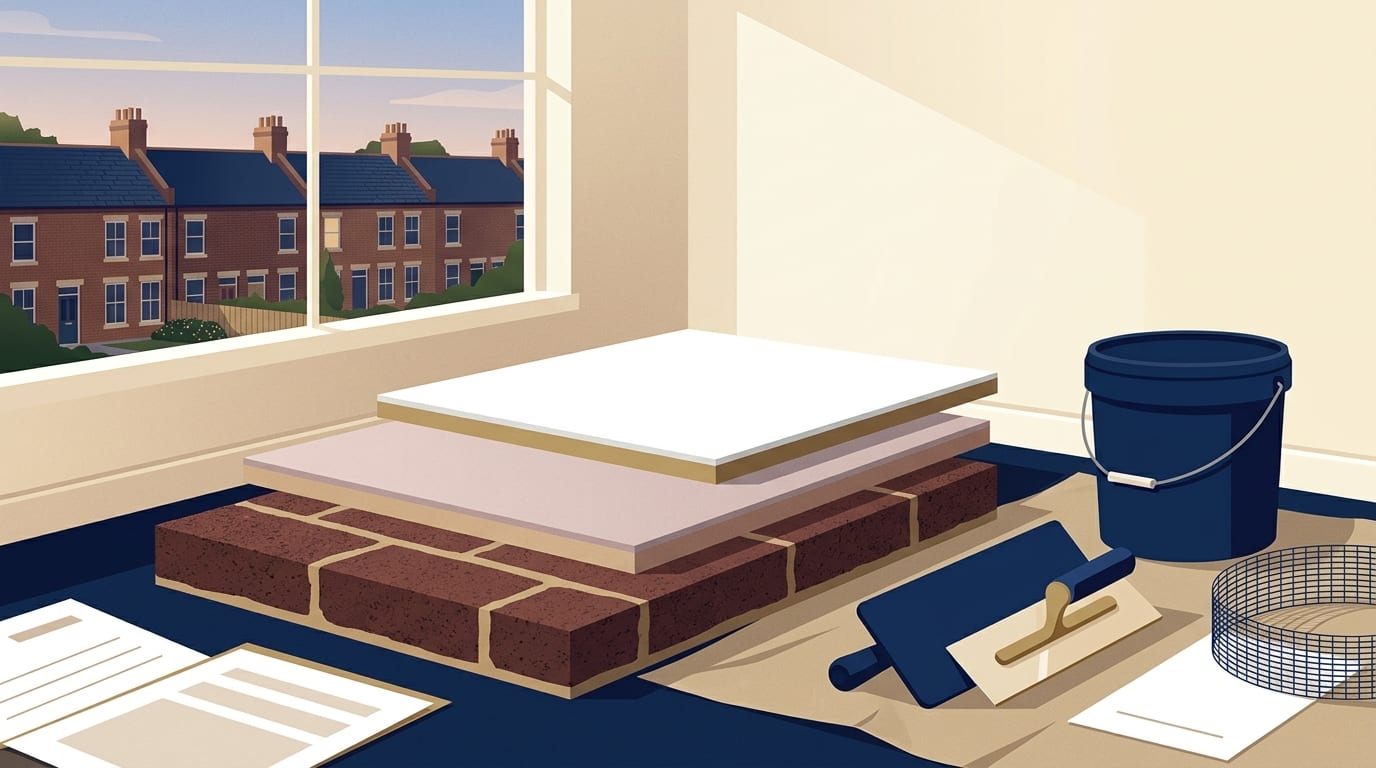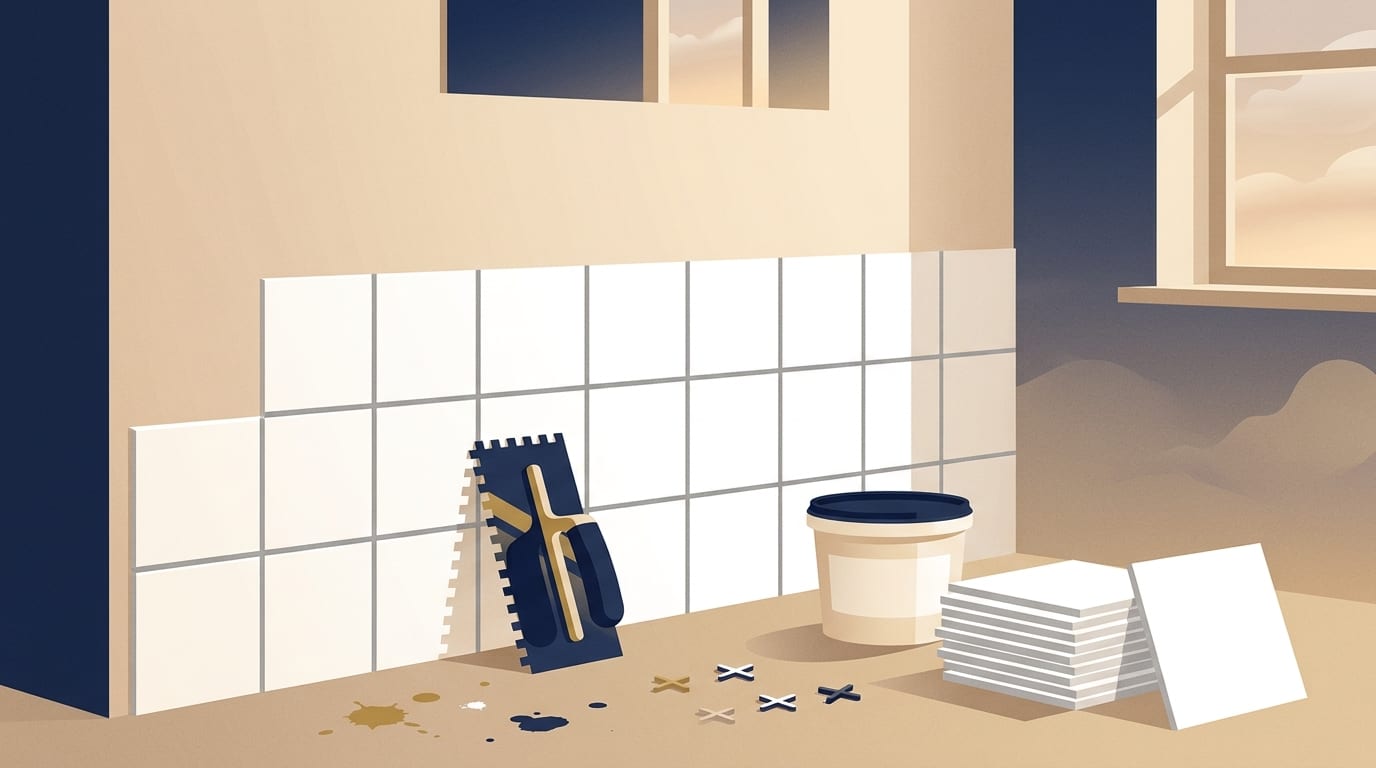
Yes, you can tile directly onto sound, dry plaster or plasterboard that is suitable for the location and the weight of your tiles. The details matter, and the adhesive manufacturer's data sheet sets the rules your tradespeople must follow. With one adhesive maker's product, bare plasterboard has a higher weight limit than gypsum plaster, and new plaster needs weeks to dry before it can be tiled.
How long new plaster must dry before tiling
Fresh plaster holds a lot of water. Fresh plaster typically takes three to seven days to dry before decorating, but that is not a tiling time.
Tiling needs a longer wait, and the adhesive maker's figure is the one to use.
One adhesive maker's data sheet states that gypsum plaster must be dry and at least four weeks old prior to tiling. Follow the time given by the maker of the adhesive your tiler uses. Preparation such as brushing off dust and priming is the tiler's job, and the data sheet names the primer to use.
Plasterboard with or without a skim
One adhesive maker's data sheet says plasterboard can be tiled by fixing directly to the paper facing, without skimming, and with a higher weight limit than gypsum plaster. Other makers may differ, so the tiler should follow the data sheet for the adhesive they use.
Plasterboard is either screwed to timber frames or stuck directly to masonry walls with dabs of adhesive, a method known as dot and dab. If you are covering an old ceiling to create a fresh surface, you might use a method called overboarding, where new plasterboard is fixed directly under the old ceiling. The adhesive maker's data sheet says boards must be rigidly braced and adequately supported.
That maker's instructions say to fix directly to the paper facing and not to skim with plaster. If you are updating a whole bathroom or kitchen, tell your plasterer which walls will be tiled so they know what to leave bare. If you want to know more about bare boards, you can read the guide to whether you can paint plasterboard without skimming it first.
Weight limits for tiles
Weight limits apply to the tiling on a wall, and they depend on the background and on the adhesive maker.
This table shows the maximum tiling weights for different backgrounds.
|
Background surface |
Maximum tiling weight |
|---|---|
|
Gypsum plaster |
20kg per square metre |
|
Bare plasterboard |
32kg per square metre |
These limits come from one adhesive maker's data sheet. Other makers may differ, so check the data sheet for the adhesive your tiler plans to use.
The data sheet for one plaster maker's finishing plasters states you can apply tiles up to 20kg per square metre directly, except where the system includes a bonding agent. The adhesive maker's data sheet also states the tiling weight on gypsum plaster should not exceed 20kg per square metre.
For plasterboard, the adhesive maker's data sheet says the tiling weight should not exceed 32kg per square metre.
Painted walls and polished plaster
Tiling over old paint is risky because the tiles are only held as strongly as the paint is stuck to the underlying wall. One adhesive maker's data sheet says its advice is always to remove the painted finish to reveal a sound substrate without barriers to adhesion.
Where the contractor deems the paint sound, the maker says it should be primed with its own primer before tiling and a trial application is recommended. This exception is for internal, dry areas only. Removing paint is a job to agree with your tiler, and older paint and textured coatings need care.
New plaster can also cause problems if it is too smooth for the tile adhesive to grip. A skim is a thin finishing coat, a few millimetres thick, applied over sound plaster or plasterboard. A plasterer usually polishes this final coat with a trowel to leave a glass smooth finish ready for paint. The data sheet for one plaster maker's finishing plasters says to avoid polishing the surface if you are plastering to provide a background for tiles.
If the plastered wall is already polished, that maker says to roughen it and use a suitable primer to create a good key for the tile adhesive. You should tell your plasterer in advance which walls will be tiled so they know to leave the surface slightly rough.
Priming and the PVA argument
Tradespeople disagree on how to prime plastered walls before tiling.
Some tradespeople say PVA diluted with water is fine on new plaster. One says PVA is for plastering, not tiling, and that a good quality tile primer should be used instead. One recommends an SBR based primer for wet, damp or moisture rooms.
Because of these differing views, you should always follow the data sheet for the specific tile adhesive your tiler plans to use. The data sheet will name the primer to use with that adhesive.
Bathrooms, showers and wet areas
One adhesive maker's data sheet says not to use its adhesive on gypsum plaster in wet or damp conditions.
Common trade advice, from individual tradespeople, is that a wet area needs green moisture resistant board at the very least and that the wall should be coated with a waterproofer. Check with the tiler and the board maker.
For areas that see direct water, such as shower enclosures and wet rooms, common trade advice is that the walls need tanking, which is waterproofing behind the tiles. You should check with your tiler and the board manufacturer about exactly what waterproofing is required before any tiles are fitted.
How plasterers price the preparation work
If your walls need a full replaster before you can tile, plasterers price per job after seeing it. A replaster means hacking off the failed plaster and applying a backing coat plus a finish coat, or fixing new plasterboard and skimming it. They base their prices on the area in square metres, the state of the background, ceiling height and access. Ceilings are usually priced separately and small jobs usually carry a minimum charge.
Preparation work is a major factor in the final price. Stripping stubborn wallpaper, removing loose plaster, sealing painted surfaces and dealing with old textured coatings all take time. You should check whether the quote includes waste removal, floor protection, materials and VAT. Quotes in London and the South East will cost more than in other parts of the UK.
A quote is a fixed price, whereas an estimate is just a rough guess that can go up later. Under the Consumer Rights Act 2015, all work must be done with reasonable care and skill. If the work falls short, the customer can ask for it to be put right or seek a partial or full refund. Citizens Advice suggests getting three written quotes, having a written contract, paying deposits of no more than 25 per cent and paying by card for extra protection. They also say you might be able to cancel within 14 days of agreeing a contract. If you need help with a dispute, you should contact Citizens Advice.
What goes wrong with tiled walls
Tiling failures usually happen because the background was not prepared properly. Common reasons tiled walls fail include:
- Skimming over loose, damp or unsealed painted surfaces so the new coat cracks or peels.
- Applying heavy tiles to freshly plastered walls before they are completely dry.
- Fixing plasterboard to timber studs that flex and bend.
- Failing to tank wet areas and shower enclosures.
Applying gypsum plaster or cement based products onto old lime walls is a common cause of problems, because it can trap moisture. If you live in an older property with lath and plaster walls, which is lime plaster on timber laths, conservation bodies advise repairing the original lime plaster where possible and replacing it like for like.
Cash-only deals with nothing in writing leave you with no proof of what was agreed and no comeback if the tiles fail. Written quotes that omit the preparation work, ceilings, scaffolding or waste removal often lead to sudden extra bills mid-way through the job.
Building regulations and planning rules
If you are replastering a large area before tiling, you may need to comply with building regulations. Where 25 per cent or more of an external wall is re-rendered, re-plastered or re-lined internally, the regulations normally apply. In these cases, the wall's insulation would normally have to be improved at the same time.
While this guide focuses on internal tiling, it is worth knowing the rules if your renovation includes the outside of your home. External render comes in several forms, including traditional sand and cement, lime, pebbledash, monocouche and thin-coat acrylic or silicone systems. You might hear tradespeople refer to K Rend, which is simply a manufacturer's brand name often used loosely for silicone render. In England, according to the Planning Portal, rendering needs no planning permission if the materials are of similar appearance to the existing house. You do need permission in conservation areas, National Parks, Areas of Outstanding Natural Beauty and the Broads.
If your home has textured coatings such as Artex on the walls or ceilings, do not disturb it before tiling. The HSE says textured coatings may contain asbestos in any building built or refurbished before 2000. Homeowners should not sand, scrape or drill suspect coatings and should tell tradespeople about them before work starts. Work on these coatings does not normally need a licensed contractor, but it must be done by people trained to work safely with asbestos. If you are unsure what to do with a textured ceiling in your bathroom, read the guide to whether you should remove, cover or leave an artex ceiling.
Listed buildings need consent for any significant work, inside or out. If you are unsure about the rules for your property, you should check with your local council.
When to ask your plasterer or tiler
Plastering and tiling are completely different trades, and communication between them is vital. A plasterer will assume every wall is being skimmed and polished for paint unless you tell them otherwise. If you tell your plasterer exactly which walls are being tiled, they know not to polish the finish coat, or they can leave new plasterboard entirely bare.
You must also give your tiler the exact details of your walls before they price the job. A tiler needs to know if they are fixing onto fresh plaster, old painted walls or bare plasterboard so they can buy the correct primer and adhesive. If they arrive expecting bare board and find polished plaster, the surface may need roughening first.
Plastering is not a licensed trade. There is no legal register like the one for gas engineers, so evidence of past work really matters when choosing who to hire. A CSCS card is for construction sites, and it is not proof of quality on domestic work. You might see plasterers who are members of FIS, which is the trade body for the finishes and interiors sector, or TrustMark, which is the government-endorsed quality scheme. If your tradesperson is removing old plaster and broken tiles, they must dispose of the rubble legally. A trader who carries waste must be a registered waste carrier, and you can check this because the register is public.
Questions to ask before tiling starts
Before you agree a price or let work begin, ask your tradespeople these questions to make sure the wall is prepared correctly:
- Are the chosen tiles too heavy for a plastered wall?
- Will you leave the plasterboard bare in the tiling areas?
- How long should the new plaster be left before tiling?
- Which primer does the adhesive manufacturer recommend for this wall?
- Will you tank the wet areas before you start tiling?
- Are you removing the old paint or priming over it?
- Does your quote include waste removal and floor protection?
Common questions
Can you tile onto fresh plaster?
Not straight away. Fresh plaster takes three to seven days to dry before decorating, but that is not a tiling time. One adhesive maker's data sheet says gypsum plaster must be dry and at least four weeks old before tiling.
Can you tile straight onto old plaster?
Yes, as long as the old plaster is sound, dry and firmly attached to the wall beneath. The tiler will advise on preparation and the primer to use with their adhesive.
Can you tile onto painted plaster?
It is always best to remove the paint to reveal the bare substrate underneath. If the paint is completely sound, one adhesive maker says that where the contractor deems the paint sound it can be primed with its own primer in dry internal areas, with a trial application first.
Do I need to plaster a wall before tiling?
Not always. One adhesive maker says plasterboard can be tiled directly onto the paper face without skimming, with a higher weight limit than gypsum plaster. Check the data sheet for the adhesive your tiler uses.
What to do next
When you are ready to move your project forward, follow these steps to get the walls ready for your tiles:
- Check the weight of your chosen tiles per square metre.
- Tell your plasterer exactly where the tiles will go so they can leave boards bare or leave the plaster unpolished.
- Ask your tiler how long to leave new plaster, because one adhesive maker's figure is at least four weeks.
- Ask your tiler to confirm their adhesive is suitable for your wall type and weight limit.
- Check the public register to ensure whoever takes away your old tiles and plaster is a registered waste carrier.
Getting the background right gives the tiles the best chance of staying firmly on the wall. If you are updating a kitchen or bathroom and need to repair old walls or board over damaged ceilings, you can find a plasterer near you to prepare the room properly.
Find a top rated plasterer near you
1,036 plasterers across the UK, each ranked on their Google rating and the number of reviews behind it. Start with your county: