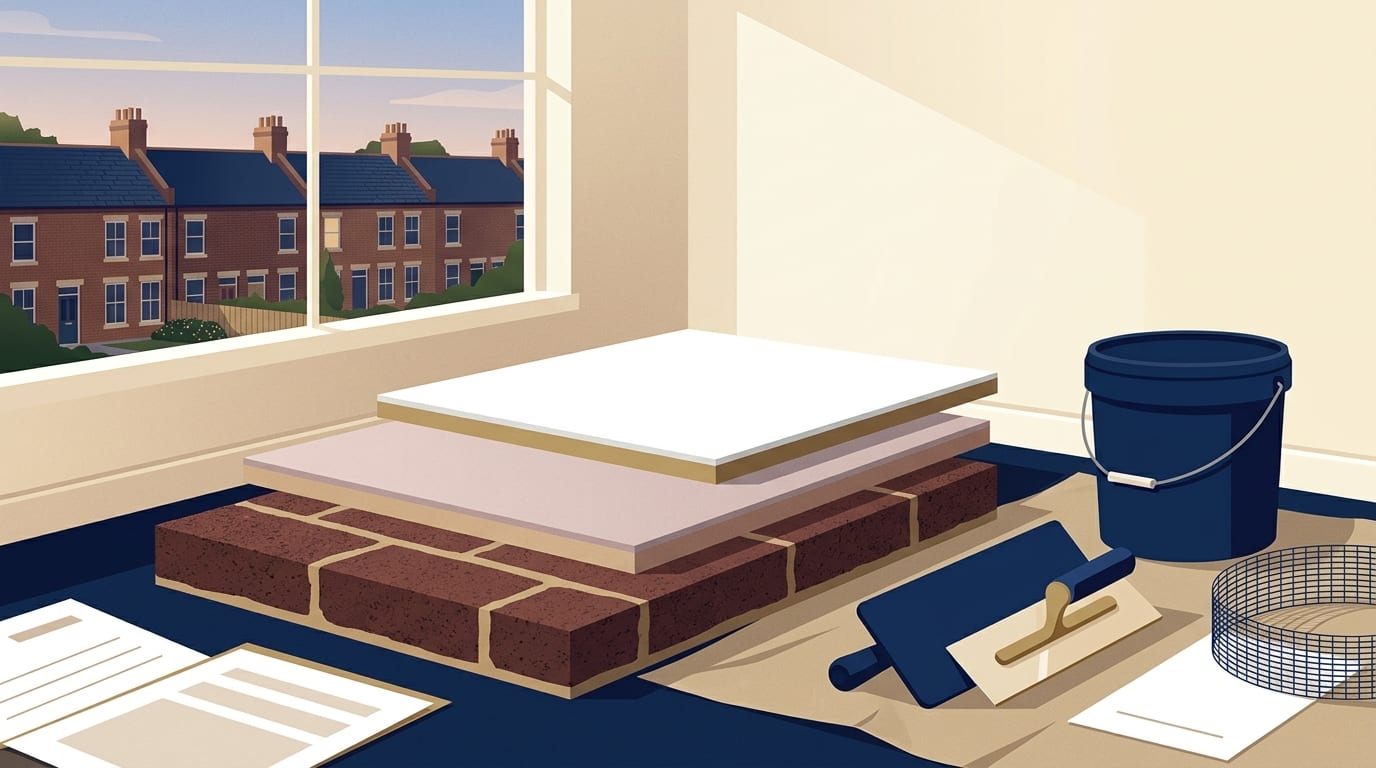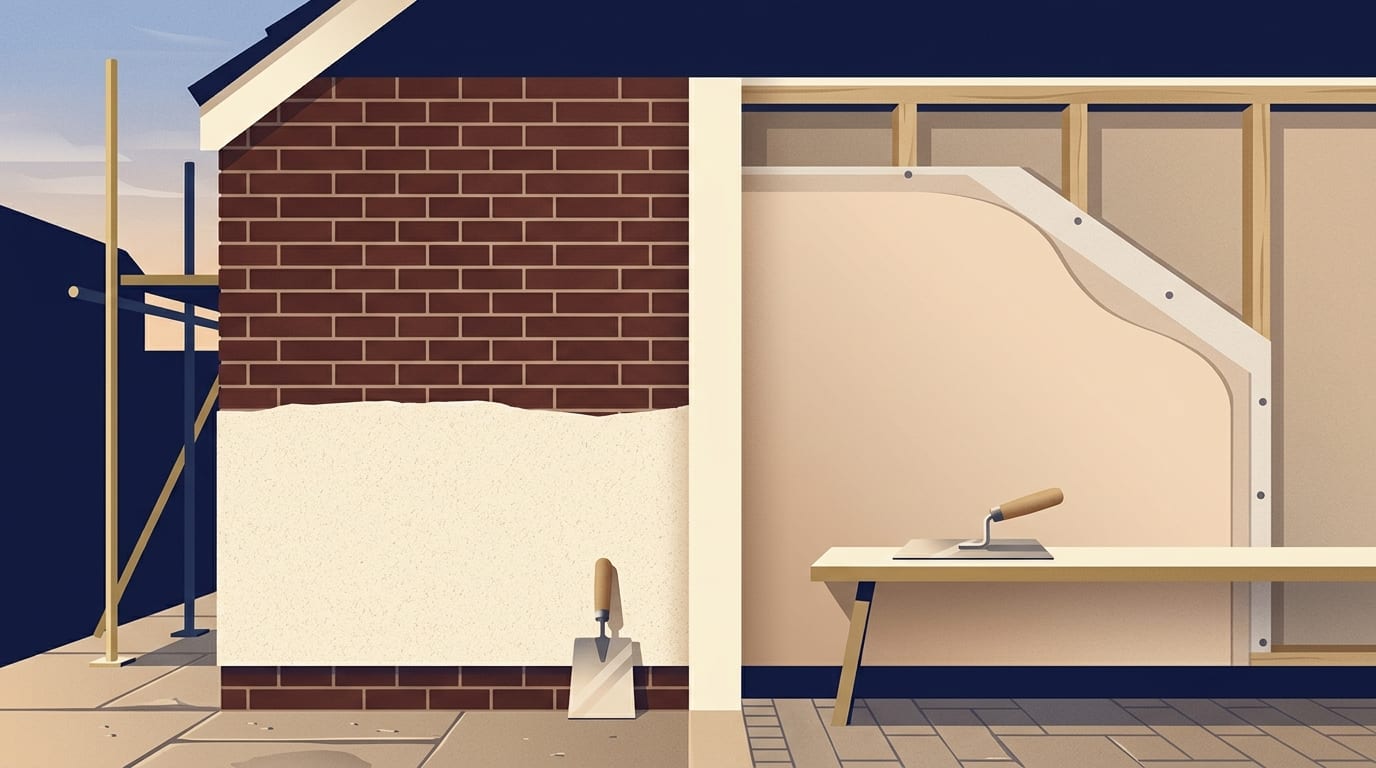
Plaster and render are both coating materials applied over the top of a building's structural fabric. Plaster is the coat applied to internal walls and ceilings to create a smooth surface for decorating. Render is the coat applied to external walls to protect the brickwork from the elements. Both of these finishes can be made from sand, cement or lime.
The two terms are often used interchangeably, but a council heritage page states that render usually refers to external finishes and plaster to internal ones. The terms differ in other ways too, particularly in how they handle moisture and structural movement. Knowing the difference helps you decide which trade to call, what material to specify and whether your project needs permission from your local council.
Where each coating is used
Plaster is usually used inside your home to cover bare brick, blockwork or plasterboard. It creates a flat, clean surface that is ready for paint or wallpaper. A skim is a thin finishing coat, just a few millimetres thick, applied over sound plaster or plasterboard. If the old walls are in poor condition, you will need a full replaster. This means hacking off the failed plaster and applying a thick backing coat followed by a finish coat.
Alternatively, a tradesperson might fix new plasterboard and skim over it, known in the trade as board and skim. Plasterboard can be fixed to timber stud walls or stuck directly to masonry on dabs of adhesive, which is called dot and dab. Sometimes, new plasterboard is fixed directly under an old, damaged ceiling, which is known as overboarding. All of these internal methods require proper preparation before the trowel touches the wall.
Good preparation includes several important steps:
- Stripping old woodchip or vinyl wallpaper completely.
- Removing loose or blown plaster back to the brickwork.
- Sealing dusty or highly porous painted surfaces with a primer.
- Dealing safely with unwanted Artex or textured coatings.
Render is usually used on the outside of your property. It acts as a shield against rain, wind and frost while improving the appearance of the house. External render comes in several traditional and modern systems. Traditional options include sand and cement, lime, and textured finishes like pebbledash. Modern render systems include monocouche, which is a single-coat coloured render, alongside thin-coat acrylic or silicone systems. You will often hear builders mention K Rend. This is simply a manufacturer's brand name that is often used loosely to describe any silicone render system.
What these materials are made of
The ingredients in your plaster or render dictate how your walls breathe and move. Historic renders and plasters are usually lime or clay. These traditional materials are porous and flexible. They allow a building to shift slightly without cracking the surface, and they let trapped moisture escape into the air. In buildings that pre-date about 1800, walls were likely originally finished with ordinary or natural hydraulic lime. Many older houses feature lath and plaster ceilings, which consist of lime plaster pressed into thin timber laths.
In the twentieth century, cement and gypsum became more prevalent as building materials. Modern gypsum plaster and Portland cement render are impermeable and rigid. They set hard and fast, making them popular for quick construction and renovation. However, because they are rigid, they cannot absorb movement well and are prone to cracking if the wall behind them shifts. Cement also stops moisture from evaporating, which changes how a wall handles damp.
You can sometimes check what material is already on your wall with a basic chemical reaction. If you apply a small amount of vinegar to a sample and it fizzes, it is likely lime-based. You should always have a small sample identified by a specialist to be certain, rather than guessing before you start work and applying the wrong finish. Do not take samples from textured coatings such as Artex, which may contain asbestos in buildings built or refurbished before 2000.
Why lime or cement matters on older buildings
Applying the wrong material to an older property can cause serious problems. Buildings built before 1919 were built to let moisture pass through. When you cover these walls with modern materials, you change how the building breathes. The Society for the Protection of Ancient Buildings points out that impervious Portland cement render blocks the evaporation older buildings depend on. When rain gets through tiny cracks in the rigid cement, the moisture stays trapped in the wall.
Cement traps moisture that can cause major damage to timber-framed, clay lump or soft brick walls. Cement renders also tend to fail in patches. In contrast, lime renders wear down gradually.
If you are renovating a historic property, conservation bodies advise repairing original lime plaster where possible and replacing materials like for like. Modern gypsum or cement on old lime walls is a common cause of problems. You can read more about making the right choice in the guide on lime or gypsum plaster in an older home.
Which trade does which job
Plasterers often do both jobs, but render and scaffolding are specialist, so ask about evidence of external work. When you need your exterior walls coated, look for a tradesperson who lists external rendering as a primary service. Ask them for evidence of their past external work and request photos of similar houses they have rendered locally. A rendering specialist's day rate is quoted at £130 to £250.
A good plasterer will price a job only after seeing it in person. They need to calculate the area in square metres, check the ceiling height and assess the state of the background. Quotes that omit preparation work are a common cause of disputes. You should avoid cash-only deals with nothing in writing. Skimming directly over loose, damp or unsealed painted surfaces is a common reason for the new coat to crack or peel.
Several factors push the price of a plastering or rendering job up:
- Working at height requiring extensive scaffolding.
- Stripping large areas of failed render or blown plaster.
- Plastering ceilings, which are usually priced separately from walls.
- Living in London and the South East where day rates are higher.
Typical render prices
Render is priced per square metre, and the final cost depends heavily on the material you choose and the condition of your existing walls. The table below shows typical costs per square metre for different types of external render.
|
Render material |
Cost per square metre |
|---|---|
|
Masonry paint |
£12 to £18 |
|
Cement |
£15 to £20 |
|
Lime |
£25 to £30 |
|
Brick effect |
£35 to £60 |
|
Pebbledash or roughcast |
£35 to £45 |
|
Polymer or acrylic |
£40 to £50 |
|
Monocouche |
£45 to £55 |
|
Sand-and-cement, exterior (separate price list) |
£40 to £70 |
|
Silicone render (separate price list) |
£55 to £95 |
These figures are typical prices for 2026. Local quotes will differ based on the size of your property, the preparation needed and regional variations. Plasterers and renderers in London and the South East typically charge more than those in other parts of the UK.
For a complete house finished in basic lime or cement, a three-bedroom semi-detached property costs £4,200 to £5,500 and takes six to nine days to complete. A four-bedroom detached property costs £6,700 to £8,300 and takes seven to 14 days. The national average cost for rendering a house is £5,000.
Scaffolding is often a separate line on your quote rather than included in the square metre rate. If your property is tall or difficult to access, the cost of the job will be much higher. Always check whether your written quote includes VAT, materials, floor protection and waste removal. Small jobs usually carry a minimum charge. You can read more about preparing for this work in the guide on before rendering a house.
Planning permission and building regulations
You do not automatically need planning permission to render the outside of your house. Outside protected areas in England, cladding can proceed without planning permission provided the materials are of a similar appearance to those used in the construction of the house. The Planning Portal notes that the policy in Wales may differ. If you are unsure whether your new render will match the existing appearance closely enough, you should check with your local council before any work begins.
Building regulations are entirely separate from planning permission and focus on safety and energy efficiency. These regulations normally apply where 25 per cent or more of an external wall is re-rendered, re-clad, re-plastered or re-lined internally. When you repair or replace a quarter or more of a wall, the thermal insulation of that wall would normally have to be improved to meet modern energy standards. Ask the tradesperson how they will handle the insulation requirement when they quote.
Listed buildings and conservation areas
If your home is in a protected area, your permitted development rights are restricted. In Conservation Areas, National Parks, Areas of Outstanding Natural Beauty and the Broads you will need to apply for planning permission before cladding or rendering your external walls.
Listed buildings require listed building consent for any significant works, whether inside or out. Check with your council before changing the render or plaster on a listed home. Conservation bodies advise repairing original lime plaster where possible and replacing like for like.
Common questions
Can you plaster or render over painted brick?
You cannot apply plaster or render directly over flaking or unsealed paint. The surface must be stable and porous enough for the new coat to bond. The plasterer or renderer will decide on site how to prepare the surface.
How long does plaster and render take to dry?
A fresh internal skim takes three to seven days to dry before decorating. Ask your plasterer or renderer how long to leave the wall before painting.
Does render cost more than plaster?
Render and plaster are priced differently, and the figures in this guide should not be set against plastering prices. Render is priced per square metre by type, scaffolding is often a separate line and the job depends on the building, so ask for a quote for the exact work.
What happens if I find Artex?
The HSE says textured coatings such as Artex may contain asbestos in any building built or refurbished before 2000. Homeowners should not dry sand, scrape or drill suspect coatings and should tell tradespeople about them before work starts. Work on them does not normally need a licensed contractor but must be done by people trained to work safely with asbestos.
Do I need a licensed plasterer?
Plastering is not a licensed trade in the UK, meaning there is no legal register like the one for gas engineers. A CSCS card is meant for construction sites, not as proof of quality on domestic work. You must judge a tradesperson on their written quotes, clear communication and evidence of past work. The Finishes and Interiors Sector (FIS) is the trade body for the industry, and TrustMark is the government-endorsed quality scheme.
How to choose the right tradesperson
Under the Consumer Rights Act 2015, any plastering or rendering work must be done with reasonable care and skill. If the work is not done with reasonable care and skill, the customer can ask for it to be put right or seek a partial or full refund. Citizens Advice suggests you might be able to cancel within 14 days of agreeing a contract, and they are the best place to go for help with disputes.
A good plasterer will leave a flat, smooth surface internally, and a crisp, weatherproof finish externally. You should check the finish before paying the final balance by shining a bright light across the wall to highlight any severe lumps or hollows. To hire the right person, follow these steps before you agree to any work:
- Get three written quotes and ensure they are fixed prices, not rough estimates.
- Check that the quote explicitly lists preparation, ceilings, scaffolding, waste removal and floor protection.
- Ask what material they intend to use and why it suits your specific walls.
- Ask for photos of similar jobs they have completed recently.
- Ensure the tradesperson is a registered waste carrier if they are removing old plaster, as the register is public.
- Agree a written contract with deposits of no more than 25 per cent, and pay by card for added protection.
When you know what material your walls need and you are ready to compare prices, you can find a plasterer near you.
Find a top rated plasterer near you
1,036 plasterers across the UK, each ranked on their Google rating and the number of reviews behind it. Start with your county: